
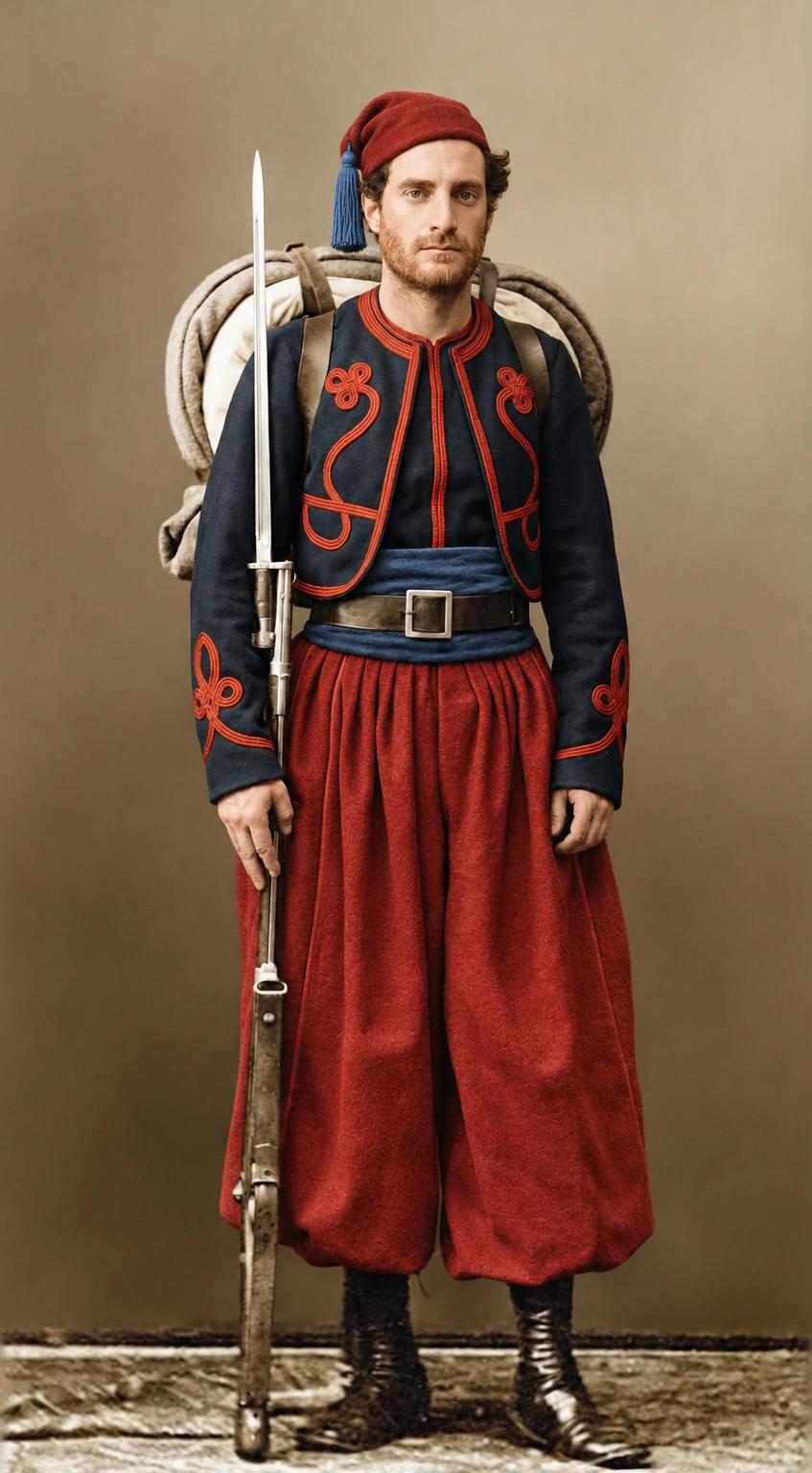
Uniform and equipment
| Uniform | Short blue jacket, baggy red trousers, yellow trim |
|---|---|
| Dress uniform | Elaborately braided jacket, embroidered waistcoat |
| Headgear | Red fez with blue tassel |
| Equipment | Rifle, yataghan bayonet |
| Insignia and standard | Brass crescent moon tips-up on cartridge box/turban |
Service record
| First appeared | 1831 |
|---|---|
| Peak strength | 20,000 men |
| Recruited from | North African Natives / French Volunteers |
| Primary tactic | Aggressive Skirmishing / Bayonet |
| Signature engagement | Storming of Malakoff (Crimean War) |
| Motto or battle cry | Être Zouave est un honneur (To be a Zouave is an honor) |
| Obsolescence | Bright Uniforms vs Machine Guns |
Timeline
- 1831: Formation. General Clausel creates the Corps of Zouaves in Algeria, initially a mixed unit of indigenous Kabyles and French volunteers.
- 1841: Frenchification. The unit is reorganized into purely French regiments, while indigenous troops are segregated into the 'Tirailleurs Algériens' (Turcos).
- 1854: Crimean Expedition. Zouaves deploy to the Crimea, gaining international fame for their flamboyant uniforms and reckless courage at Alma and Inkerman.
- 1859: Italian Campaign. Zouaves distinguish themselves against the Austrian Empire at Magenta and Solferino.
- 1860: Papal Zouaves Formed. Inspired by the French unit, Catholic volunteers form the Papal Zouaves to defend Rome.
- 1870: Franco-Prussian War. The regiments suffer catastrophic losses against modern Prussian artillery but earn respect for their refusal to yield.
- 1914: World War I. Zouaves enter the Great War in traditional red trousers but are forced to adopt khaki and later horizon blue uniforms for survival.
- 1962: Disbandment. Following the independence of Algeria, the historic Zouave regiments are disbanded, ending over a century of service.
Battles
Battle of the Alma
The Zouaves stunned the Russian forces by scaling the precipitous cliffs of the Alma heights, appearing on the enemy flank where no troops were expected. Their agility turned the tide, cementing their reputation as elite shock troops.
Storming of the Malakoff
The decisive assault of the Crimean War. Zouaves spearheaded the attack on the formidable Malakoff redoubt. Amidst brutal hand-to-hand combat in the trenches, they planted the French tricolor, breaking the year-long siege.
Battle of Magenta
In a chaotic engagement, the Zouaves of the Imperial Guard displayed ferocious discipline. They stormed the town of Magenta house-by-house against Austrian forces, securing a bloody triumph that paved the way for Italian unification.
Battle of Frœschwiller-Wœrth
A tragic display of heroism. Outnumbered and outgunned by Prussian artillery, the Zouaves launched repeated, suicidal bayonet charges to cover the French retreat. The unit was decimated, but their honor remained intact.
Commanders
Christophe de Lamoricière
The architect of the Zouaves. He transformed a ragtag group of Kabyle mercenaries and French outcasts into the premier light infantry of the 19th century, instilling the aggressive 'système débrouillard' (resourcefulness) that defined their ethos.
François Certain Canrobert
Known for his camaraderie with the rank and file, Canrobert commanded the 1st Division in Crimea. He possessed a reckless bravery that endeared him to the Zouaves, often leading from the front lines during the brutal siege of Sevastopol.
Patrice de MacMahon
A paragon of French martial grit. As a General, he led the 2nd Corps in the Crimea. His legendary defiance at the Malakoff redoubt—'J'y suis, j'y reste!' (Here I am, here I stay!)—epitomized the stubborn valor of the Zouave spirit under fire.
Tactics
Furia Francese
A psychological shock tactic involving rapid, aggressive bayonet charges accompanied by wild cheering to break enemy morale before contact.
Open Order Skirmishing
Unlike rigid line infantry, Zouaves fought in loose formations, utilizing terrain for cover and firing independently to harass enemy lines.
Pas Gymnastique
A rapid marching pace (gymnastic step) allowing Zouaves to cover ground faster than standard infantry, flanking enemies or seizing key positions quickly.