
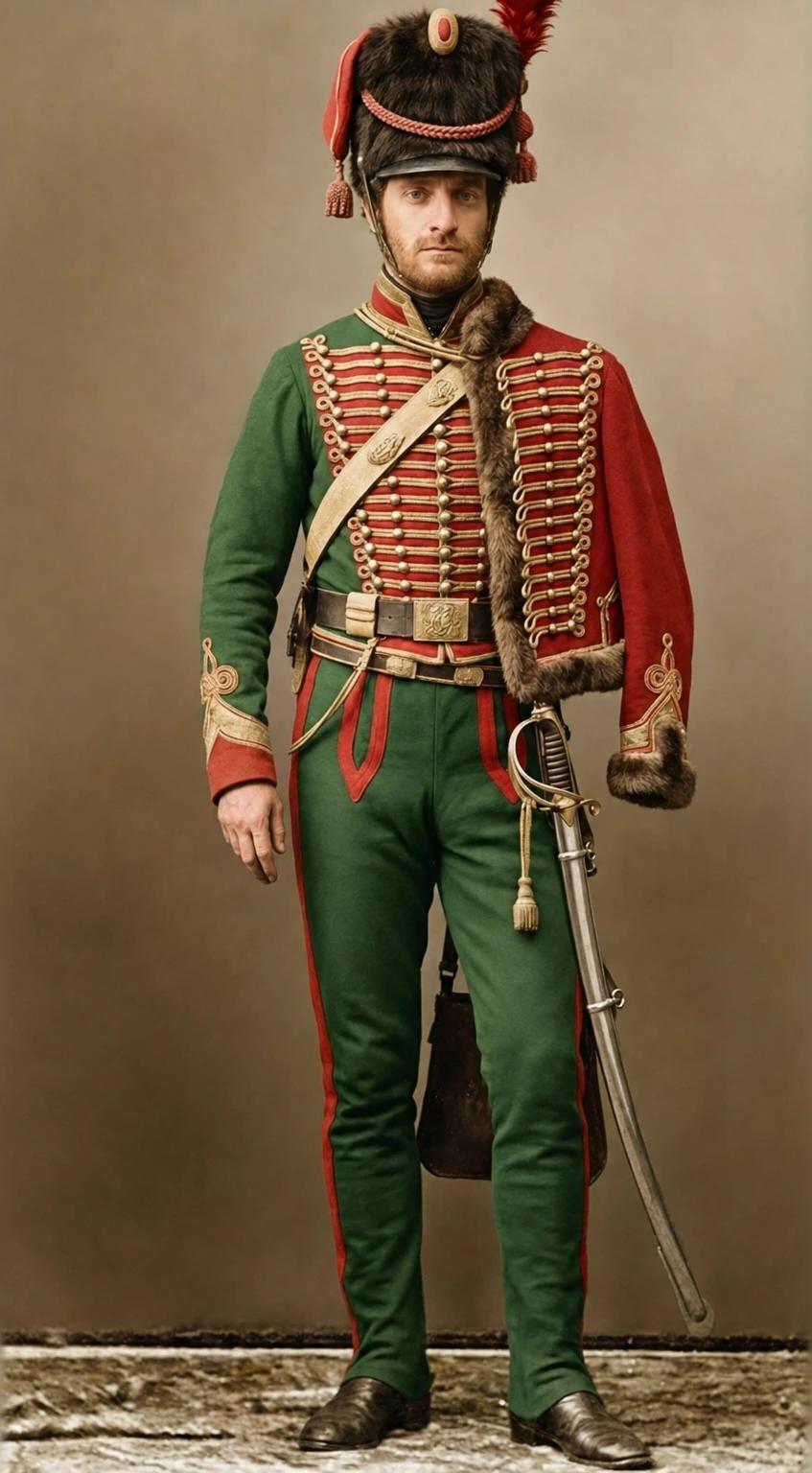
Uniform and equipment
| Uniform | Dark green dolman with crimson facings, pelisse with fur trim |
|---|---|
| Dress uniform | Green and crimson heavily braided, leopard-skin saddlecloths |
| Headgear | Fur colpack with colored bag and plume; officers with higher plumes |
| Equipment | Light cavalry sabre, pistols, carbines for some |
| Insignia and standard | Imperial Eagle on sabretache/shako; green trumpet banner |
Service record
| First appeared | 1800 |
|---|---|
| Peak strength | 1,000–1,200 men |
| Recruited from | Veterans of Italian Campaign |
| Primary tactic | Escort / Pursuit Charge |
| Signature engagement | Battle of Austerlitz (1805) |
| Motto or battle cry | Honneur et Patrie (Honor and Fatherland) |
| Obsolescence | Fall of Napoleon |
Timeline
- 1800: Formation of the Guides. Originally formed as the Guides of the Consular Guard, tasked with the personal protection of the First Consul, Napoleon Bonaparte.
- 1804: Imperial Guard Status. With Napoleon's coronation, the unit is redesignated as the Chasseurs à Cheval of the Imperial Guard.
- 1805: Glory at Austerlitz. The regiment defeats the Russian Imperial Guard cavalry, earning legendary status.
- 1808: Peninsular Campaign. Deployed to Spain; they engage in skirmishes but suffer a morale blow when Lefebvre-Desnouettes is captured at Benavente.
- 1812: Russian Campaign. Serving primarily as the Emperor's close escort, they suffer terrible attrition from the freezing retreat rather than combat.
- 1815: Disbandment. Following the defeat at Waterloo and the Bourbon Restoration, the regiment is dissolved.
Battles
Battle of Austerlitz
The defining moment. When the Russian Chevalier Guard threatened the French center, the Chasseurs counter-charged. In a brutal melee, they shattered the Russian elite, prompting Napoleon to say, 'Many fine ladies will weep in St. Petersburg tomorrow.'
Battle of Eylau
Amidst a blinding blizzard, the Chasseurs joined Murat's legendary 10,000-man cavalry charge to save the crumbling French center. They pierced the Russian lines twice, suffering heavy casualties, including General Dahlmann, but prevented total defeat.
Battle of Waterloo
The final curtain. Assigned to guard the Emperor, they were eventually committed to the desperate assaults on the British squares. Despite heroic efforts to break the redcoats, they were decimated by point-blank musketry and canister fire.
Commanders
Charles Lefebvre-Desnouettes
A dashing favorite of the Emperor who commanded the regiment in Spain. Known for his aggressive pursuit, he was captured by the British at Benavente but returned to lead the Chasseurs in the final campaigns of the Empire.
Eugène de Beauharnais
Napoleon's stepson and the unit's Colonel-General. While often commanding larger corps elsewhere, his nominal leadership imbued the Chasseurs with prestige. A capable and loyal administrator who embodied the chivalric ideal of the Guard.
Nicolas Dahlmann
A fearless tactician who led the Chasseurs into the freezing hell of Eylau. He died leading a desperate charge against the Russian columns, cementing the unit's reputation for self-sacrifice in the face of overwhelming odds.
Tactics
The Service Squadron
A rotating squadron was always on duty to surround the Emperor. In battle, they acted as a human shield, only detaching to charge if the Emperor was directly threatened or ordered a decisive blow.
Shock Charge
Although technically 'light' cavalry, their status as Guard troops meant they were often used like heavy cavalry to smash through enemy lines using sheer momentum and morale superiority.
Pursuit à outrance
Relentless pursuit of a broken enemy to prevent them from rallying, utilizing their light horses' speed to cut down fleeing troops.