
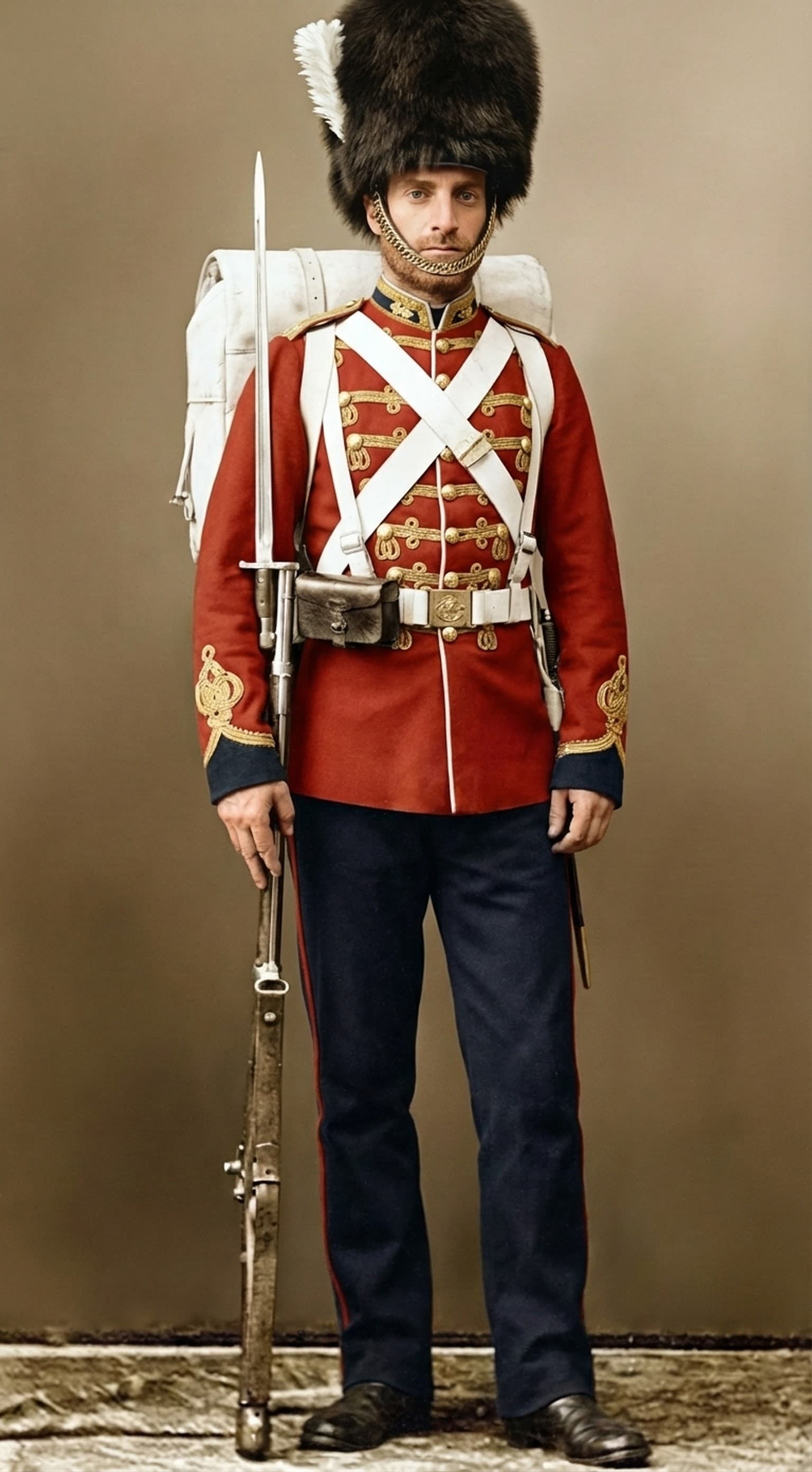
Uniform and equipment
| Uniform | Dark blue coat, red facings, white waistcoat |
|---|---|
| Dress uniform | Blue with gold lace, red epaulettes |
| Headgear | Tall bearskin with brass plate, red plume, white cords |
| Equipment | Musket, bayonet, sabre-briquet |
| Insignia and standard | Eagle and crown brass plate on bearskin |
Service record
| First appeared | 1799 |
|---|---|
| Peak strength | 12,000 men |
| Recruited from | Veterans of 3 Campaigns |
| Primary tactic | Massed Column Attack |
| Signature engagement | Battle of Waterloo (1815) |
| Motto or battle cry | La Garde meurt mais ne se rend pas (The Guard dies but does not surrender) |
| Obsolescence | Bourbon Restoration / 1815 Defeat |
Timeline
- 1804: Creation of the Imperial Guard. Napoleon transforms the Consular Guard into the Imperial Guard. The Grenadiers become the senior infantry regiment, requiring 10 years of service and a height of at least 1.78m to join.
- 1805: The Sun of Austerlitz. The Guard serves as the tactical reserve, securing the Emperor's decisive victory against the Third Coalition.
- 1812: Retreat from Moscow. The Guard maintains formation amidst total chaos. While the rest of the Grande Armée disintegrates, the Old Guard forms a protective square around Napoleon, starving but unbroken.
- 1814: Farewell at Fontainebleau. Following the invasion of France, Napoleon abdicates. He delivers a tearful farewell to the 1st Regiment of Grenadiers in the castle courtyard, kissing their flag.
- 1815: The Final Square. At Waterloo, the Guard covers the rout of the French army. They form squares to repel cavalry and artillery, dying in place rather than yielding, before being disbanded by the Bourbons.
Battles
Battle of Austerlitz
Held in reserve as the ultimate guarantor of victory. Their mere presence behind the lines bolstered the morale of the conscripts and terrified the Coalition forces. They were unleashed late to shatter the Russian Imperial Guard, cementing Napoleon's masterpiece.
Battle of Eylau
In a blinding snowstorm, the Guard was committed to stabilize a crumbling French center. Marching through a blizzard of canister fire with bayonets fixed, they halted the Russian advance through sheer physical imposition and disciplined volley fire.
Battle of Waterloo
The tragic apotheosis of the Guard. Committed too late against fresh British lines, the 'Immortals' marched uphill into a storm of lead. For the first time in history, the Old Guard recoiled, signaling the end of the Napoleonic era.
Commanders
Pierre Cambronne
A rough-hewn veteran of the Revolutionary Wars, Cambronne commanded a division of the Old Guard at Waterloo. Famous for his defiant refusal to surrender, apocryphally shouting 'The Guard dies but does not surrender!' or simply 'Merde!' as the British artillery tore his squares apart.
Jean-Martin Petit
Commander of the 1st Regiment of Grenadiers, the senior-most unit of the Grande Armée. He is immortalized as the officer Napoleon embraced and kissed during the emotional 'Farewell to the Old Guard' at the Palace of Fontainebleau before his first exile.
Louis Friant
One of the 'Iron Marshals' in spirit if not rank, Friant led the Foot Grenadiers during the Hundred Days. A tactician of immense skill, he was severely wounded leading the final, doomed assault of the Old Guard against Wellington's center at Waterloo.
Tactics
Pas de Charge
A rapid, rhythmic marching cadence (120 steps per minute) accompanied by drums, designed to close distance quickly and intimidate the enemy before the bayonet charge.
Massed Column Attack
A dense formation used to smash through enemy lines by sheer weight of numbers and momentum, relying on shock rather than firepower.
The Square
A defensive formation where soldiers form a hollow box with bayonets pointing outward to repel cavalry charges. The Old Guard's squares were famously impenetrable.
Psychological Reserve
Often held back until the critical moment, the commitment of the Guard signaled to both friend and foe that the battle was about to be decided, often causing enemy morale to collapse.