
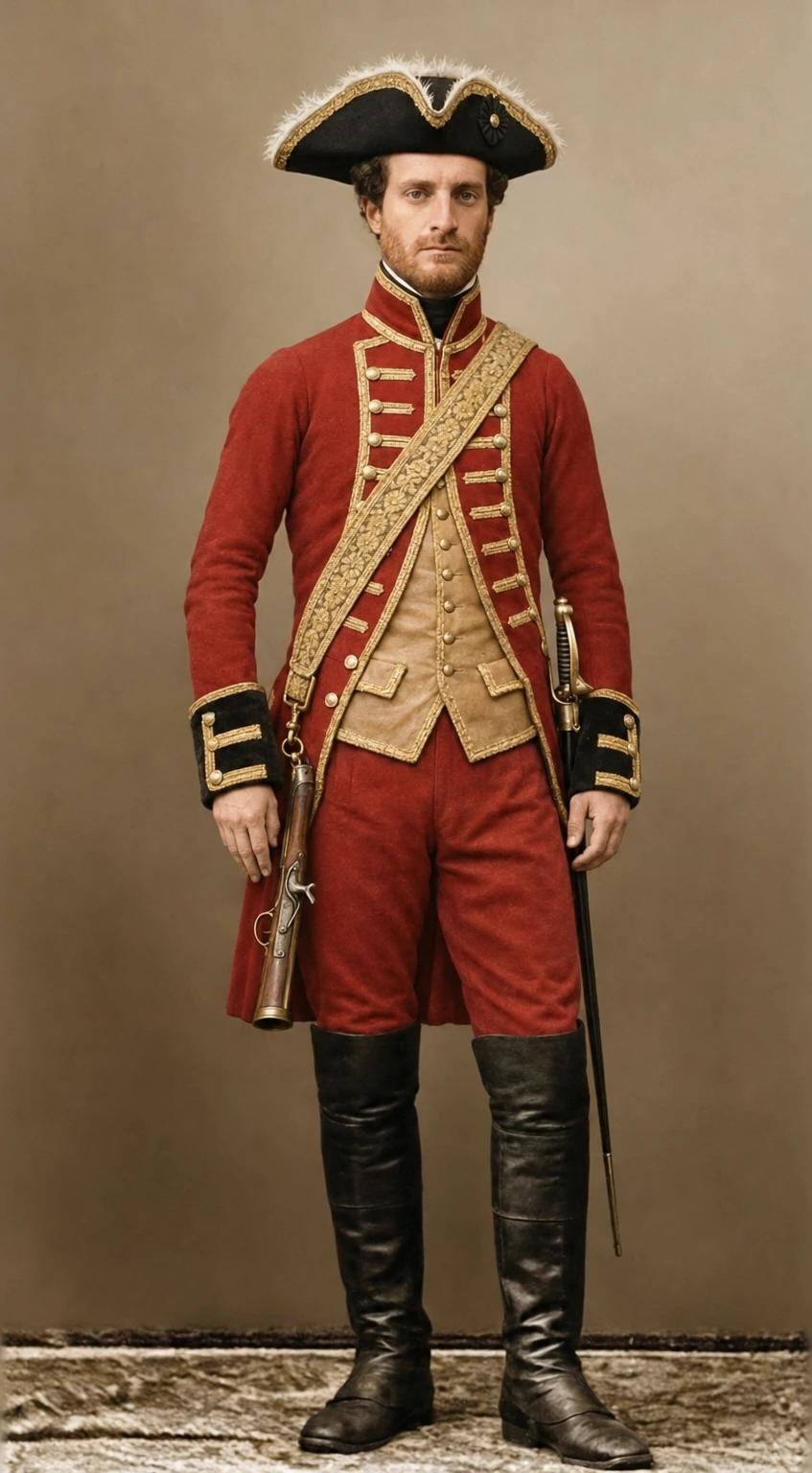
Uniform and equipment
| Uniform | Red coat with gold embroidery |
|---|---|
| Dress uniform | Scarlet coat, white plume, rich gold lace |
| Headgear | Black tricorn with white trim |
| Equipment | Sword, pistols, musketoon |
| Insignia and standard | Embroidered Jupiter's thunderbolts; black horses |
Service record
| First appeared | 1600s |
|---|---|
| Peak strength | ~200 men |
| Recruited from | High Nobility |
| Primary tactic | Heavy Shock |
| Signature engagement | Battle of Fontenoy (1745) |
| Motto or battle cry | Nec pluribus impar (Not unequal to many) |
| Obsolescence | French Revolution |
Timeline
- 1609: Formation. Henry IV establishes the company as the Gendarmes d'Ordonnance, later integrated into the royal household.
- 1660: Integration into Maison Rouge. Under Louis XIV, they are solidified as the senior heavy cavalry of the 'Red Companies' (Maison Rouge), second only to the Gardes du Corps.
- 1745: The Charge at Fontenoy. The unit achieves legendary status by breaking the Anglo-Dutch column, suffering heavy casualties including many high nobility.
- 1763: Post-War Reforms. Following the Seven Years' War, the utility of heavy household cavalry is questioned amidst military modernization efforts.
- 1788: Disbandment. Due to extreme budget deficits and the reforms of the Comte de Guibert, the Gendarmes de la Maison du Roi are disbanded just prior to the Revolution.
Battles
Battle of Leuze
A textbook cavalry action where the Maison du Roi, outnumbered but superior in quality, charged the Allied cavalry. The Gendarmes struck with such ferocity that they routed the enemy squadrons before the main armies could fully engage.
Battle of Malplaquet
In the bloodiest battle of the century, the Gendarmes launched six desperate charges against Marlborough's advancing lines. Though forced to retreat, their grim sacrifice prevented a rout, allowing the French army to withdraw in good order.
Battle of Fontenoy
The unit's apotheosis. As the massive British square ground the French infantry to dust, the Gendarmes and the Maison du Roi launched a suicidal, furious charge into the point-blank musket fire, breaking the British formation and saving the French monarchy.
Commanders
Louis, Duke of Burgundy
The 'Petit Dauphin' and grandson of Louis XIV. Though his strategic command in Flanders was marred by political infighting, he personally led the Gendarmes with the reckless courage expected of Bourbon blood, embodying the aristocratic ethos of the Maison du Roi.
Charles de Rohan, Prince of Soubise
A favorite of Louis XV and Captain-Lieutenant of the Gendarmes. While his later reputation suffered, at Fontenoy he was instrumental, rallying the household cavalry for the decisive, desperate charge that shattered the British infantry column.
Tactics
Charge en Muraille
A shock tactic where troopers rode boot-to-boot in a solid wall. The psychological impact of a dense red line of armored heavy cavalry was often enough to break enemy resolve before impact.
Shock Action
Unlike light cavalry, they did not skirmish. They were held in reserve to deliver the 'coup de grâce', smashing into infantry squares or engaging enemy heavy horse with cold steel.
Counter-Charge
Used defensively to blunt enemy breakthroughs. The Gendarmes were trained to counter-attack immediately if the French infantry line wavered, buying time with their lives.