
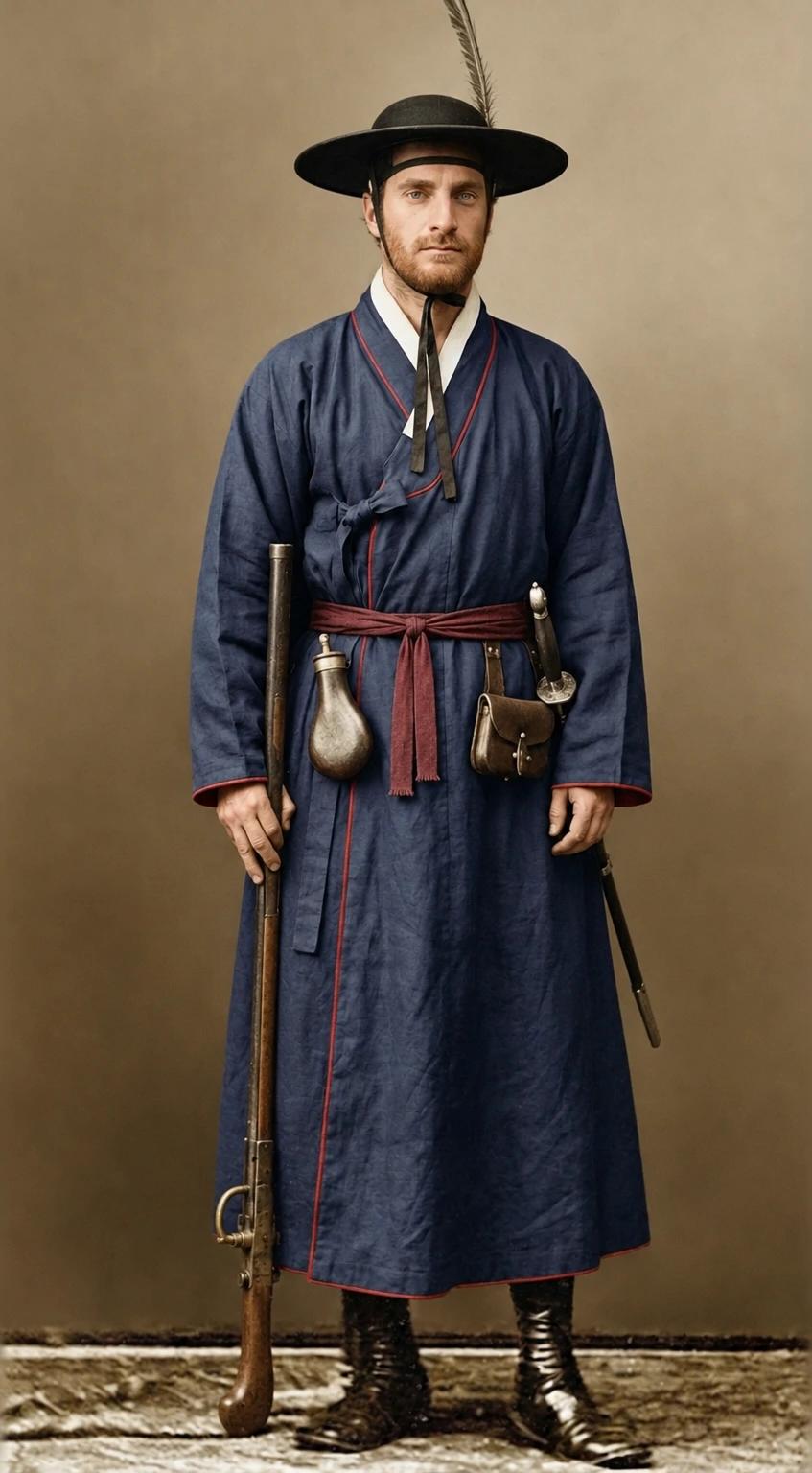
Uniform and equipment
| Uniform | Blue or black robe, white trousers |
|---|---|
| Dress uniform | Official military robes with chest patch |
| Headgear | Black felt hat with feather |
| Equipment | Matchlock musket, sword |
| Insignia and standard | Wooden hopae ID tag; officers' peacock feathers |
Service record
| First appeared | 16th Century |
|---|---|
| Peak strength | Thousands |
| Recruited from | Peasant Conscripts |
| Primary tactic | Volley Fire |
| Signature engagement | Imjin War (1592) |
| Motto or battle cry | N/A (Drum Signals) |
| Obsolescence | Modernization |
Timeline
- 1592: Imjin War Begins. Japan invades Korea. The devastating effectiveness of Japanese musketry forces Joseon to rapidly adopt gunpowder infantry.
- 1593: Establishment of Hunryeon Dogam. King Seonjo establishes the Military Training Agency, creating a standing army of professional musketeers paid in rice.
- 1593: Victory at Haengju. The new musketeer corps proves its worth in a major defensive victory against superior numbers.
- 1619: Expedition to Manchuria. Joseon musketeers deploy to aid the Ming Dynasty against the rising Later Jin (Manchu) forces.
- 1654: Naseon Jeongbeol. Joseon musketeers are deployed to help the Qing Dynasty fight Russian explorers in the Amur River region, displaying marksmanship superiority.
- 1894: Gabo Reforms. The traditional military system is abolished, and the matchlock is finally phased out for modern rifles.
Battles
Battle of Haengju
A desperate hilltop stand where 3,000 Joseon troops faced 30,000 Japanese soldiers. Utilizing palisades and relentless volley fire from matchlocks and hwacha rocket carts, the musketeers decimated the uphill charges of the enemy, turning the tide of the Imjin War.
Battle of Sarhu
Sent to aid the Ming Dynasty, the Joseon musketeers fought amidst blinding sandstorms against Manchu cavalry. Though ultimately overrun due to wind rendering their matches useless, their discipline in the face of annihilation drew respect from the victors.
Battle of Ganghwa (Shinmiyangyo)
The twilight of the matchlock era. Tiger Hunters and musketeers, armed with antiquated weapons, fought to the last man against modern U.S. Marines. Despite the technological disparity, they refused to surrender, choosing death over the dishonor of abandoning their posts.
Commanders
Kwon Yul
A scholar turned field marshal who orchestrated the legendary defense at Haengju. Despite lacking formal military training, his iron will and tactical use of terrain and concentrated firepower broke the Japanese samurai charge, proving the worth of Joseon's reformed infantry.
Kim Si-min
The defiant defender of Jinju. Leading a garrison of only 3,800 men, he utilized muskets and heavy artillery to repel over 20,000 invaders. He fell in battle, struck by a bullet just as victory was secured, immortalizing the spirit of the Joseon resistance.
Tactics
Samsu (Three Hands) System
A combined arms doctrine integrating Sasu (archers), Posu (gunners), and Salsu (spearmen/swordsmen) to cover the reload time of the muskets.
Rotational Volley Fire
Musketeers formed ranks; the front rank fired and kneeled to reload while the rear ranks stepped forward to maintain a continuous wall of lead.
Fortress Defense
Leveraging Korea's mountainous geography, musketeers utilized high walls and choke points to rain fire down on approaching enemies.