
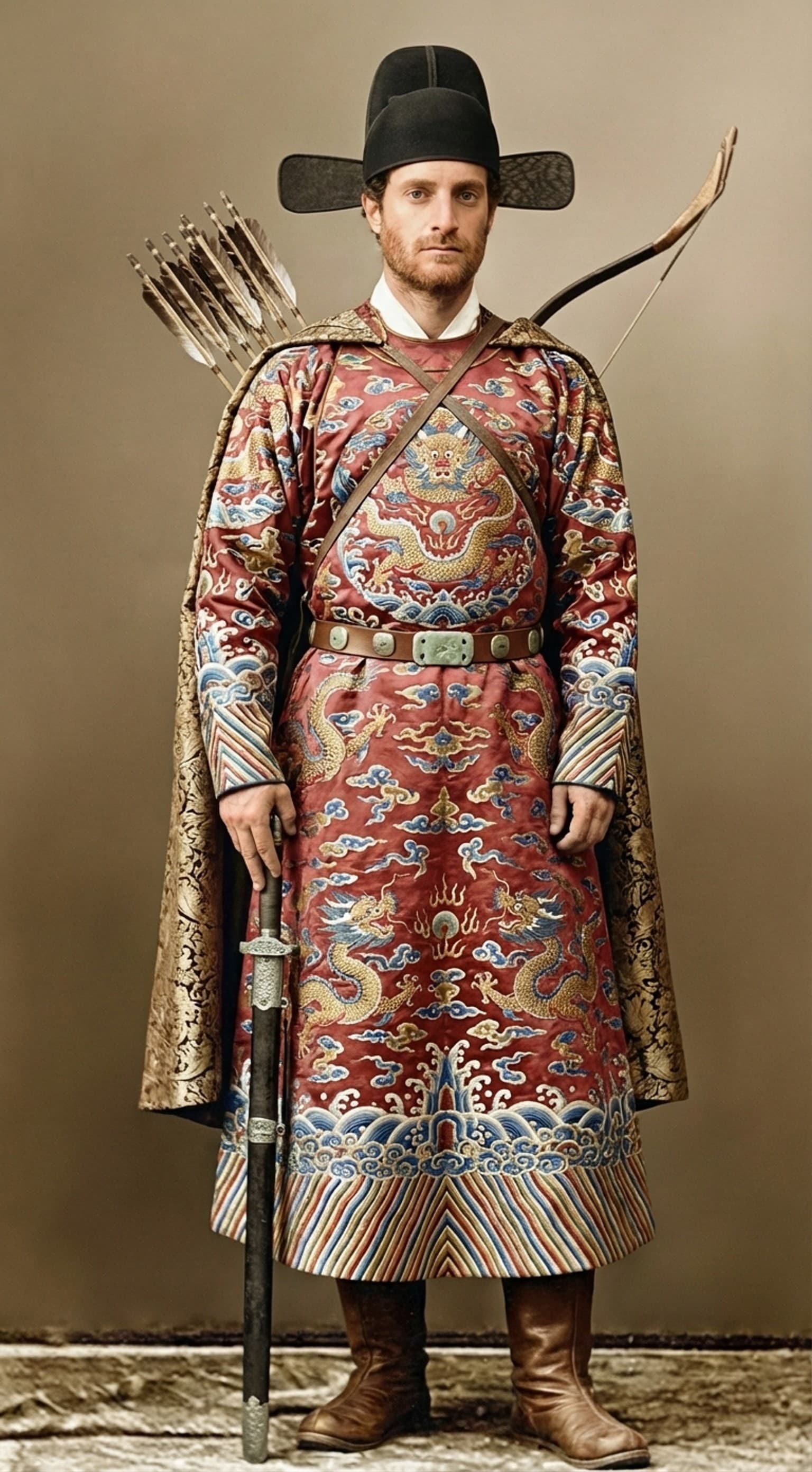
Uniform and equipment
| Uniform | Colorful embroidered robes with flying fish motif |
|---|---|
| Dress uniform | Bright red or blue silk robes, heavy embroidery, jeweled belts |
| Headgear | Black gauze hats with wing-like flaps |
| Equipment | Straight sword, baton, sometimes crossbow or staff weapons |
| Insignia and standard | Golden Paizi tablet; Flying Fish robe |
Service record
| First appeared | 1400s |
|---|---|
| Peak strength | ~70,000 officials and guards |
| Recruited from | Selected Military Families |
| Primary tactic | Police Action / Assassination |
| Signature engagement | Tumu Crisis (Bodyguard Role) |
| Motto or battle cry | Loyalty to the Emperor |
| Obsolescence | Fall of Ming Dynasty (1644) |
Timeline
- 1368: Precursor Formation. Hongwu Emperor establishes the 'Archery Guard' as his personal bodyguards.
- 1382: Official Establishment. The unit is formally reorganized as the Jinyiwei, granted authority to overrule judicial proceedings and arrest nobles.
- 1387: Temporary Abolition. Hongwu Emperor, fearing their excessive cruelty and power, orders the burning of their torture instruments and limits their power.
- 1402: Restoration. The Yongle Emperor reinstates the Jinyiwei to purge political enemies following his usurpation of the throne.
- 1592: Imjin War Intelligence. Jinyiwei agents are deployed to Korea to gather intelligence on Japanese movements during Toyotomi Hideyoshi's invasions.
- 1644: Dissolution. With the fall of the Ming Dynasty to the Qing, the Jinyiwei is disbanded, with many members executed or fleeing into obscurity.
Battles
Tumu Crisis
Acting as the final line of defense for the captured Zhengtong Emperor against Oirat Mongols. While the army collapsed, the Jinyiwei bodyguard detachment fought desperately to shield the monarch, suffering near-total annihilation in a gritty display of suicidal loyalty.
Renyin Palace Plot
Not a battlefield engagement, but a critical close-quarters defense. When palace maids attempted to strangle the Jiajing Emperor in his sleep, the Jinyiwei, led by Lu Bing, secured the palace, rescued the Emperor, and brutally suppressed the conspirators.
Defense of Beijing
The final stand of the Imperial Guard. As Li Zicheng's rebel army breached the capital, the remaining Jinyiwei fought in the streets and palace courtyards. Though the dynasty fell, the Guard maintained their post until the city was overrun.
Commanders
Ji Gang
A ruthless enforcer for the Yongle Emperor, Ji Gang expanded the Guard's surveillance network to terrify the bureaucracy. He was instrumental in the purges of the Emperor's enemies but eventually fell victim to the very paranoia he cultivated, executed for alleged treason.
Lu Bing
The foster brother of the Jiajing Emperor, Lu Bing is the epitome of the loyal Jinyiwei. He famously rescued the Emperor from a palace fire, carrying the monarch on his back. Unlike many corrupt commanders, he maintained stability and wielded immense power with a rare degree of competence.
Tactics
The Tingzhang
A ritualized public flogging of officials in the imperial court. Used to humiliate and physically break political opponents, often resulting in death or permanent disability.
Extra-Judicial Arrest
Bypassing standard legal bureaucracy, the Guard answered only to the Emperor, conducting night raids to seize high-ranking targets from their homes.
Networked Surveillance
Deploying a vast network of informants across the empire to monitor the conversations and letters of the scholar-gentry class for sedition.
Human Shielding
In combat, their primary tactic was defensive; forming a tight, sacrificial perimeter around the Emperor to deny enemy access at any cost.