
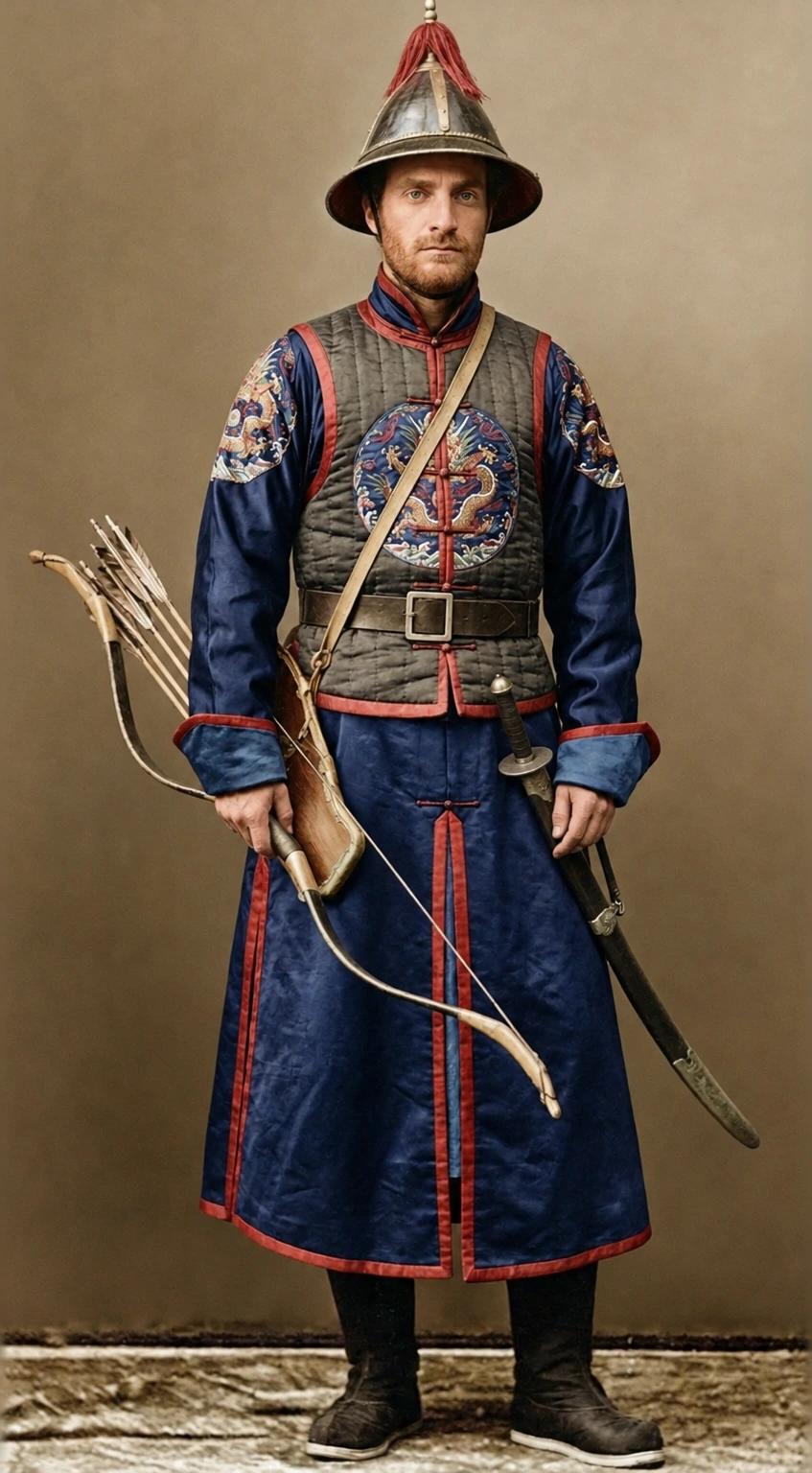
Uniform and equipment
| Uniform | Colored riding coats by banner, partial lamellar armor |
|---|---|
| Dress uniform | Silk surcoats in banner colors, rank badges, ornate belts |
| Headgear | Conical Manchu hat with colored button and peacock feathers for officers |
| Equipment | Composite bow, sabre, lance, sometimes matchlock |
| Insignia and standard | Dragon banner in banner colors |
Service record
| First appeared | 17th century |
|---|---|
| Peak strength | 80,000+ mounted banner men |
| Recruited from | Manchu/Mongol Tribesmen |
| Primary tactic | Mounted Archery / Flanking |
| Signature engagement | Battle of Sarhu (1619) |
| Motto or battle cry | Wansui! (Ten Thousand Years!) |
| Obsolescence | Opium Wars / Firepower |
Timeline
- 1601: Formation of the Four Banners. Nurhaci organizes his Jurchen followers into four color-coded administrative and military units: Yellow, White, Red, and Blue.
- 1615: Expansion to Eight Banners. The system is doubled by adding 'bordered' variants to the original colors, creating the full Eight Banners structure.
- 1644: Conquest of Beijing. The Banners seize the capital, establishing the Qing Dynasty over China proper.
- 1696: Battle of Jao Modo. The Kangxi Emperor utilizes the Banners to decisively defeat the Dzungar Khanate, securing the northern frontier.
- 1796: White Lotus Rebellion. The prolonged struggle exposes the declining martial quality and corruption within the hereditary Banner forces.
- 1911: Xinhai Revolution. The Wuchang Uprising leads to the fall of the Qing Dynasty and the final disbandment of the Banner armies.
Battles
Battle of Sarhu
The defining masterpiece of Manchu warfare. Outnumbered nearly 4 to 1, Nurhaci's cavalry used interior lines to isolate and annihilate four converging Ming columns individually in a blizzard of arrows and steel before they could unite.
Battle of Shanhai Pass
The Banners breached the Great Wall. Allied with defector Wu Sangui, the heavy Manchu cavalry charged through a dust storm to crush Li Zicheng's rebel army, opening the road to Beijing and centuries of Qing rule.
Battle of Palikao
The tragic twilight of the Banners. Sengge Rinchen's elite cavalry launched a heroic, suicidal frontal charge against Anglo-French lines, only to be shredded by modern rifled artillery and musketry, signaling the end of the era of the bow.
Commanders
Dorgon
The Prince Regent who smashed through the Great Wall. A ruthless pragmatist and master of cavalry warfare, he led the Eight Banners into Beijing, crushing the Ming resistance and enforcing the queue order with an iron fist.
Nurhaci
The architect of the Banner system and unifier of the Jurchen tribes. A brilliant strategist who transformed tribal raiders into a disciplined state machine, he laid the foundation for the Qing dynasty through relentless drilling and the integration of conquered foes.
Agui
A veteran of the Ten Great Campaigns under the Qianlong Emperor. Known for his logistical mastery and ability to lead multi-ethnic banner armies across the punishing terrain of Central Asia to suppress the Dzungars and rebels in the borderlands.
Tactics
The Parting Shot
Feigning retreat to lure enemies out of formation, then turning in the saddle to fire arrows backward with lethal precision.
Combined Arms Assault
Unlike pure steppe nomads, Manchu Banners integrated heavy infantry and artillery (Hongyipao) to break fortifications before cavalry exploitation.
Double Envelopment
Using superior mobility to extend the line of battle and flank the enemy on both wings simultaneously, collapsing their center.