
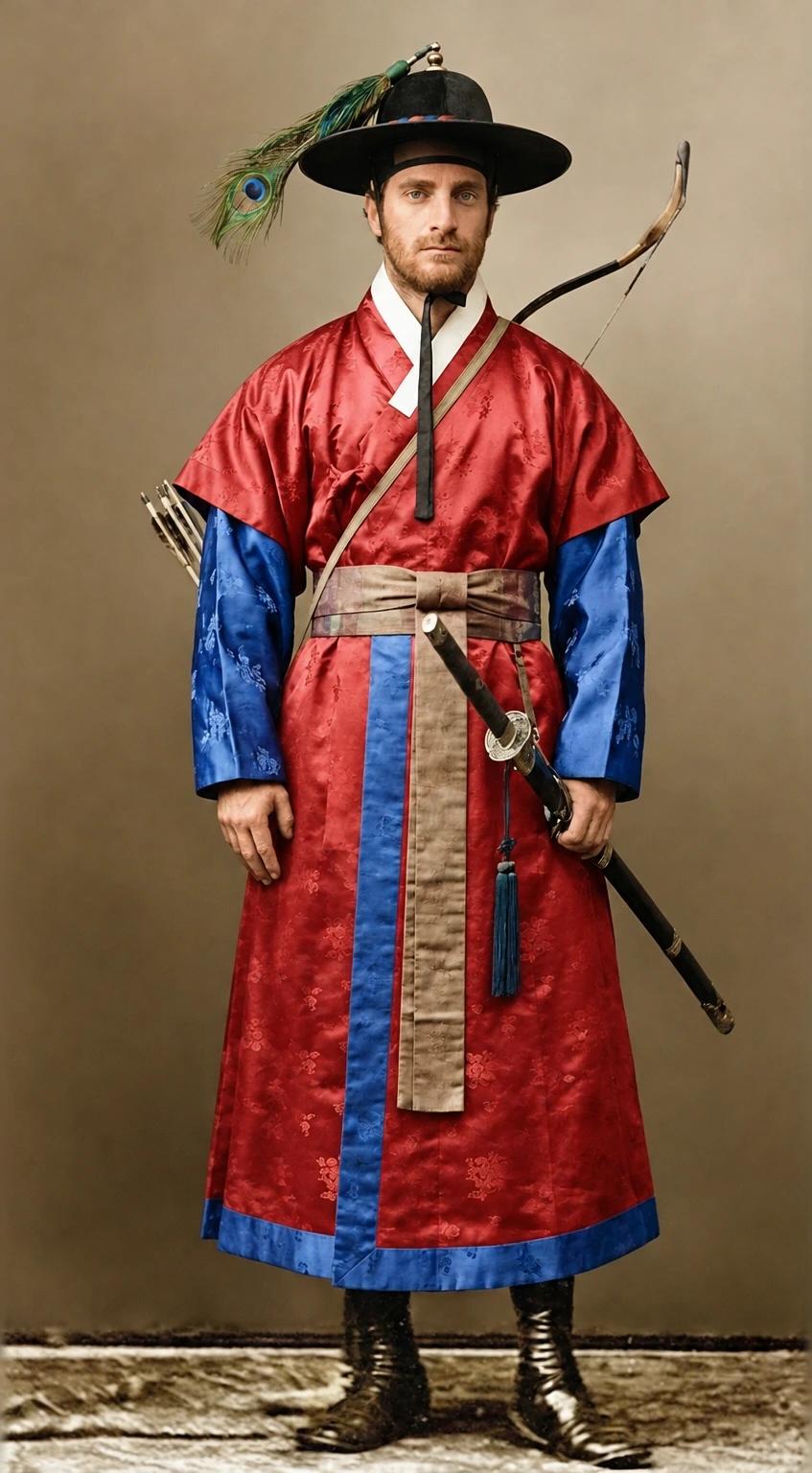
Uniform and equipment
| Uniform | Brightly colored robes in red, blue or yellow with armor vests |
|---|---|
| Dress uniform | Layered silk robes, broad belts, colored bead necklaces |
| Headgear | Black felt military hat (jeonrip) with peacock feather and colored cords |
| Equipment | Spears, halberds, bows, swords |
| Insignia and standard | Turtle/dragon painted emblems on armor/tags |
Service record
| First appeared | 15th century |
|---|---|
| Peak strength | Hundreds of guards on strength |
| Recruited from | Hereditary Military Families |
| Primary tactic | Gate Defense / Archery |
| Signature engagement | Imjin War (Defense of Palace) |
| Motto or battle cry | Wansae! (Ten Thousand Years!) |
| Obsolescence | Japanese Annexation (1910) |
Timeline
- 1392: Foundation of the Naegeumwi. King Taejo establishes the elite inner palace guards immediately following the founding of the Joseon Dynasty.
- 1469: Military Reforms of Sejo. King Sejo reorganizes the Five Guards system, strengthening the central command and the professionalism of the Royal Guard.
- 1592: The Imjin War. Japanese invasion decimates the capital; the Royal Guards fight a desperate rearguard action as the King flees north.
- 1636: The Qing Invasion. The guards are tested in the freezing siege of Namhansanseong, leading to a humiliation that spurs later military modernization.
- 1790: Publication of Muyedobotongji. King Jeongjo commissions a comprehensive martial arts manual, codifying the fighting styles of the Royal Guards.
- 1895: Gabo Reforms. Traditional guard units are disbanded or modernized into Western-style units, ending centuries of tradition.
Battles
Battle of Tangeumdae
The elite cavalry of the Royal Guard, led by Sin Rip, made a desperate last stand against Japanese musketeers. Choosing death over retreat, they fought on the muddy banks of the Han River until they were annihilated.
Siege of Haengju
A mix of Royal Guards, monks, and commoners repelled 30,000 Japanese invaders. The guards utilized hwacha rocket fire and archery to break wave after wave of samurai assaults.
Siege of Namhansanseong
Trapped in a mountain fortress during a brutal winter, the Royal Guards defended King Injo against the massive Qing army. Despite starvation and frostbite, they held the walls for 47 days before the eventual capitulation.
Commanders
Gwon Yul
A scholar-official turned general who commanded the capital's defense forces. He rallied the shattered remnants of the Royal Army and Guards to achieve the impossible victory at Haengju, proving that strategic brilliance could overcome overwhelming numbers.
Yi Sun-sin
Before his legendary naval exploits, Yi served as a junior officer in the Royal Guards. His unyielding discipline and refusal to compromise on standards, even against corrupt superiors, epitomized the ideal integrity of the King's personal protectors.
Tactics
Gung-sul (Composite Archery)
The guards prioritized archery above all else, raining death from the walls before enemies could engage in melee.
Won-ang Jin (Mandarin Duck Formation)
Adopted post-Imjin War, this squad-level tactic utilized mixed weapons (shields, bamboo spears, tridents, muskets) to cover each other's weaknesses.
Salsu (Close Quarters Combat)
Specialized swordsmanship and shield work designed for the cramped confines of palace gates and courtyards.