
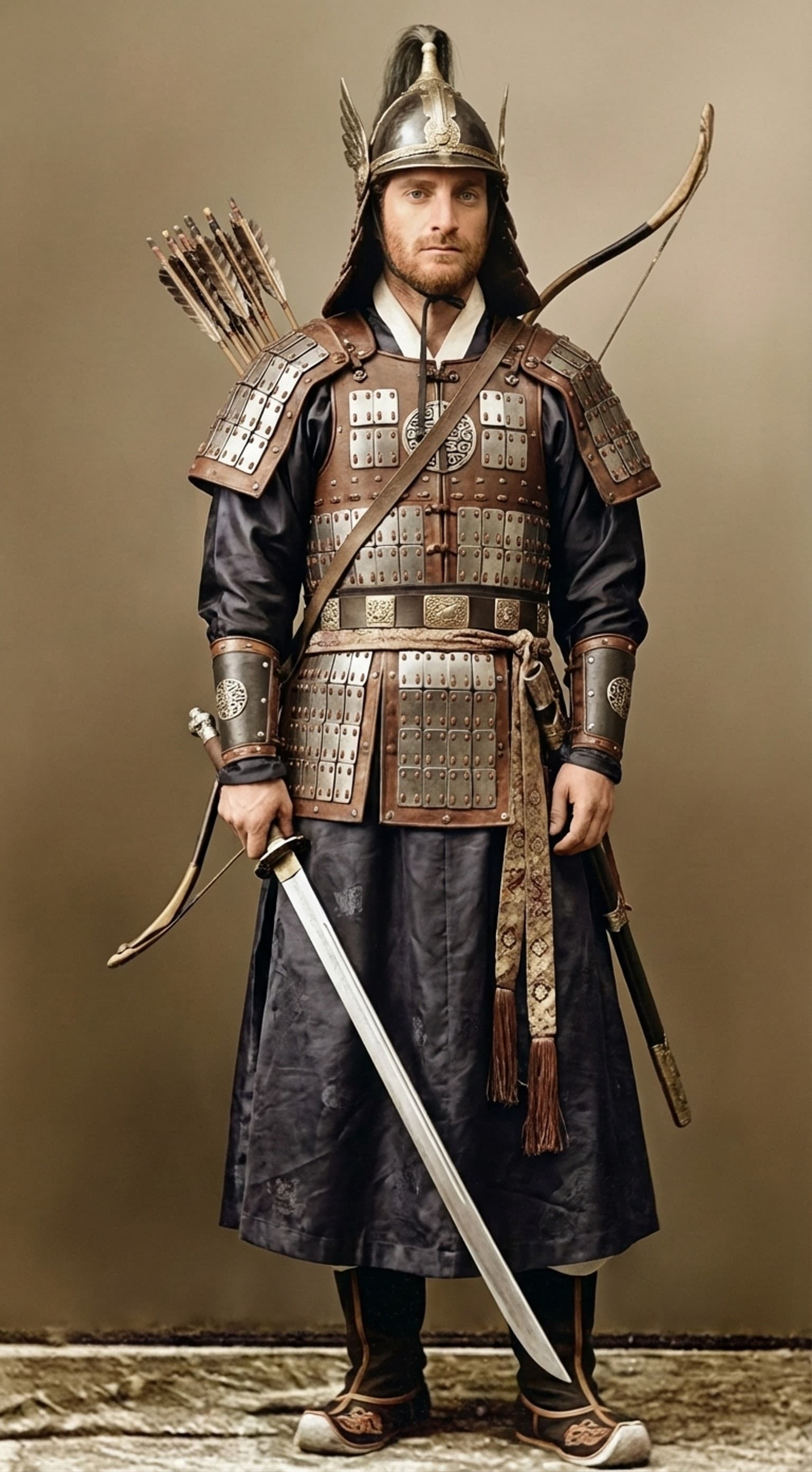
Uniform and equipment
| Uniform | Bright silk robes over armor, colored sashes |
|---|---|
| Dress uniform | Multi-colored ceremonial robes, jeweled belts |
| Headgear | Decorated headbands or caps with plumes |
| Equipment | Composite bow, sword, spear, dagger |
| Insignia and standard | Flower insignia / decorative robes (no fixed badge) |
Service record
| First appeared | 500s |
|---|---|
| Peak strength | ~3,000 warriors |
| Recruited from | Aristocratic Youth |
| Primary tactic | Moral Leadership / Shock |
| Signature engagement | Unification Wars |
| Motto or battle cry | Loyalty and Filial Piety |
| Obsolescence | Confucian Bureaucracy |
Timeline
- 576: Formal Organization. King Jinheung formalizes the Hwarang into a state-sponsored military and educational organization for aristocratic youth.
- 642: Fall of Daeya Fortress. A catastrophic loss to Baekje that radicalized the Hwarang corps, fueling a generation of revanchist fervor led by Kim Yushin.
- 660: Conquest of Baekje. Hwarang units play a critical role in the destruction of Silla's ancient rival at Hwangsanbeol.
- 668: Unification of the Peninsula. Silla-Tang alliance destroys Goguryeo; Hwarang warriors participate in the final sieges of Pyongyang.
- 681: Political Decline. Following the revolt of Kim Heum-dol, the Hwarang's political power is curtailed, transitioning them back to a more ceremonial role.
Battles
Battle of Gwansanseong
A pivotal ambush where Silla forces, spearheaded by Hwarang cavalry, intercepted and decapitated King Seong of Baekje. This victory secured the strategic Han River basin for Silla.
Battle of Hwangsanbeol
A grueling stalemate against the Baekje suicide squad. The battle was won not by tactics, but by the ritual suicide charges of young Hwarang knights, whose deaths shamed the main Silla army into a berserk assault.
Commanders
Kim Yushin
The architect of the Three Kingdoms unification. A master strategist and former Hwarang leader who transformed the corps from ritualistic youths into a hardened vanguard. His leadership blended mystical charisma with ruthless pragmatic warfare.
Kwan Chang
The archetype of Hwarang martyrdom. At age 16, he charged the Baekje lines alone at Hwangsanbeol. Captured and released, he charged again, only to be beheaded. His severed head, returned to the Silla lines, incited a blood-frenzy that won the war.
Tactics
Martyr's Charge
A psychological shock tactic where individual Hwarang charged enemy lines to court death, inspiring their own troops with 'Sesok Ogye' (secular commandments) fervor.
Mountain Maneuver
Trained in harsh terrain during peace-time pilgrimages, Hwarang excelled at guerrilla warfare and ambushes in Korea's mountainous geography.
Mounted Archery
Utilizing the Parthian shot and rapid maneuvers to harass enemy infantry formations before closing in for the kill.