
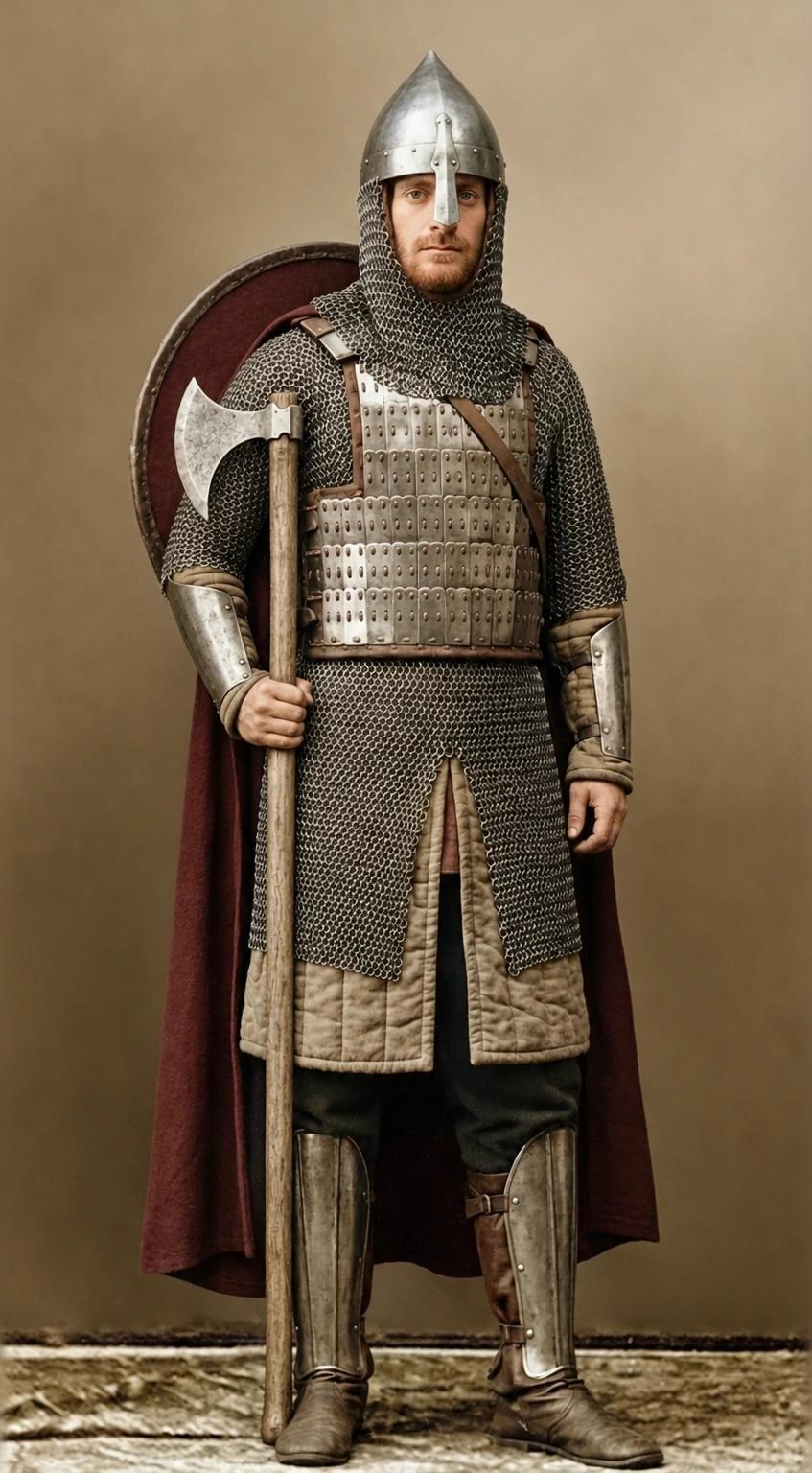
Uniform and equipment
| Uniform | Long mail hauberk over tunic, round or kite shield, richly dyed cloaks |
|---|---|
| Dress uniform | Gold-trimmed cloaks, inlaid axes, decorated belts; officers wore silken robes |
| Headgear | Conical helmet with nasal guard, sometimes winged or plumed for officers |
| Equipment | Massive two-handed axe, sword, shield, dagger |
| Insignia and standard | Raven banner (early) / Byzantine double-headed eagle (late) |
Service record
| First appeared | 10th century |
|---|---|
| Peak strength | 6,000 men |
| Recruited from | Norse/Rus/Saxon Mercenaries |
| Primary tactic | Shock Infantry / Axe Strike |
| Signature engagement | Battle of Manzikert (1071) |
| Motto or battle cry | Epi sfragida (By the Seal/Contract) |
| Obsolescence | Fourth Crusade (1204) / Loss of Funds |
Timeline
- 988: Formation. Prince Vladimir of Kiev sends 6,000 Rus' warriors to Emperor Basil II, forming the nucleus of the Guard.
- 1034: Harald's Service. Harald Sigurdsson (Hardrada) joins the Guard, ushering in a golden age of prestige and recruitment from Scandinavia.
- 1066: Anglo-Saxon Influx. Following the Battle of Hastings, many displaced Anglo-Saxon huscarls emigrate to Byzantium, changing the Guard's ethnic composition.
- 1081: Disaster at Dyrrhachium. The Guard suffers near-total annihilation fighting the Normans, requiring a massive rebuilding effort.
- 1204: Defense of the City. The Guard defends the Blachernae Palace during the Fourth Crusade sack of Constantinople.
- 1400: Decline. By the 15th century, the distinct 'Varangian' identity fades, assimilating into the general palace guard.
Battles
Battle of Cannae
Under the Catepan Basil Boioannes, the Guard crushed the Lombard revolt and their Norman allies. The Varangians proved their worth as shock troops, securing Byzantine dominance in Southern Italy for decades.
Battle of Manzikert
A catastrophic betrayal. While the main army routed, the Varangians stood firm around Emperor Romanos IV, hacking at the Seljuk tide until they were overwhelmed. A testament to their blood-oath loyalty.
Battle of Dyrrhachium
Driven by a vendetta against the Normans, the Guard advanced too far ahead of the main line. Exhausted and isolated, they were surrounded in a church and burned alive or slaughtered to the man.
Siege of Constantinople
The Fourth Crusade. The Varangians were the only unit to offer significant resistance against the Crusaders at the sea walls, fighting for their pay until the city's leadership collapsed.
Commanders
Harald Hardrada
The 'Thunderbolt of the North.' Before becoming King of Norway, he served the Empire with brutal efficiency, amassing vast wealth and leading the Guard in campaigns from Sicily to Bulgaria. A giant of a man who embodied the mercenary spirit.
Basil II
The 'Bulgar Slayer.' While an Emperor rather than a Guard commander, he was the architect of the unit, formalizing the corps in 988 from 6,000 Rus' warriors sent by Vladimir of Kiev to crush a rebellion.
Bolli Bollason
An Icelandic saga hero known for his vanity and prowess. He returned to Iceland wearing gold-embroidered silk and carrying a shield given by the Emperor, illustrating the immense wealth Varangians could accrue.
Tactics
The Axe Strike
Shock infantry tactic where the heavy Dane axe is used to hook enemy shields or shatter armor, creating gaps for the sword.
Skjaldborg (Shield Wall)
A dense, overlapping formation of shields used to absorb missile fire and cavalry charges before the counter-attack.
Svinfylking (Boar Snout)
A wedge formation designed to penetrate and split enemy infantry lines through sheer kinetic force.
Imperial Shield
A defensive protocol where the Guard forms a tight, impenetrable ring around the Emperor, fighting to the death if breached.