
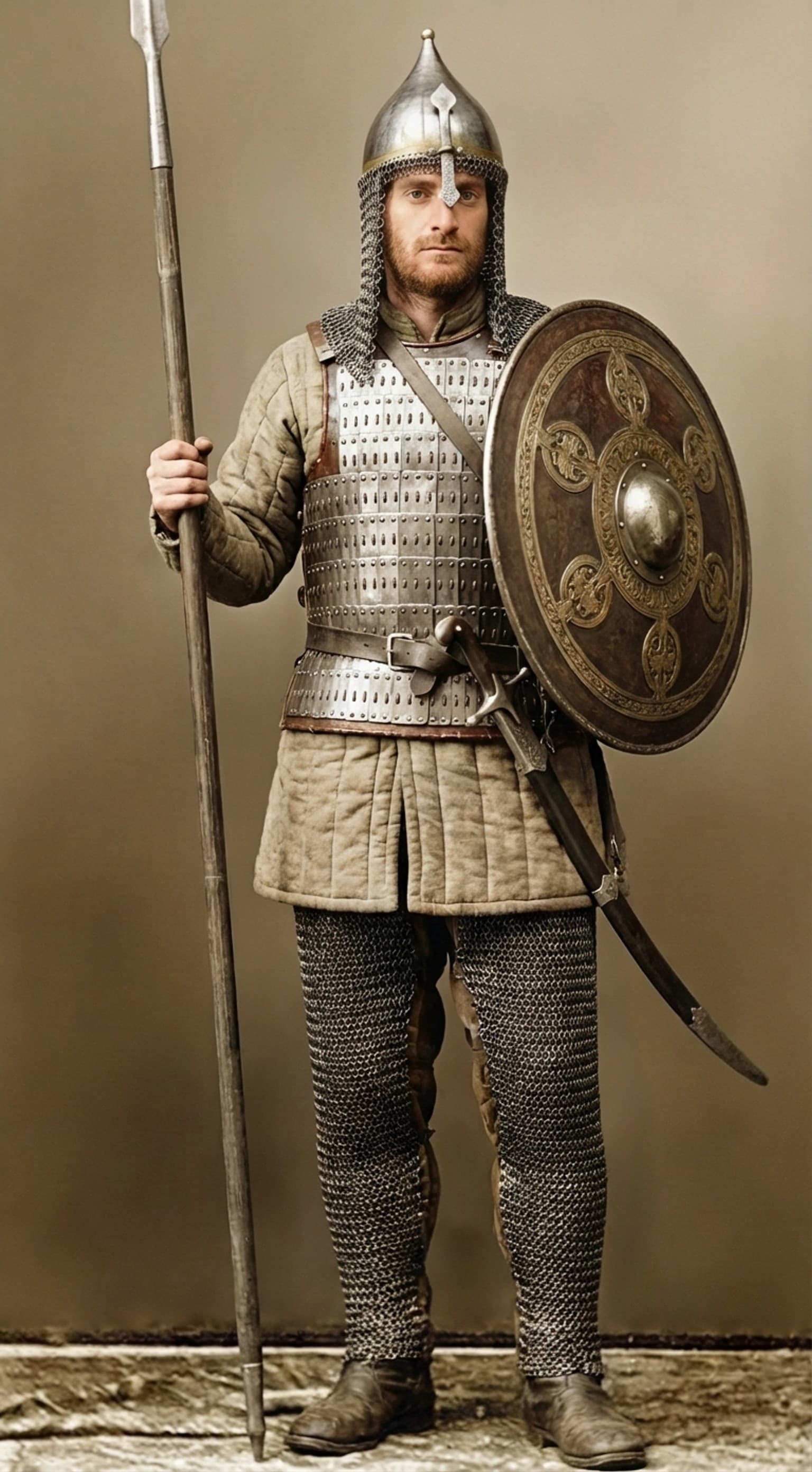
Uniform and equipment
| Uniform | Full lamellar armor for man and horse, over colorful tunic |
|---|---|
| Dress uniform | Silvered or gilded armor, embroidered saddle cloths and cloaks |
| Headgear | Enclosed conical helmets with face masks for some |
| Equipment | Long kontos lance, sword, mace, sometimes bow |
| Insignia and standard | Drafsh-e Kavian royal standard |
Service record
| First appeared | 3rd century AD |
|---|---|
| Peak strength | 8,000–12,000 men |
| Recruited from | Azadan (Lesser Nobility) |
| Primary tactic | Massed Heavy Charge |
| Signature engagement | Battle of Edessa (260 AD) |
| Motto or battle cry | For the Shahanshah! (King of Kings) |
| Obsolescence | Arab Muslim Conquest (High Mobility) |
Timeline
- 224: Rise of the Sassanids. Ardashir I overthrows the Parthians, establishing a new dynasty that prioritizes heavy, centralized cavalry over horse archers.
- 260: Triumph at Edessa. Shapur I demonstrates the supremacy of the Clibanarii by capturing Roman Emperor Valerian.
- 363: Julian's Persian War. Clibanarii units engage in a grueling war of attrition against Rome, ultimately repelling the invasion.
- 531: Reforms of Khosrow I. Military reforms standardize the equipment and pay of the cavalry, creating a professional standing army of knights.
- 627: Battle of Nineveh. A catastrophic defeat by the Byzantines that depletes the elite cavalry ranks.
- 651: Fall of the Empire. With the death of Yazdegerd III, the organized Sassanian military structure dissolves into history.
Battles
Battle of Edessa
The zenith of Sassanian power. Shapur I's heavy cavalry isolated and crushed the Roman army. The psychological impact of seeing their Emperor dragged away in chains by armored giants haunted Rome for generations.
Battle of Ctesiphon
A tactical defeat but strategic turning point. While Julian's legions pushed back the Clibanarii outside the walls, the heavy cavalry's constant harassment and the heat of their armor eventually exhausted the Romans, leading to Julian's death during the retreat.
Battle of Dara
A rare failure where the Clibanarii charge was stalled by Belisarius's trench tactics. Despite their superior armor and weight, the Persian heavy horse were flanked by Huns, proving that shock alone could not break a disciplined, entrenched defense.
Battle of al-Qadisiyyah
The twilight of the Clibanarii. Heavily armored and mounted on barded horses, they bogged down in the mud against the agile, light infantry of the Rashidun Caliphate. The defeat marked the end of Sassanid military supremacy.
Commanders
Shapur II
Reigning for seventy years, 'The Great' was a relentless hammer against the West. He modernized the Clibanarii, turning them into an impenetrable wall of steel that ground down the invasion of Julian the Apostate, preserving the empire through sheer attrition and armored discipline.
Khosrow I (Anushirvan)
The philosopher-king who reformed the military caste system. He professionalized the Savaran knights, ensuring the Clibanarii were not just feudal levies but a standardized, elite shock force capable of facing the Byzantines and the White Huns simultaneously.
Shapur I
The 'King of Kings' who brought Rome to its knees. A master tactician and warrior-king, Shapur personally led his iron-clad cavalry to shatter the Roman legions, famously capturing Emperor Valerian alive and using him as a footstool, symbolizing the absolute dominance of Persian heavy armor.
Tactics
The Iron Wall
Riders locked knees in a tight formation, creating a solid line of metal that swept across the battlefield, relying on sheer mass to trample infantry.
Assault Archery
Uniquely for heavy shock cavalry, Clibanarii would halt just out of spear range to unleash a volley of heavy arrows before switching to the lance for the final impact.
Feigned Retreat
Though heavily armored, they retained the discipline to fake a rout, drawing enemy infantry out of formation before wheeling around to crush the disorganized pursuers.