
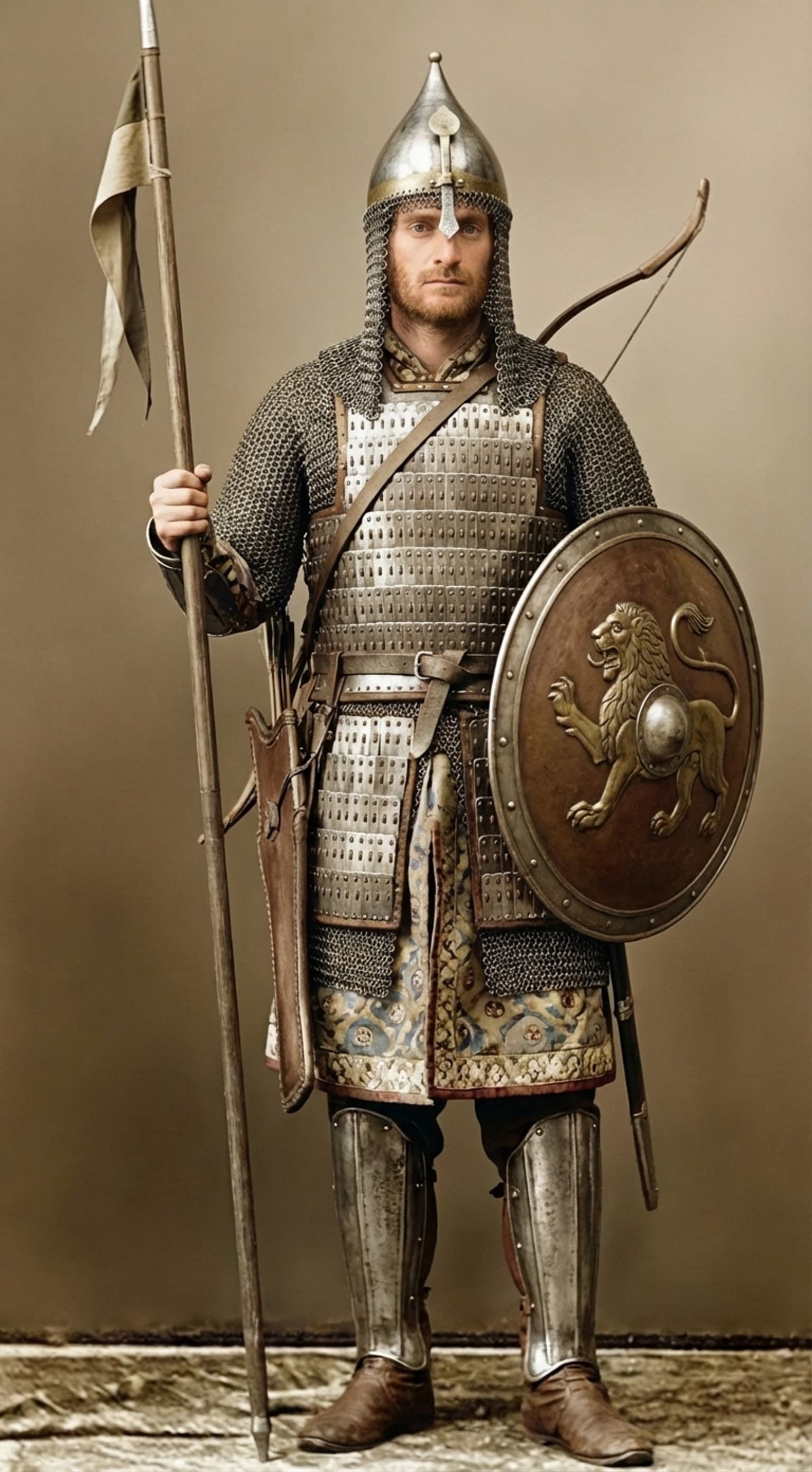
Uniform and equipment
| Uniform | Mail or scale armor, colorful tunics, trousers |
|---|---|
| Dress uniform | Gold-embroidered tunics, jeweled belts, clan symbols |
| Headgear | Ridge helmet or rounded helmet with mail |
| Equipment | Lance, bow, sword, mace |
| Insignia and standard | Senmurv motif on armor/silk |
Service record
| First appeared | 224 AD |
|---|---|
| Peak strength | ~20,000 men |
| Recruited from | Wuzurgan (High Nobility) |
| Primary tactic | Archery and Shock |
| Signature engagement | Battle of Ctesiphon |
| Motto or battle cry | Pērōz (Victory) |
| Obsolescence | Arab Conquest |
Timeline
- 224: Rise of the Sassanids. Ardashir I defeats the Parthians; the feudal cavalry is reorganized into the centralized Savaran corps.
- 260: Triumph at Edessa. The Savaran achieve legendary status by capturing Roman Emperor Valerian.
- 363: Julian's War. Heavy cavalry successfully repels the massive Roman invasion of Mesopotamia.
- 531: Reforms of Khosrow I. Military reforms create a paid professional knightly class (Dehqans), standardizing equipment and loyalty.
- 636: Fall at al-Qadisiyyah. The destruction of the main Savaran army by the Rashidun Caliphate.
- 651: End of the Empire. Death of Yazdegerd III; surviving Savaran nobles flee to Tang China or integrate into local administration.
Battles
Battle of Edessa
The zenith of Sassanid power. Shapur I's heavy cavalry encircled and crushed the Roman army. The capture of Emperor Valerian sent shockwaves through the ancient world, proving the Savaran superior to the Roman legionary in open combat.
Battle of Samarra
Defending against Julian the Apostate's invasion. While the Romans held the field tactically, the Savaran's relentless harassment and heavy charges exhausted the legions. Julian was mortally wounded by a Sassanid spear, forcing a disastrous Roman retreat.
Battle of al-Qadisiyyah
The twilight of the Savaran. Despite their heavy armor and war elephants, the Sassanid knights were outmaneuvered by lighter Arab cavalry in a multi-day battle amidst a dust storm. The death of Rostam Farrokhzad here broke the backbone of the Imperial Army.
Commanders
Rostam Farrokhzad
The Eran-Spahbed and Prince of Media, Rostam was the tragic titan of the late empire. A brilliant strategist burdened with saving a fracturing realm, he led the Savaran at al-Qadisiyyah, fighting amidst a blinding sandstorm until his death marked the end of Persian dominance.
Shapur I
The King of Kings who humbled Rome. Shapur personally led the Savaran charge at Edessa, capturing Emperor Valerian alive. He forged the heavy cavalry into an iron fist capable of shattering the discipline of Roman legions.
Bahram Chobin
A legendary general of the Mihranid house, Bahram was famed for his towering height and skill with the bow. He crushed the Göktürks with inferior numbers using disciplined Savaran archery before rebelling to briefly seize the throne.
Tactics
Shower Shooting
Ranks of Savaran would unleash massed volleys of arrows to disrupt enemy formations and wound unarmored horses before closing in.
Cataphract Charge
A disciplined, close-order charge with the heavy kontos lance, intended to smash through infantry shield walls or enemy cavalry lines.
Parthian Shot
The ability to shoot arrows backward while retreating, luring eager enemies out of formation to be counter-attacked.