
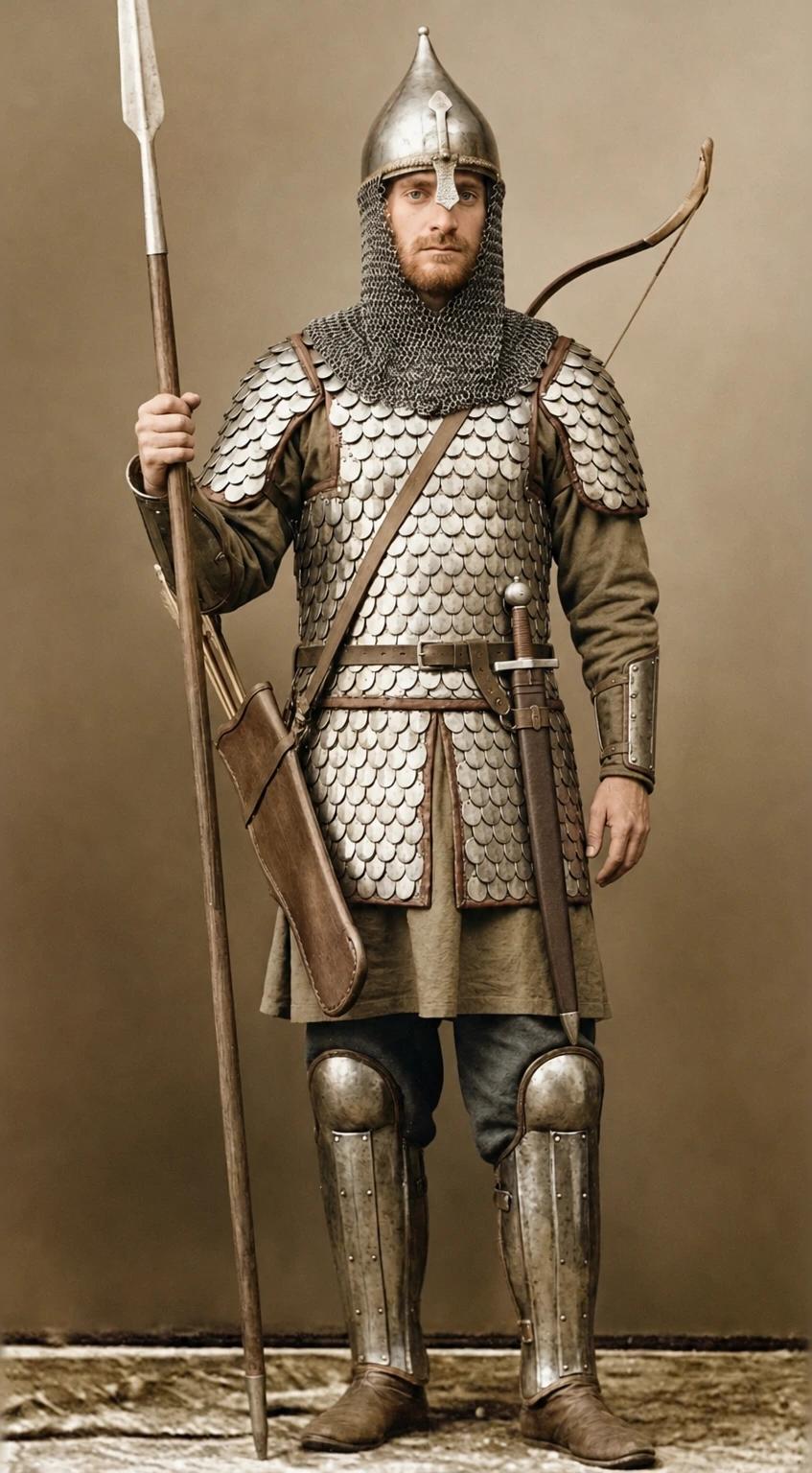
Uniform and equipment
| Uniform | Layered lamellar plates over mail, armored limbs |
|---|---|
| Dress uniform | Inlaid metal plates, patterned cloth under armor |
| Headgear | Fully enclosed helmet with nasal and cheek guards |
| Equipment | Heavy lance, composite bow, sword |
| Insignia and standard | Draco windsock standard |
Service record
| First appeared | 1st century BC |
|---|---|
| Peak strength | ~4,000 riders |
| Recruited from | Feudal Nobility |
| Primary tactic | Shock and Missile Barrage |
| Signature engagement | Battle of Carrhae (53 BC) |
| Motto or battle cry | Mithra! (God of War/Sun) |
| Obsolescence | Rise of Sassanids |
Timeline
- 53: Triumph at Carrhae. The Clibanarii achieve legendary status by destroying a Roman consular army, halting Rome's eastern expansion.
- 116: Trajan's Campaign. Roman legions briefly capture Ctesiphon; the heavy cavalry struggles against organized Roman siegecraft and logistics.
- 141: Conquest of Mesopotamia. Mithridates I captures Babylon, securing the resources and smiths needed to mass-produce heavy iron armor.
- 224: Fall to the Sassanids. The Parthian Empire falls, but the Sassanids adopt and refine the Clibanarii, evolving them into the Savaran.
- 247: Rise of the Arsacids. Arsaces I founds the dynasty; early experiments with armored cavalry begin to counter Scythian and Seleucid threats.
Battles
Battle of Carrhae
The defining moment of Parthian warfare. Surena's Clibanarii acted as an anvil to the horse archers' hammer. When Crassus's legions formed a testudo, the heavy cavalry charged with lances, shattering the Roman shields and morale in a cataclysmic defeat for Rome.
Antony's Parthian War
While not a single set-piece battle, the Clibanarii harassed Mark Antony's retreat through the freezing mountains. They punished stragglers and blocked foraging parties, turning a Roman invasion into a desperate fight for survival.
Battle of Nisibis
A brutal three-day engagement against Emperor Macrinus. The Parthian heavy cavalry repeatedly charged the Roman lines, enduring caltrops and heavy infantry resistance. Their relentless pressure eventually forced Rome to purchase a humiliating peace.
Commanders
Surena
A tactical genius of the House of Suren, he orchestrated the annihilation of Roman legions at Carrhae. Known for his personal valor and immense wealth, he commanded the Clibanarii with devastating precision, using them to pin the enemy while horse archers rained death.
Pacorus I
Son of King Orodes II, Pacorus led aggressive campaigns into Roman Syria and Judea. He utilized heavy cavalry to smash through Roman infantry formations, proving the Clibanarii could operate effectively even outside the flat plains of Mesopotamia.
Tactics
The Iron Charge
A close-order charge where riders locked knees, presenting a solid wall of metal and lance points to shatter infantry lines through sheer kinetic impact.
Combined Arms Barrage
Clibanarii would carry bows alongside lances. They would soften the enemy with arrows, charge to force a defensive turtle formation, and then retreat to let light horse archers exploit the gaps.
Parthian Shot (Heavy)
Unlike light cavalry, Clibanarii could execute a fighting retreat while heavily armored, firing backwards to discourage pursuit before wheeling around for a counter-charge.