
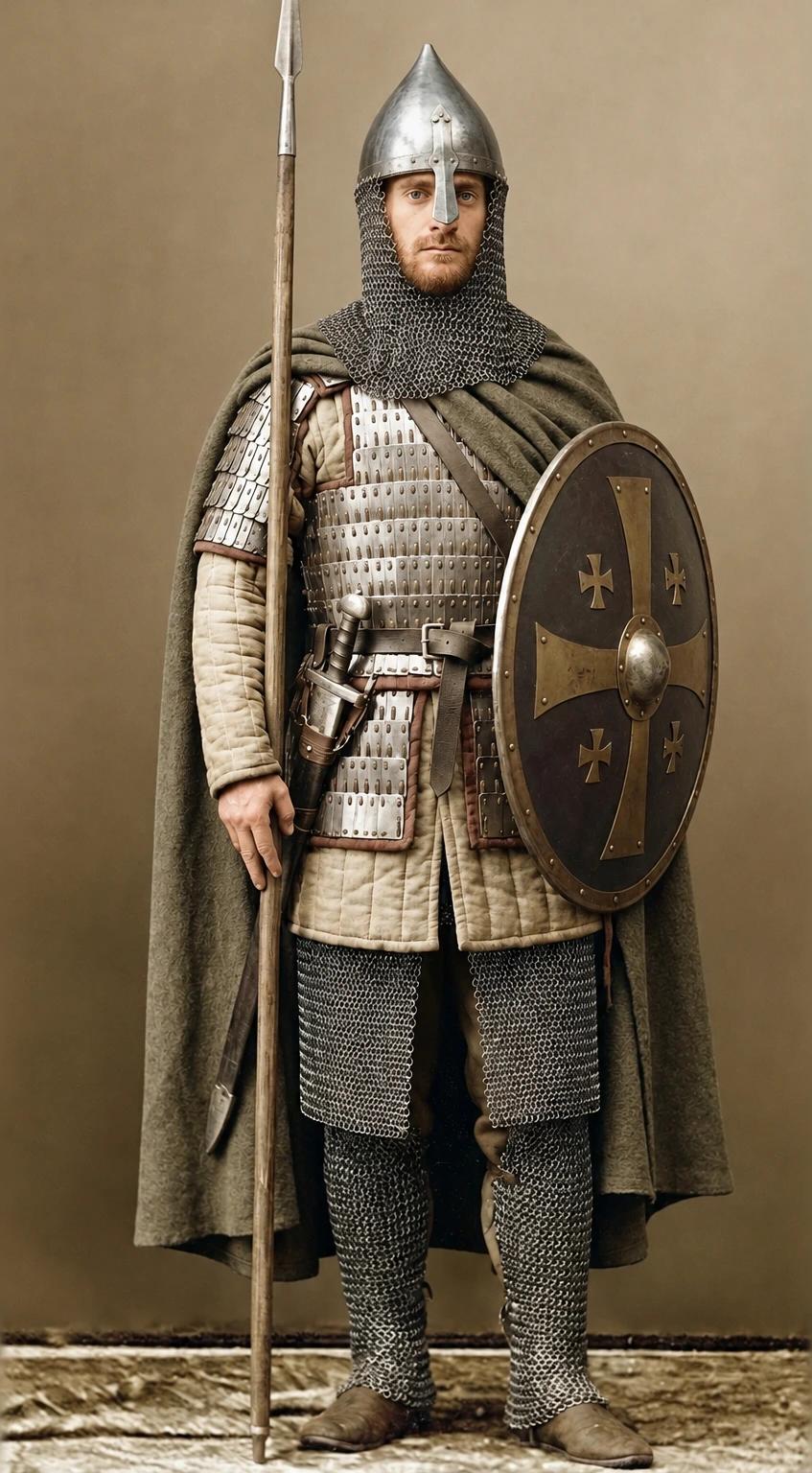
Uniform and equipment
| Uniform | Lamellar armor for rider and partly for horse, colored surcoat |
|---|---|
| Dress uniform | Brightly dyed surcoats in imperial colors, gilded lamellar plates |
| Headgear | Conical or segmented helmet with mail aventail |
| Equipment | Kontarion lance, sword, composite bow, sometimes mace |
| Insignia and standard | Chi-Rho or double-headed eagle on shields |
Service record
| First appeared | 9th century |
|---|---|
| Peak strength | 10,000–15,000 men |
| Recruited from | Professional Soldiers / Thematic Landholders |
| Primary tactic | Wedge Charge |
| Signature engagement | Battle of Dorostolon (971) |
| Motto or battle cry | Nobiscum Deus (God with us) |
| Obsolescence | Manzikert / Economic Decline |
Timeline
- 533: Vandalic War. Under Belisarius, the cataphracts prove their dominance in North Africa, cementing their status as the empire's elite arm.
- 552: Conquest of Italy. The destruction of the Ostrogoths at Taginae marks the high-water mark of Justinian's restoration.
- 636: Battle of Yarmuk. A catastrophic defeat against the Rashidun Caliphate forces a reorganization of the military into the Theme system.
- 960: Phokas Reforms. Nikephoros II Phokas reintroduces super-heavy cavalry (Klibanophoroi) to counter Arab incursions.
- 1071: Battle of Manzikert. Political betrayal and tactical failure lead to the destruction of the heavy cavalry core, marking the beginning of the end for the classic Byzantine army.
Battles
Battle of Dara
Belisarius utilized a defensive trench system and the superior mobility of his cataphracts to flank and destroy a Sassanid Persian army twice the size of his own force.
Battle of Tricamarum
A pure cavalry engagement where the sheer aggression of the cataphract charge shattered the Vandal army, effectively ending the Vandal Kingdom in a single afternoon of thunderous violence.
Battle of Taginae
Narses deployed dismounted cataphracts as a phalanx supported by archers to absorb the impetuous charge of the Ostrogothic knights, leading to the total destruction of the Gothic army.
Commanders
Narses
An elderly eunuch who succeeded Belisarius, Narses was a master of logistics and combined arms. He utilized dismounted heavy cavalry to crush the Gothic heavy horse in Italy, proving the versatility of the Byzantine military machine.
Nikephoros II Phokas
The 'White Death of the Saracens.' As Emperor, he reformed the heavy cavalry into the super-heavy 'Klibanophoroi,' creating an unstoppable armored wedge capable of shattering the most disciplined infantry shield walls.
Flavius Belisarius
The 'Last Roman' who reconquered the West. A tactical genius who utilized the cataphract's dual role as archer and lancer to devastating effect against Vandals and Goths, often fighting against overwhelming odds with a core of iron-disciplined veterans.
Tactics
The Wedge Formation
Riders formed a triangular wedge to concentrate force on a single point of the enemy line, shattering infantry formations through sheer kinetic impact.
Shower and Charge
Cataphracts would soften the enemy with volleys of arrows from their composite bows before switching to lances for a decisive shock charge.
Feigned Flight
Adopted from steppe peoples, the unit would pretend to retreat to draw enemy formation apart, then wheel around to counter-attack the disorganized pursuers.