
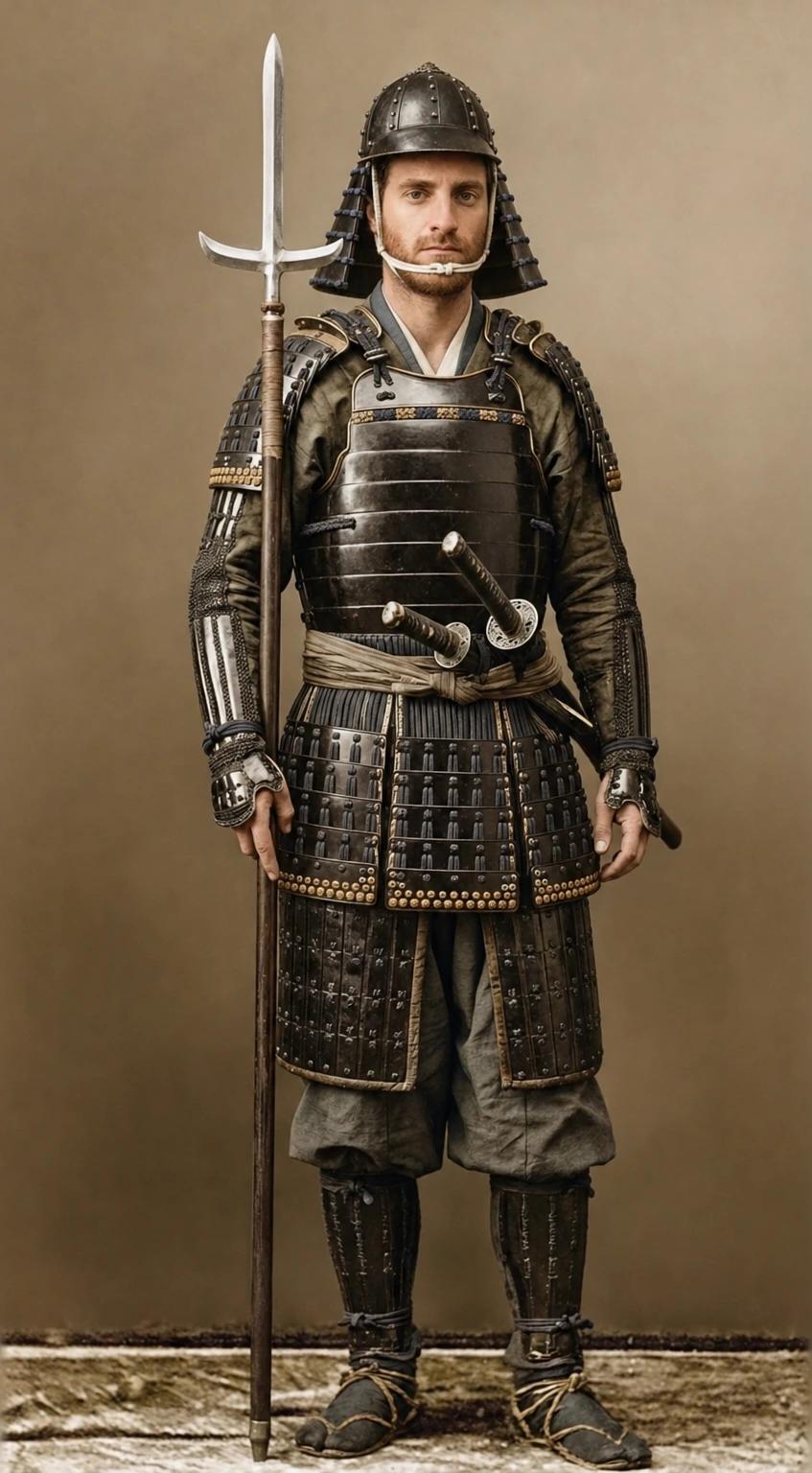
Uniform and equipment
| Uniform | Kimono and hakama with mon, do-maru armor for service |
|---|---|
| Dress uniform | Kamishimo formal dress with tall shoulders over armor or undercoat |
| Headgear | Kabuto for combat, tall eboshi caps or court caps for ceremonies |
| Equipment | Spears, matchlock guns, katana and wakizashi |
| Insignia and standard | Mitsuba Aoi triple hollyhock crest |
Service record
| First appeared | 17th century |
|---|---|
| Peak strength | 4,000–5,000 men |
| Recruited from | Hereditary Vassals |
| Primary tactic | Leadership / Elite Reserve |
| Signature engagement | Siege of Osaka (1614) |
| Motto or battle cry | Service to the Shogun |
| Obsolescence | Meiji Restoration (1868) |
Timeline
- 1600: Battle of Sekigahara. Ieyasu's victory establishes the de facto hegemony of the Tokugawa; the core Mikawa retainers become the proto-Hatamoto.
- 1603: Establishment of the Shogunate. Ieyasu is named Shogun. The Hatamoto are formally institutionalized as direct vassals with incomes under 10,000 koku.
- 1615: Fall of Osaka. The destruction of the Toyotomi clan removes the last threat to Tokugawa rule; the Hatamoto transition from pure warriors to a standing military bureaucracy.
- 1635: Sankin-kotai Enforcement. The Hatamoto are tasked with enforcing the alternate attendance policy, policing Edo and the highways against rebellious Daimyo.
- 1638: End of the Shimabara Rebellion. The last major deployment of the Hatamoto in large-scale warfare until the 19th century; the Pax Tokugawa begins.
- 1868: Boshin War. The modernized but rusty Hatamoto corps is defeated by Imperial forces, leading to the fall of the Shogunate and the unit's disbandment.
Battles
Battle of Sekigahara
The decisive clash that ended the Sengoku period. The Hatamoto guarded Ieyasu's main camp, repelling enemy charges and serving as the iron reserve that allowed Ieyasu to dominate the field and seize control of Japan.
Siege of Osaka (Summer Campaign)
The annihilation of the Toyotomi clan. Hatamoto units engaged in vicious close-quarters street fighting and open-field clashes, breaking the 'Crimson Demons' of Sanada Yukimura and cementing Tokugawa hegemony in blood.
Shimabara Rebellion
A brutal siege against Christian rebels entrenched in Hara Castle. The Hatamoto were deployed to stiffen the resolve of local daimyo levies, ultimately storming the fortress in a massacre that ended major military conflict in Japan for two centuries.
Commanders
Tokugawa Hidetada
The second Shogun, often overshadowed by his father but a capable administrator and field commander. He led the Hatamoto main body during the grueling Siege of Osaka, proving the shogunate's military might against the desperate Toyotomi defenders.
Tokugawa Ieyasu
The patient architect of modern Japan. Having survived decades of civil war as a hostage and minor lord, he forged the Hatamoto from his most loyal Mikawa retainers. His leadership was defined by caution, strategic brilliance, and ruthless pragmatism.
Itakura Shigemasa
A Hatamoto commander tasked with suppressing the Shimabara Rebellion. Though he fell in battle leading a desperate charge against the fortifications of Hara Castle, his death galvanized the shogunate forces to crush the uprising.
Tactics
Kiba-musha Totsugeki
A disciplined mounted charge. Unlike the chaotic individual duels of earlier eras, Hatamoto cavalry struck as a cohesive wedge to break enemy lines.
Teppo-tai Volleys
Rotating volley fire by matchlock corps. They utilized layered ranks to maintain continuous fire, suppressing enemy movement and breaking morale.
Honjin Defense
The 'Iron Ring' tactic. Hatamoto formed an impenetrable defensive perimeter around the Shogun's standard, refusing to retreat regardless of casualties.