
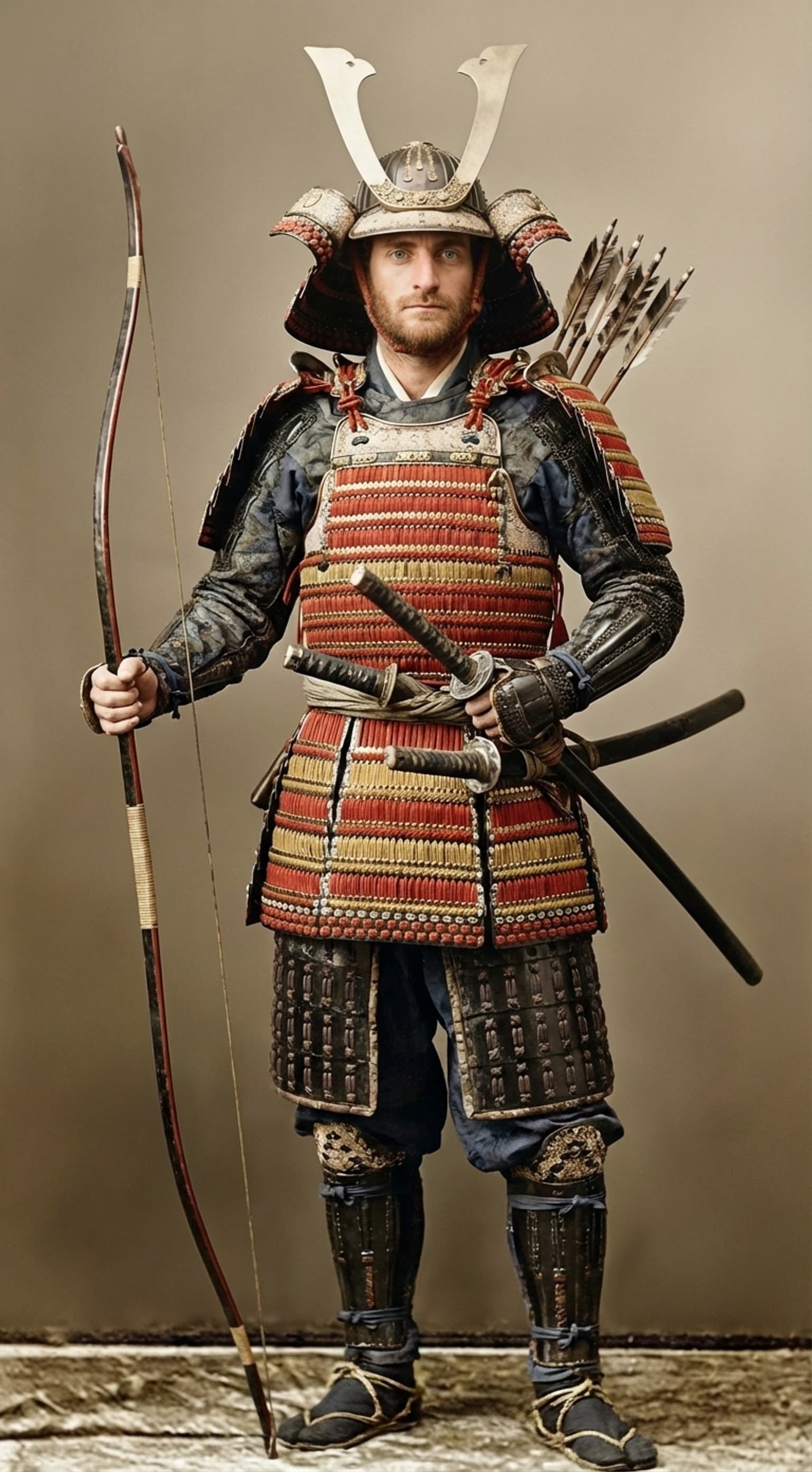
Uniform and equipment
| Uniform | Lacquered lamellar armor (ō-yoroi) with silk cords |
|---|---|
| Dress uniform | Elaborate armor with multiple colors of lacing, brocade sashes |
| Headgear | Large kabuto helmet with horn or crest ornaments |
| Equipment | Yumi longbow, tachi sword, spear, later katana |
| Insignia and standard | Clan mon on sode and kabuto |
Service record
| First appeared | 10th century |
|---|---|
| Peak strength | Several tens of thousands across clans |
| Recruited from | Hereditary Warrior Caste |
| Primary tactic | Mounted Archery / Duels |
| Signature engagement | Genpei War (1180-1185) |
| Motto or battle cry | Namu Hachiman Daibosatsu (Prayer to War God) |
| Obsolescence | Mass Infantry Tactics (Sengoku) |
Timeline
- 794: Heian Period Begins. The imperial court moves to Kyoto; provincial military families begin to consolidate power to protect land holdings.
- 1156: Hogen Rebellion. A civil conflict that marked the turning point where samurai clans (Taira and Minamoto) became the true arbiters of political power.
- 1180: Start of Genpei War. The Minamoto clan rises against the ruling Taira, initiating a five-year conflict that would define samurai culture.
- 1192: Kamakura Shogunate Established. Yoritomo is named Seii Taishogun, formally establishing the first military government (bakufu) of Japan.
- 1274: Mongol Invasions. The threat of foreign invasion forces a shift from individual heroic duels to massed infantry tactics and defensive fortifications.
- 1333: Fall of Kamakura. The Hojo regency falls, ending the Kamakura period and marking the transition to lighter armor (Do-Maru) and infantry-focused warfare.
Battles
Battle of Ichi-no-Tani
Yoshitsune led a cavalry squadron down a near-vertical cliff face thought impassable by the Taira defenders. This shock assault from the rear shattered the enemy formation, exemplifying the samurai spirit of reckless bravery and tactical innovation.
Battle of Dan-no-ura
The decisive naval clash of the Genpei War. Samurai fought on ships, unleashing volleys of arrows before boarding. The Taira clan was annihilated, and the child Emperor Antoku drowned, cementing Minamoto dominance and the rise of the Shogunate.
Battle of Bun'ei (First Mongol Invasion)
Traditional samurai single-combat rituals clashed disastrously with Mongol group tactics and gunpowder bombs. Though the samurai fought fiercely, a providential typhoon (Kamikaze) ultimately saved Japan, forcing a tactical evolution away from ritualized warfare.
Commanders
Tomoe Gozen
A legendary onna-musha (female warrior) of immense strength and skill. Known for her loyalty to Minamoto no Yoshinaka, she was a rider of unbroken horses and a lethal archer, famously taking heads in the chaotic Battle of Awazu.
Minamoto no Yoritomo
The first Shogun of the Kamakura period. A cold, calculating strategist who transformed the samurai from hired muscle into the ruling political class of Japan. He orchestrated the destruction of the Taira clan and established a military government that lasted centuries.
Minamoto no Yoshitsune
A tragic genius of the battlefield. Known for his daredevil tactics, such as the cliff charge at Ichi-no-Tani, he was the sword that won the Genpei War. His brilliance sparked jealousy in his brother Yoritomo, leading to his betrayal and forced suicide.
Tactics
Kyuba no Michi
The 'Way of the Horse and Bow.' The primary combat doctrine of the era, emphasizing the ability to shoot accurately from a galloping horse.
Nanori
The ritual of name-announcing. Before combat, a samurai would proclaim his lineage and achievements to find a worthy opponent for a duel.
Kabura-ya Signaling
The use of whistling-bulb arrows to signal the start of battle or to demoralize the enemy with their shrieking sound.