
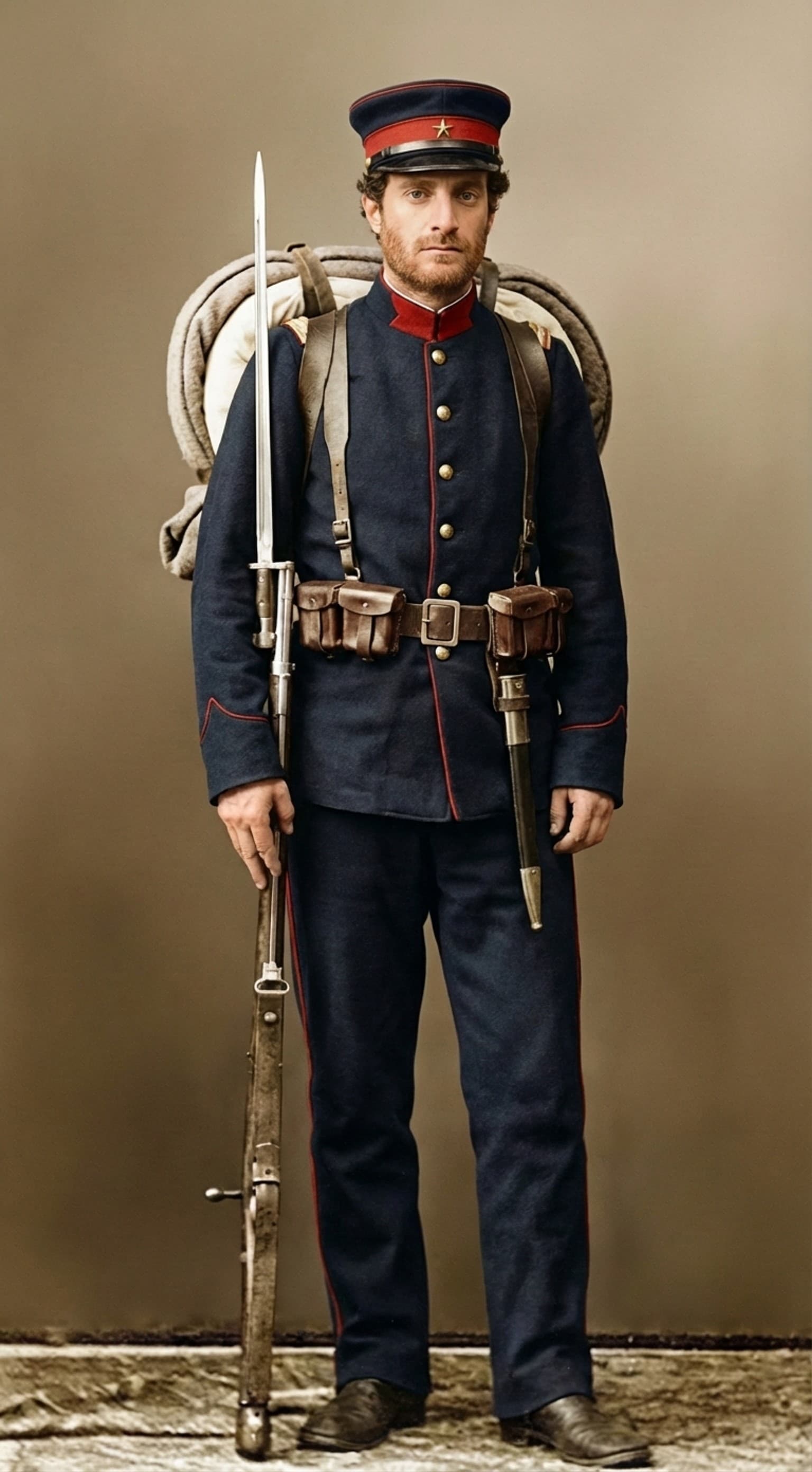
Uniform and equipment
| Uniform | Dark blue tunic and trousers with red piping; officers with gold braid |
|---|---|
| Dress uniform | Dark blue with extensive gold braid, white gloves, red sashes |
| Headgear | Spiked helmet similar to pickelhaube, later peaked caps with star badge |
| Equipment | Arisaka rifle, bayonet, officers with swords |
| Insignia and standard | Star and Chrysanthemum cap badge |
Service record
| First appeared | 1871 |
|---|---|
| Peak strength | 20,000 men |
| Recruited from | Selected Conscripts / Samurai Families |
| Primary tactic | Modern Infantry Assault |
| Signature engagement | Russo-Japanese War (1904) |
| Motto or battle cry | Tenno Heika Banzai (Long Live the Emperor) |
| Obsolescence | WWII Surrender (1945) |
Timeline
- 1867: Formation of the Goshinpei. The original Imperial Bodyguard is formed from samurai of the Satsuma, Choshu, and Tosa domains to protect the Emperor.
- 1871: Reorganization into Imperial Guard. The unit is officially designated the 'Imperial Guard' (Konoe), becoming the model for the new national army.
- 1877: Suppression of Satsuma Rebellion. The Guard faces its baptism of fire, defeating the samurai uprising led by former commander Saigō Takamori.
- 1891: Divisional Status. The Guard is expanded and reorganized as the Imperial Guard Division, the elite formation of the IJA.
- 1904: Deployment to Manchuria. The Guard is deployed for the Russo-Japanese War, serving with distinction under the First Army.
- 1943: Expansion and Split. As the Pacific War escalates, the Guard Division is split into the 1st, 2nd, and 3rd Guards Divisions.
- 1945: Disbandment. Following the surrender of Japan, the Imperial Guard is dissolved, later replaced by the civilian Imperial Guard Headquarters.
Battles
Battle of Tabaruzaka
A seventeen-day slugfest in rain and mud. The conscripted Guard proved they could stand toe-to-toe with samurai swordsmen in brutal close-quarters combat, securing the legitimacy of the modern army.
Battle of the Yalu River
The Guard spearheaded the crossing of the Yalu, shattering the myth of European invincibility by routing Russian forces through disciplined fire and maneuver.
Battle of Mukden
Participating in one of the largest land battles prior to WWI, the Guard executed grueling flanking maneuvers in freezing conditions to break the Russian line.
Commanders
Yamagata Aritomo
The father of the modern Japanese Army. A stern disciplinarian who transformed the Imperial Guard from a samurai collection into a modernized, conscript-based elite force loyal solely to the Emperor.
Hasegawa Yoshimichi
A battle-hardened commander who led the Imperial Guard Division through the bloody fields of Manchuria during the Russo-Japanese War, earning a reputation for relentless aggression and tactical rigidity.
Saigō Takamori
The 'Last Samurai' who initially commanded the Imperial Guard before ideological schisms led him to lead the Satsuma Rebellion against the very army he helped create.
Tactics
Hakuhye-sen (White Steel Warfare)
A doctrine emphasizing the decisive bayonet charge. Officers believed that spiritual strength and cold steel could overcome superior enemy firepower.
Night Infiltration
Utilizing stealth and darkness to close the distance to enemy trenches, negating the range advantage of Russian machine guns and artillery.
Human Bullet (Nikudan) Assault
High-casualty frontal assaults against fortified positions, relying on the sheer will and self-sacrifice of the infantry to overwhelm defenders.