
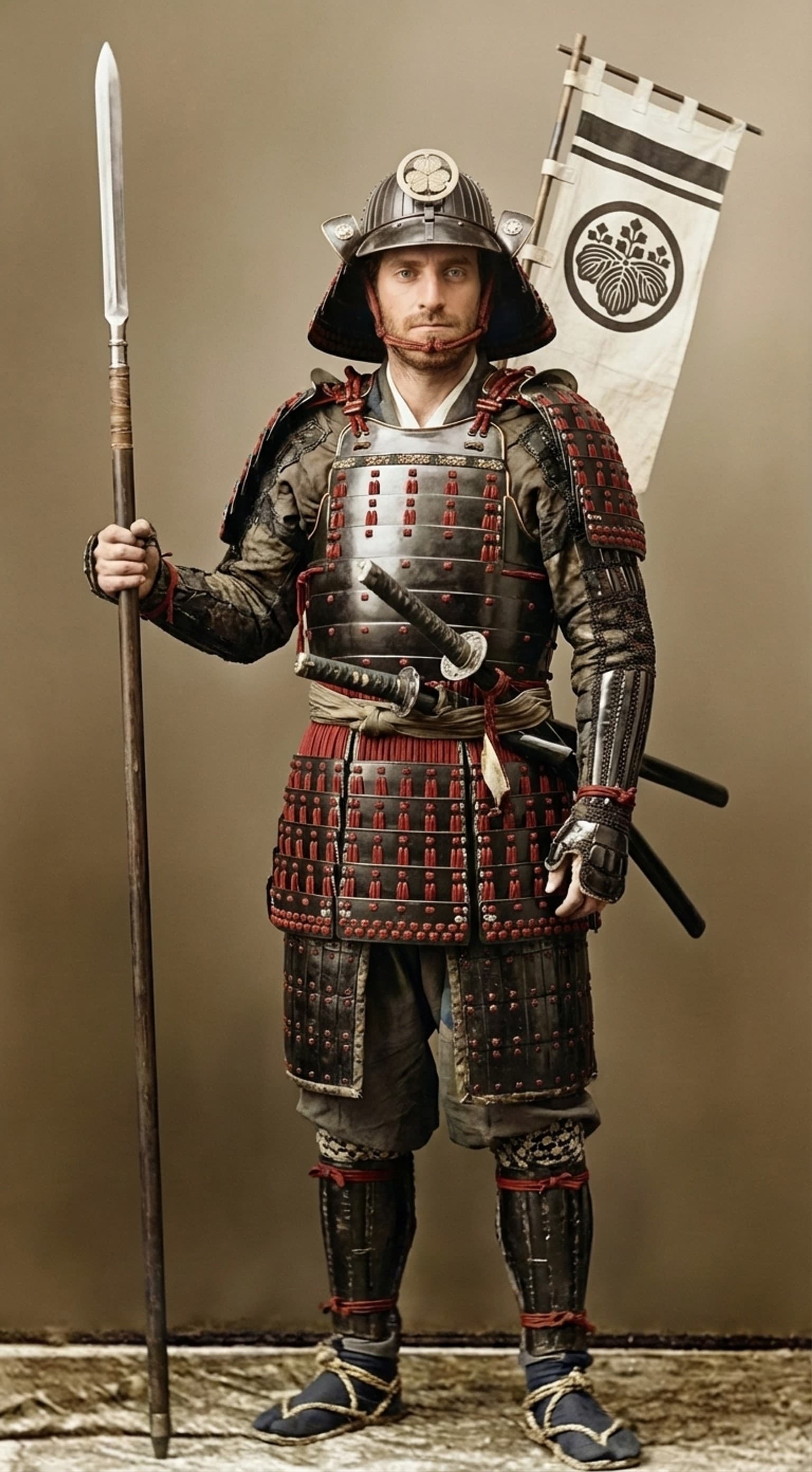
Uniform and equipment
| Uniform | Do-maru and haramaki armor with clan colors, suneate greaves |
|---|---|
| Dress uniform | Brilliantly lacquered armor, silk jinbaori surcoats with bold patterns |
| Headgear | Kabuto helmets with extravagant crests, horns or antlers |
| Equipment | Spears (yari), matchlock arquebus for some, katana and wakizashi |
| Insignia and standard | Clan mon on helmet maedate and armor |
Service record
| First appeared | 15th century |
|---|---|
| Peak strength | Thousands per major clan |
| Recruited from | Feudal Vassals / Professionals |
| Primary tactic | Combined Arms (Spear/Gun) |
| Signature engagement | Battle of Sekigahara (1600) |
| Motto or battle cry | Ei! Ei! Oh! (War Cry) |
| Obsolescence | Meiji Restoration / Modern Army |
Timeline
- 1467: Onin War Begins. The collapse of the Ashikaga Shogunate triggers a century of civil war, fracturing Japan into warring states.
- 1543: Introduction of Firearms. Portuguese traders arrive on Tanegashima, introducing the matchlock musket which is rapidly reverse-engineered.
- 1560: Battle of Okehazama. Oda Nobunaga defeats a vastly superior force in a surprise attack, beginning his rise to power.
- 1588: Sword Hunt. Toyotomi Hideyoshi forbids peasants from owning weapons, solidifying the samurai class as the sole military caste.
- 1600: Battle of Sekigahara. The decisive engagement that clears the path for the Tokugawa Shogunate.
- 1615: Siege of Osaka. The destruction of the Toyotomi clan marks the end of the Sengoku period and the beginning of the Pax Tokugawa.
Battles
Fourth Battle of Kawanakajima
A legendary, blood-soaked clash between Uesugi Kenshin and Takeda Shingen. It featured complex tactical maneuvers and fierce hand-to-hand combat, epitomizing the romantic ideal of samurai warfare.
Battle of Nagashino
Oda Nobunaga's forces decimated the legendary Takeda cavalry using rotating volleys of matchlock fire behind wooden palisades. This engagement marked the end of traditional mounted warfare and the rise of modern combined arms in Japan.
Battle of Sekigahara
The 'Battle that Divided the Realm'. Over 160,000 men clashed in thick fog and mud. Through betrayal and grit, Tokugawa Ieyasu defeated the Western Army, effectively unifying Japan under his rule.
Commanders
Oda Nobunaga
The 'Demon King' who shattered tradition. Ruthless and visionary, he integrated massed arquebus fire with pike formations, transforming the samurai from individual duelists into a disciplined military machine.
Tokugawa Ieyasu
The patient unifier. A master of logistics and political maneuvering, he survived the chaotic wars to establish a shogunate that would last over 250 years, commanding the largest samurai army in history at Sekigahara.
Takeda Shingen
The 'Tiger of Kai'. Renowned for his cavalry charges and adherence to Sun Tzu's Art of War (Fūrinkazan), he represented the pinnacle of traditional samurai martial prowess before the dominance of gunpowder.
Tactics
San-dan-gamae
Three-rank volley fire. Arquebusiers rotated ranks to maintain a continuous stream of fire, negating the weapon's slow reload time.
Yari Fusuma
Wall of Spears. Ashigaru and samurai locked shields and leveled pikes to create an impenetrable barrier against charges.
Kiba Totsugeki
Shock Cavalry Charge. Though rare, elite mounted samurai were used to flank or break wavering infantry lines with sudden violence.