
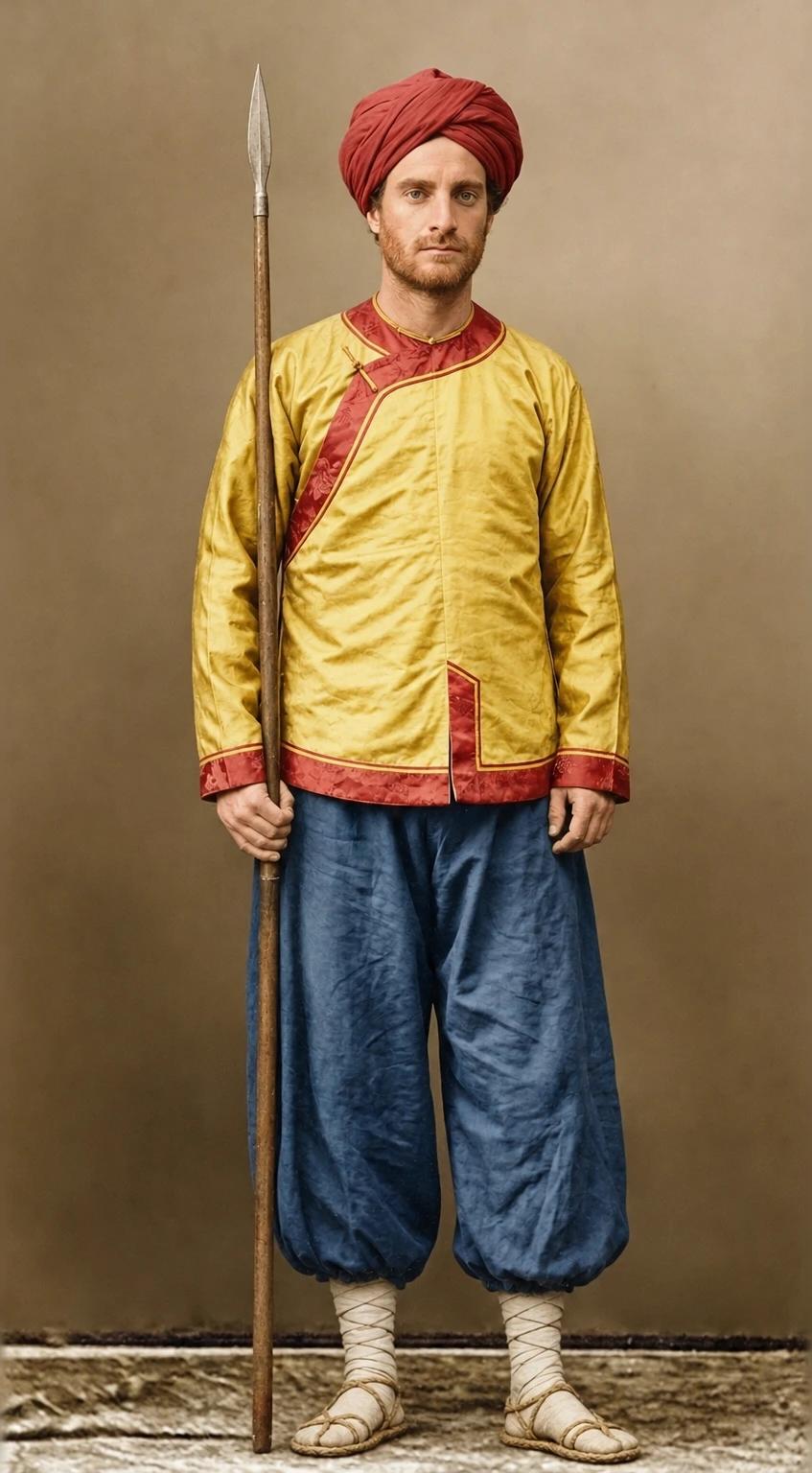
Uniform and equipment
| Uniform | Red jackets, long hair (Longhairs) |
|---|---|
| Dress uniform | Yellow/Red robes |
| Headgear | Red Turban |
| Equipment | Spear, Sword, Musket |
| Insignia and standard | Red turban and unshaven forelock |
Service record
| First appeared | 1850 |
|---|---|
| Peak strength | Millions |
| Recruited from | Religious Converts / Peasants |
| Primary tactic | Human Wave |
| Signature engagement | Fall of Nanjing |
| Motto or battle cry | Slay the Demons (Qing) |
| Obsolescence | Total Defeat |
Timeline
- 1851: Declaration of the Heavenly Kingdom. Following the Jintian Uprising, Hong Xiuquan declares the establishment of the Taiping Heavenly Kingdom.
- 1853: Establishment of the Capital. Nanjing is captured and renamed Tianjing. The Taiping Northern Expedition is launched but eventually fails.
- 1856: The Tianjing Incident. Internal power struggles result in a bloody purge. The East King Yang Xiuqing is assassinated, weakening the leadership core.
- 1860: Attempt on Shanghai. Taiping forces threaten Shanghai but are repelled by a coalition of Qing forces and Western mercenaries (Ever Victorious Army).
- 1864: The Fall of the Kingdom. Tianjing falls to the Xiang Army. Hong Xiuquan dies of illness (or poison) shortly before the city is breached.
Battles
Jintian Uprising
The spark of the rebellion. A ragtag congregation of charcoal burners and miners, armed with farm tools and religious fervor, routed the local Green Standard Army, marking the official birth of the Heavenly Kingdom.
Capture of Nanjing
The Taiping's crowning glory. After floating down the Yangtze, they breached the massive walls of Nanjing. The Manchu garrison was annihilated, and the city was renamed Tianjing (Heavenly Capital), becoming the heart of the holy war.
Battle of Sanhe
A tactical masterpiece where Taiping forces encircled and crushed the elite Hunan Army forces of the Qing. This victory temporarily halted the imperial advance and bought the Kingdom several more years of life.
Fall of Tianjing
The apocalyptic end. After a grueling siege and starvation, Qing forces detonated explosives under the walls. The ensuing street fighting was merciless; the defenders, refusing to surrender, burned themselves alive or fought to the death.
Commanders
Shi Dakai
Known as the 'Wing King,' Shi was the most capable general and administrator of the Taiping. A poet-warrior who despised the internal purges of the capital, he led his armies on a legendary long march away from Nanjing, fighting with tragic brilliance until his capture.
Li Xiucheng
The 'Loyal King.' Rising from a common soldier to commander-in-chief, Li was the firewall that held back the Qing armies in the rebellion's final years. A master of mobile warfare, he defended the Heavenly Capital with desperate ingenuity against impossible odds.
Hong Xiuquan
The Heavenly King and self-proclaimed brother of Jesus Christ. A failed scholar turned mystic, his visions ignited a civil war that claimed millions. While he retreated into palace hedonism later in the war, his spiritual authority remained the absolute bedrock of the rebellion's morale.
Tactics
Fanatical Charge
Driven by the promise of a heavenly afterlife, Taiping soldiers would launch overwhelming frontal assaults, often ignoring heavy casualties to break enemy morale through sheer ferocity.
Total Mobilization
Unlike traditional armies, the Taiping mobilized entire populations, including women (who had their own combat units), creating a massive, self-sustaining logistical and combat force.
Earthworks and Sapping
In the later years, Taiping engineers became masters of defensive warfare, constructing elaborate trench systems and tunnels to counter the superior firepower of the Qing and Westerners.