
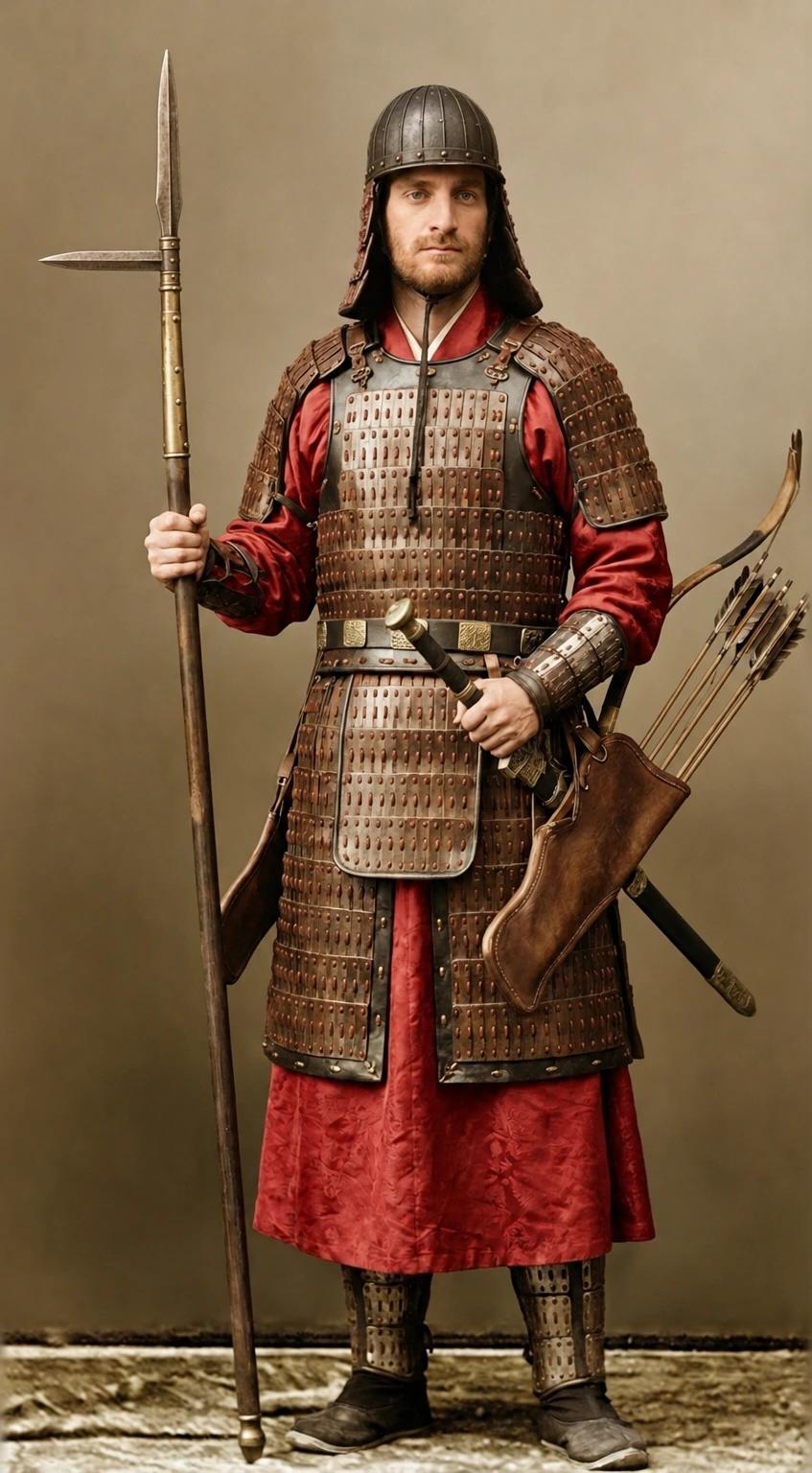
Uniform and equipment
| Uniform | Lacquered lamellar armor over colored robes, trousers and boots |
|---|---|
| Dress uniform | Bright red or imperial yellow robes over black lacquer armor, embroidered rank badges |
| Headgear | Lacquered helmets with side flaps; officer helmets with tall crests or feathers |
| Equipment | Long spear or halberd (ji), straight sword (jian), composite bow for some |
| Insignia and standard | Huben Rapid as Tigers standard; Tiger Tally |
Service record
| First appeared | 2nd century BC |
|---|---|
| Peak strength | 5,000–10,000 men |
| Recruited from | Orphans of War / Nobility (Huben) |
| Primary tactic | Combined Arms / Halberd Wall |
| Signature engagement | Battle of Mobei (119 BC) |
| Motto or battle cry | Rapid as Tigers |
| Obsolescence | Dynastic Cycle / Warlordism |
Timeline
- 202 BC: Formation of the Han. Emperor Gaozu establishes the Han Dynasty; the Northern and Southern Armies are formed to guard the capital.
- 133 BC: Mayi Ambush. The strategic shift from appeasement to aggression against the Xiongnu, initiating the era of active campaigning.
- 119 BC: Battle of Mobei. The zenith of Han military power; the Imperial Guard spearheads the destruction of the Xiongnu main force.
- 104 BC: Reform of the Eight Colonels. Emperor Wu reorganizes the Northern Army into eight specialized corps, including the elite 'Yulin' (Feathered Forest) orphans.
- 189: Burning of Luoyang. Warlord Dong Zhuo seizes the capital; the Imperial Guard structure fractures, leading to the Three Kingdoms chaos.
Battles
Battle of Hexi
A lightning campaign led by Huo Qubing. The Guard cavalry swept through the vital corridor to the west, capturing the Golden Man idols and driving the tribes beyond the Qilian Mountains, opening the Silk Road.
Battle of Mobei
The magnum opus of the Han military. Crossing the vast Gobi, the Imperial Guard and levy armies engaged the Chanyu's main force. Amidst a dust storm, Han discipline and encirclement tactics crushed the Xiongnu court, securing the empire's safety for decades.
Defense of Chang'an
The last stand of the usurper Wang Mang's guard. Despite fighting with fanatical loyalty in the Weiyang Palace against rebel forces, the guards were overwhelmed, marking the chaotic end of the interregnum era.
Commanders
Huo Qubing
The illegitimate son who became the Wolf of the North. A prodigy of lightning warfare, he led the Imperial cavalry deep into the steppes, discarding baggage trains for speed and living off the enemy. He died young, having broken the Xiongnu spirit.
Wei Qing
Rising from a stable slave to General-in-Chief, Wei Qing was the stoic architect of Han military supremacy. He professionalized the Imperial Guard, integrating heavy cavalry tactics to match the nomads and securing the northern borders through seven major campaigns.
Tactics
The Crossbow Grid
Rotating ranks of crossbowmen delivering a continuous, withering storm of bolts to break enemy charges before contact.
Caracole of the Steppe
Adopted from the Xiongnu, Han cavalry utilized horse archery to harass flanks before committing to a shock charge with lances.
Forest of Ji
A dense infantry phalanx presenting a wall of hooked halberds (Ji) to stop cavalry momentum and drag riders from their mounts.