
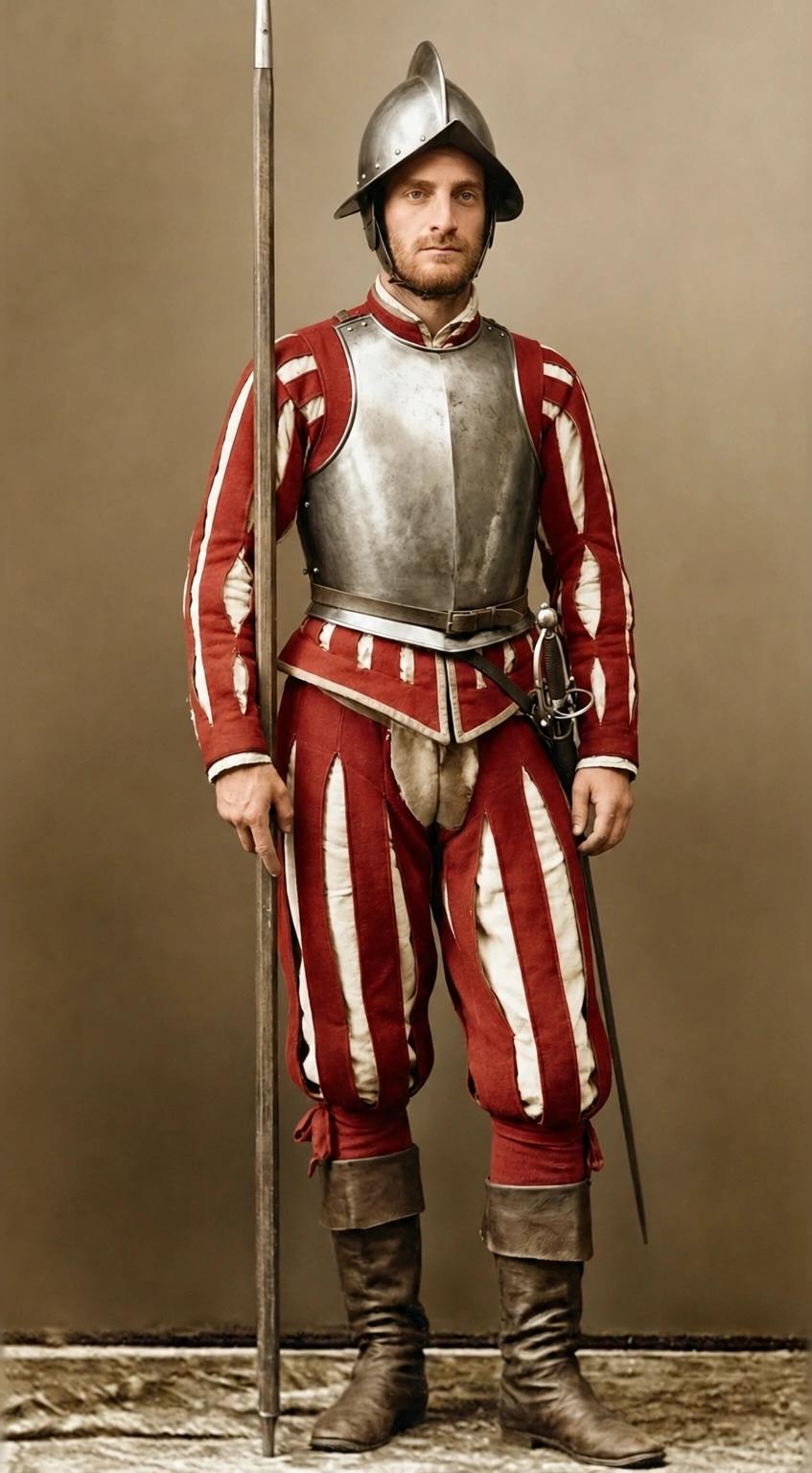
Uniform and equipment
| Uniform | Slashed and puffed doublets in bright colors |
|---|---|
| Dress uniform | Highly slashed garments of silk and wool, wide hats |
| Headgear | Broad-brimmed hats or berets with feathers |
| Equipment | Pike, halberd, Swiss degen sidearm |
| Insignia and standard | White cross fabric strips on clothing |
Service record
| First appeared | 1400s |
|---|---|
| Peak strength | ~30,000 in foreign service |
| Recruited from | Cantonal Mercenaries |
| Primary tactic | Pike Square Push |
| Signature engagement | Battle of Marignano (1515) |
| Motto or battle cry | Hie Eidgenoss! (Here Confederate!) |
| Obsolescence | Field Artillery |
Timeline
- 1315: Battle of Morgarten. Swiss peasantry ambush Austrian knights, proving that disciplined infantry could defeat feudal cavalry.
- 1386: Battle of Sempach. Consolidation of aggressive shock tactics; the legend of Arnold von Winkelried sacrificing himself to break the enemy line.
- 1474: Start of Burgundian Wars. The Swiss Cantons engage Charles the Bold, bringing their pike tactics to the world stage.
- 1499: Swabian War. De facto independence from the Holy Roman Empire; intensification of the rivalry with German Landsknechts.
- 1506: Formation of the Pontifical Swiss Guard. Pope Julius II hires Swiss mercenaries for his personal protection, a tradition lasting to the modern day.
- 1515: Battle of Marignano. Catastrophic loss against France leads to the 'Perpetual Peace' and a shift toward supplying mercenaries rather than state expansion.
- 1525: Battle of Pavia. The rise of firearms (arquebus) begins to render the dense pike square obsolete as the primary offensive formation.
Battles
Battle of Murten
The definitive destruction of Charles the Bold's army. The Swiss squares caught the Burgundians unprepared, slaughtering thousands in the lake. It cemented the reputation of the Swiss as invincible shock infantry who gave no quarter.
Battle of Novara
A stunning display of Swiss aggression. Without cavalry or artillery support, Swiss pikemen charged French positions, routing the German Landsknechts and seizing the French guns. It was the high-water mark of Swiss military dominance.
Battle of Marignano
The 'Battle of Giants'. Despite superhuman endurance, the Swiss squares could not withstand the combined onslaught of French heavy artillery and Venetian cavalry. This defeat ended Swiss expansionism and marked the beginning of their neutrality.
Commanders
Ulrich von Hohensax
A seasoned mercenary captain who navigated the treacherous politics of the Italian Wars. He commanded Swiss contingents with distinction, representing the transition of the Reisläufer from patriotic defenders to Europe's most sought-after contract killers.
Hans Waldmann
A peasant's son who rose to become the Mayor of Zurich and a supreme military commander. He led the Swiss confederates to decisive victories against Burgundy, epitomizing the ruthless efficiency of the Swiss pike squares before falling victim to political execution.
Adrian von Bubenberg
The stoic defender of Murten. Despite being outnumbered, his command held the walls against Charles the Bold, famously declaring that his men would not yield as long as blood flowed in their veins, buying time for the relief army to annihilate the Burgundians.
Tactics
Gewalthaufen (Shock Square)
A massive, deep formation of pikemen that moved with surprising speed. Unlike static defensive walls, the Swiss used the square as an offensive steamroller to crush enemy lines.
The Rapid Advance
Swiss units were famous for running into battle, closing the distance quickly to minimize exposure to missile fire and maximize the impact of the initial collision.
Bad War (Schlechter Krieg)
When fighting rival mercenaries like the German Landsknechts, the Swiss suspended the rules of war, taking no prisoners and killing all wounded.