
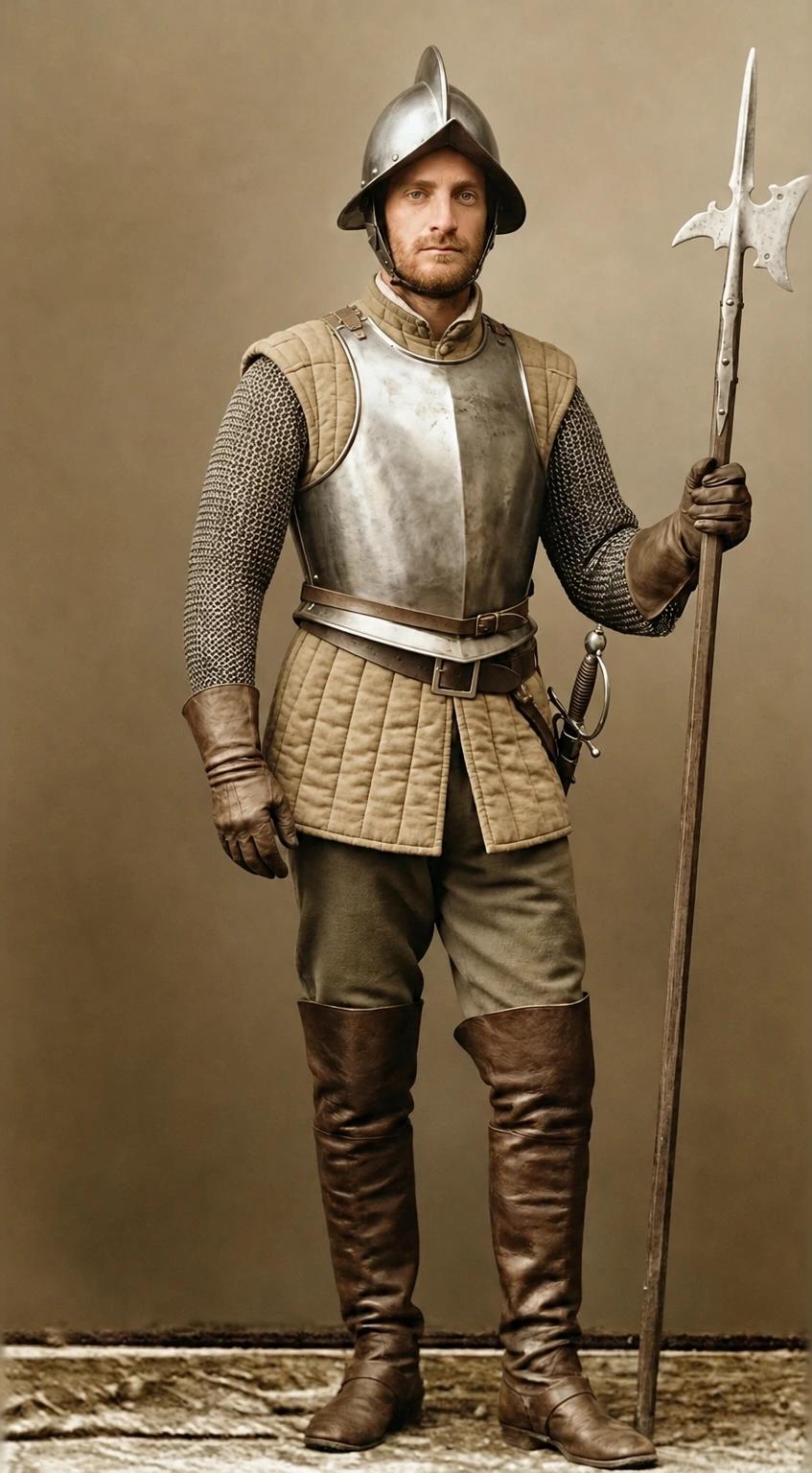
Uniform and equipment
| Uniform | Steel cuirass, morion helmet |
|---|---|
| Dress uniform | N/A |
| Headgear | Morion |
| Equipment | Sword, Buckler, Arquebus, Pike |
| Insignia and standard | Royal Standard of Castile and Leon |
Service record
| First appeared | 1492 |
|---|---|
| Peak strength | Small bands |
| Recruited from | Adventurers / Second Sons |
| Primary tactic | Shock / Combined Arms |
| Signature engagement | Conquest of Tenochtitlan (1521) |
| Motto or battle cry | Plus Ultra (Further Beyond) |
| Obsolescence | Settlement / Colonial Administration |
Timeline
- 1492: First Voyage of Columbus. Christopher Columbus arrives in the Americas, opening the door for Spanish exploration and the era of the Conquistadors.
- 1519: Landing at Veracruz. Hernán Cortés lands on the Mexican coast and scuttles his ships, committing his force to conquest or death.
- 1520: La Noche Triste. The 'Night of Sorrows', where Cortés and his men are driven out of Tenochtitlan with heavy casualties.
- 1521: Fall of the Aztec Empire. Tenochtitlan surrenders to Spanish forces and their indigenous allies.
- 1532: Capture of Atahualpa. Francisco Pizarro captures the Sapa Inca at Cajamarca, effectively decapitating the Inca Empire.
- 1540: Coronado Expedition. Francisco Vázquez de Coronado explores the American Southwest in a fruitless search for the Seven Cities of Gold.
- 1573: Ordinances of Discovery. King Philip II bans the term 'conquest' in favor of 'pacification', officially ending the era of the freelance Conquistador.
Battles
Battle of Otumba
Following the disastrous 'Night of Sorrows', a battered Spanish force faced an overwhelming Aztec army. By charging the enemy commander with heavy cavalry, the Conquistadors shattered the Aztec command structure and snatched survival from certain death.
Siege of Tenochtitlan
After a grueling 93-day siege involving brigantines on the lake and street-by-street fighting, Cortés and his Tlaxcalan allies destroyed the Aztec capital. It marked the end of the Aztec Empire and the rise of New Spain.
Battle of Cajamarca
Pizarro's small force ambushed the Inca Emperor Atahualpa in the great plaza. Using arquebuses and cavalry in a confined space, they slaughtered thousands of lightly armed retainers and captured the Emperor without suffering a single Spanish casualty.
Commanders
Francisco Pizarro
An illiterate soldier of fortune who rose from obscurity to topple the Inca Empire. With fewer than 200 men, he captured the Inca Emperor Atahualpa in a daring ambush, demonstrating the devastating effectiveness of psychological shock and steel.
Hernán Cortés
A brilliant and ruthless strategist who defied the Spanish crown to lead an expedition into Mexico. Through a mix of diplomatic manipulation and brutal warfare, he dismantled the Aztec Empire, securing vast wealth for Spain and establishing a legacy of conquest.
Pedro de Alvarado
Known as 'Tonatiuh' (Sun) by the Aztecs for his blonde hair and fiery temper. A lieutenant of Cortés and later conqueror of Guatemala, he was infamous for his reckless bravery and extreme cruelty, notably ordering the Massacre in the Great Temple.
Tactics
Rodeleros Shock
Sword-and-buckler men (Rodeleros) would slip under the reach of enemy weapons to engage in brutal close-quarters combat, often supported by pikemen.
Indigenous Alliances
Exploiting local political fractures to recruit thousands of native warriors (like the Tlaxcalans) to serve as the bulk of the infantry and logistical support.
Cavalry Charge
Using horses—unknown to the Americas—as shock weapons to break enemy lines and instill panic. A small group of horsemen could rout thousands.
Combined Arms
Integrating crossbows and arquebuses to soften targets from a distance before closing in with steel swords and pikes.