
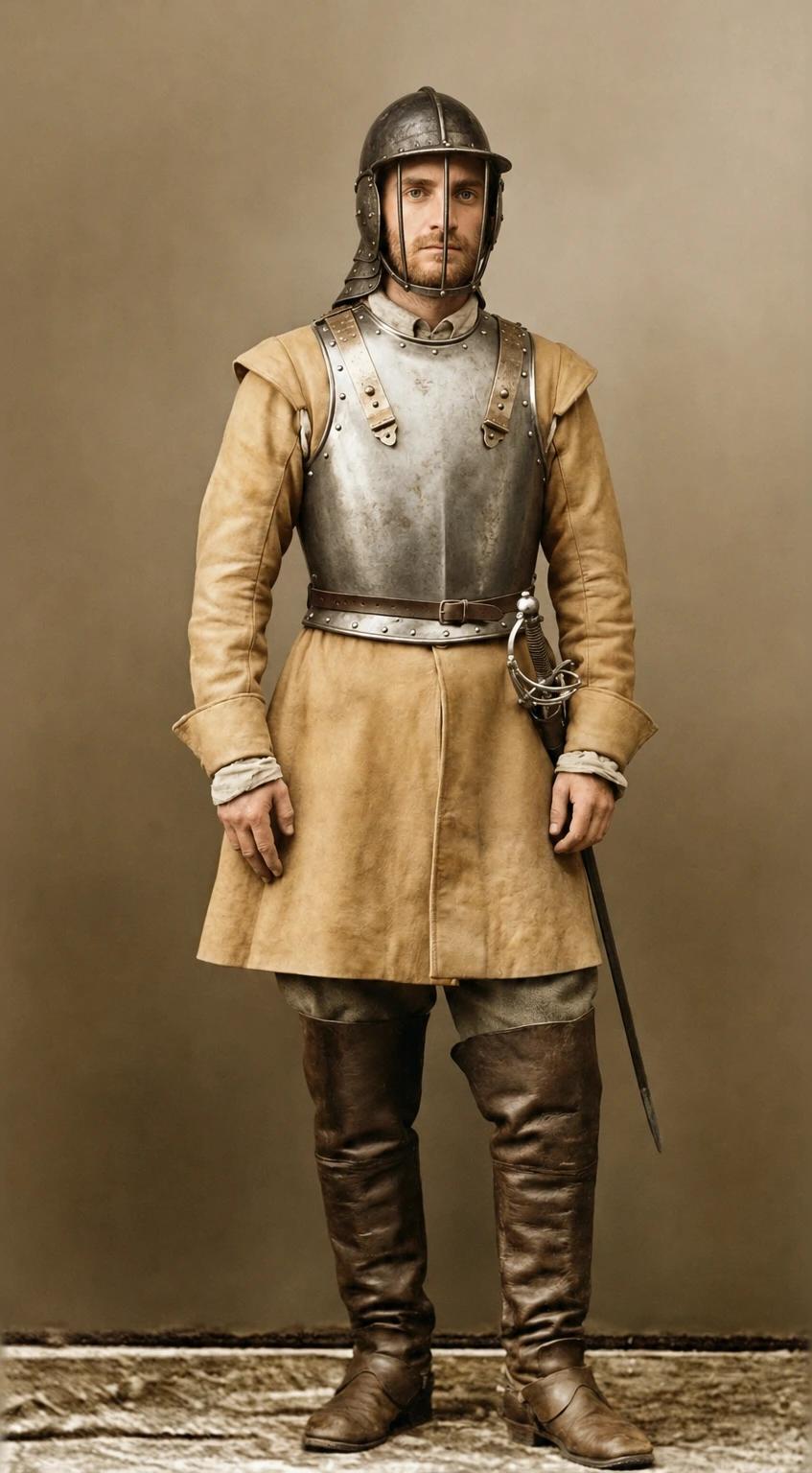
Uniform and equipment
| Uniform | Buff coat, lobster-tail pot helmet, breastplate |
|---|---|
| Dress uniform | Orange sash (Parliament) |
| Headgear | Lobster-tail pot helmet |
| Equipment | Sword, pistols |
| Insignia and standard | Orange sash identifier |
Service record
| First appeared | 1642 |
|---|---|
| Peak strength | Regiment size |
| Recruited from | Religious Volunteers (Puritans) |
| Primary tactic | Disciplined Charge |
| Signature engagement | Battle of Marston Moor (1644) |
| Motto or battle cry | God is our Strength |
| Obsolescence | Restoration of Monarchy |
Timeline
- 1643: Formation of the Eastern Association. Cromwell begins recruiting 'godly men' in East Anglia, prioritizing character and discipline over nobility.
- 1644: Battle of Marston Moor. The unit earns national fame and the moniker 'Ironsides' after defeating Prince Rupert's cavalry.
- 1645: New Model Army Integration. The Ironsides regiments are absorbed as the core cavalry of the newly professionalized national army.
- 1645: Battle of Naseby. The unit delivers the decisive blow that effectively ends the First English Civil War.
- 1649: Campaign in Ireland. Veterans of the unit participate in the brutal conquest of Ireland under Cromwell.
- 1651: Battle of Worcester. The final battle of the Civil Wars; the Ironsides help destroy the last Royalist army.
Battles
Battle of Marston Moor
The engagement where the legend was born. While the Royalist cavalry scattered to loot, Cromwell's troopers broke Prince Rupert's elite horse and rallied to annihilate the infantry. It was here Rupert dubbed Cromwell 'Old Ironsides'.
Battle of Naseby
The death knell of the Royalist cause. The Ironsides routed the opposing wing and, displaying supreme discipline, turned inward to crush the King's infantry center, capturing the royal artillery and baggage.
Battle of Dunbar
Outnumbered and cornered, Cromwell launched a daring pre-dawn cavalry charge. The Ironsides smashed the Scottish lines in a chaotic melee, securing a miraculous victory against overwhelming odds.
Commanders
Oliver Cromwell
A devout Puritan squire who forged a cavalry force of 'men of conscience'. His iron discipline transformed a ragtag militia into the hammer of Parliament, crushing Royalist cavaliers with God on his lips and a sword in his hand.
Henry Ireton
Cromwell's son-in-law and a fierce intellect of the Parliamentarian cause. A brave commander of the left wing at Naseby, he was wounded and captured, only to escape and continue the fight for the Commonwealth.
Tactics
The Dutch Charge
Advancing at a controlled trot rather than a wild gallop, keeping knee-to-knee formation to maximize the weight of impact.
Controlled Aggression
Unlike the Royalists who chased fleeing enemies for plunder, Ironsides were drilled to halt immediately after a charge, reform, and strike the enemy flank.
Point-Blank Volley
Holding pistol fire until the very last moment—often pressing the barrel against the enemy's cuirass—before drawing swords.