
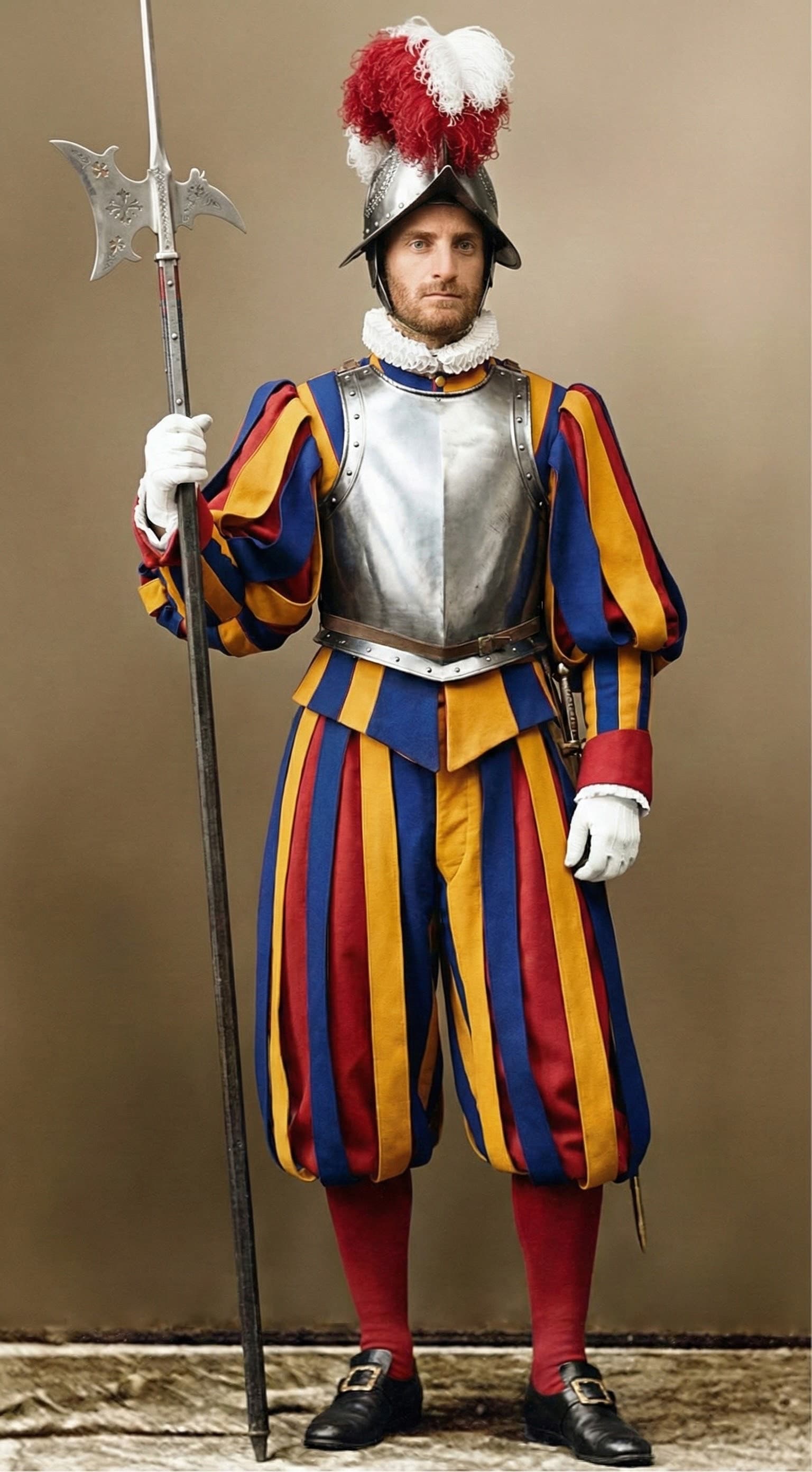
Uniform and equipment
| Uniform | Blue, yellow, red striped Renaissance doublet and hose |
|---|---|
| Dress uniform | Morion-era ceremonial with slashed sleeves |
| Headgear | Morion helmet with red plume (metal or black) |
| Equipment | Halberd, sword, crossbow/arquebus |
| Insignia and standard | Quartered flag with white cross; papal arms + commandant's arms |
Service record
| First appeared | 1506 |
|---|---|
| Peak strength | 200 men |
| Recruited from | Swiss Catholic Volunteers |
| Primary tactic | Halberd Defense |
| Signature engagement | Sack of Rome (1527) |
| Motto or battle cry | Acriter et Fideliter (Fiercely and Faithfully) |
| Obsolescence | N/A (Ceremonial Role Active) |
Timeline
- 1506: Foundation. Pope Julius II welcomes the first 150 Swiss mercenaries, formally establishing the 'Defenders of the Church's Freedom'.
- 1527: The Stand of the 147. The Guard is nearly wiped out defending Clement VII during the Sack of Rome; the anniversary remains the swearing-in date for new recruits.
- 1548: Reconstitution. After the chaos of the wars, the Guard is fully restored to strength under Pope Paul III.
- 1798: Napoleonic Dissolution. French forces invade Rome; the Guard is disarmed and disbanded, with the Pope sent into exile.
- 1870: Fall of Rome. Italian nationalist forces breach Rome. The Swiss Guard prepares to fight but is ordered to stand down by Pius IX to prevent a massacre.
- 1929: Lateran Treaty. Vatican City sovereignty is recognized; the Swiss Guard becomes the sole active military unit of the Holy See.
Battles
Sack of Rome
The Guard's darkest and finest hour. 189 Swiss faced 20,000 mutinous Imperial troops. 147 died holding the steps of St. Peter's, buying time for the Pope to escape via the Passetto. They were annihilated to the last man in the cemetery, but the Pontiff survived.
Battle of Lepanto
While primarily a naval engagement, a detachment of the Swiss Guard served on the Papal flagship. They engaged in brutal close-quarters boarding actions against Ottoman janissaries, defending the banner of the Holy League amidst the chaos of the galleys.
Commanders
Kaspar Röist
The epitome of loyalty. During the Sack of Rome, Röist led the desperate defense at the Teutonic Cemetery. While covering Pope Clement VII's escape to Castel Sant'Angelo, he was wounded and brutally killed by Spanish mercenaries in front of his wife, refusing to yield ground.
Kaspar von Silenen
The first Captain of the Guard. A seasoned mercenary commander who led the original contingent of 150 Swiss soldiers into Rome through the Porta del Popolo, establishing the iron bond between the Swiss Cantons and the Holy See.
Tactics
Halberd Wall
A static defensive formation used to block narrow corridors and gates. The reach of the halberds creates an impenetrable zone of death for anyone attempting to rush the position.
Extraction Screen
A fighting retreat tactic where guardsmen form a moving perimeter around the VIP (the Pope), sacrificing the rearguard to ensure the principal reaches safety (e.g., the Passetto di Borgo).
Pike Square (Gewalthaufen)
Though rarely used in the tight confines of the Vatican, the Guard was trained in the traditional Swiss mercenary square, capable of repelling cavalry charges in open piazzas.