
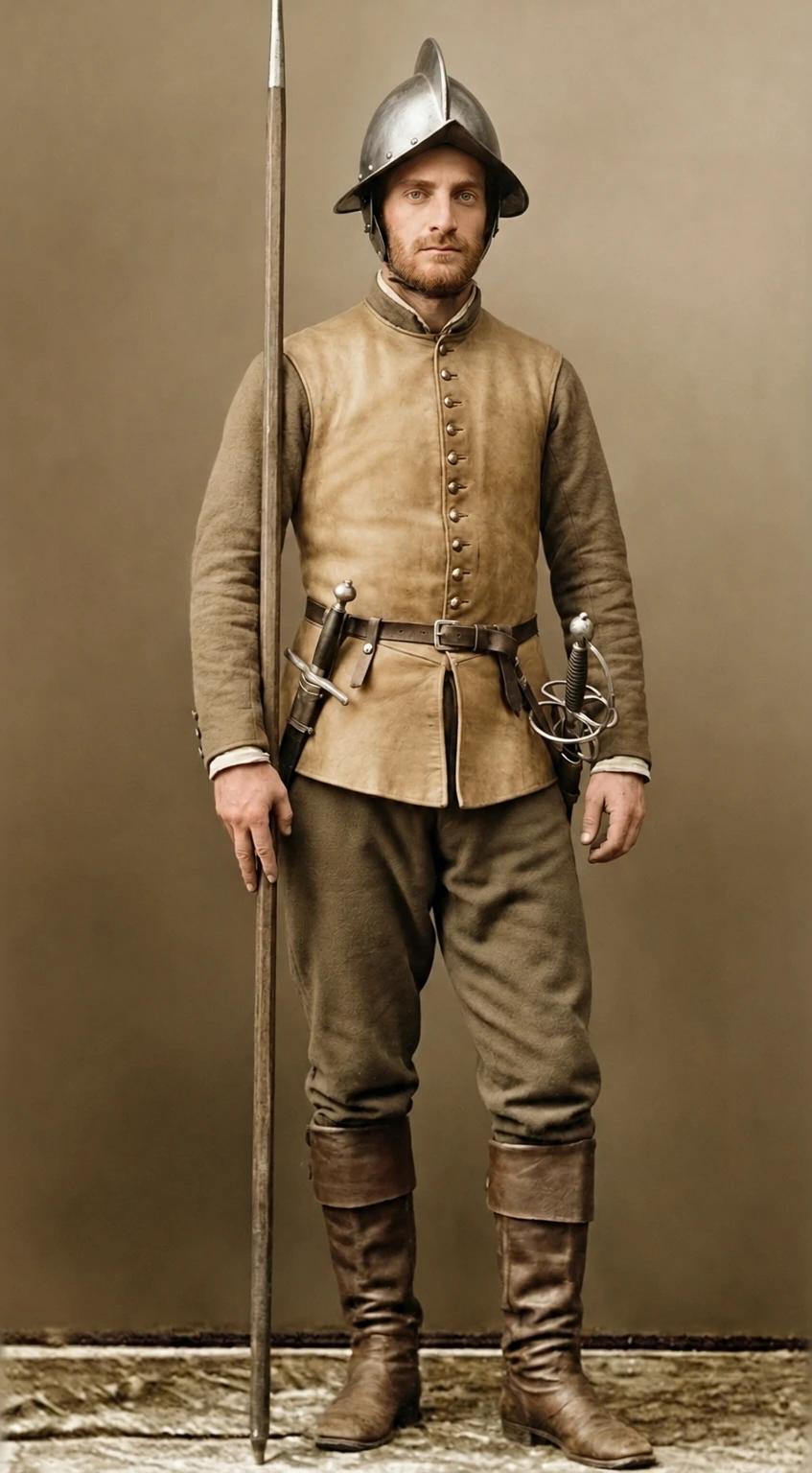
Uniform and equipment
| Uniform | Yellow/Red slashed doublets, wide hats, hose |
|---|---|
| Dress uniform | Elaborate silks, feathers, Burgundy Cross flags |
| Headgear | Morion helmet or wide-brimmed hat |
| Equipment | Pike, arquebus/musket, sword (Toledo steel) |
| Insignia and standard | Cross of Burgundy ragged saltire |
Service record
| First appeared | 1534 |
|---|---|
| Peak strength | ~3,000 per tercio |
| Recruited from | Volunteers (Professional Soldiers) |
| Primary tactic | Combined Pike & Shot |
| Signature engagement | Battle of Rocroi (1643) |
| Motto or battle cry | Santiago y cierra España! (St. James, strike and drive out Spain's enemies!) |
| Obsolescence | Linear Tactics / Rocroi Defeat |
Timeline
- 1534: Ordinance of Genoa. Official administrative creation of the Tercios (Tercio of Naples, Sicily, and Lombardy), organizing companies into massive distinct units.
- 1567: March of the Iron Duke. The Duke of Alba marches the Tercios from Italy to Flanders via the 'Spanish Road', beginning a long presence in the Low Countries.
- 1585: Miracle of Empel. Trapped by water and ice, a Tercio prays to the Immaculate Conception and escapes when the river freezes overnight, defeating the Dutch fleet.
- 1643: Defeat at Rocroi. The aura of invincibility is broken by the French, marking the beginning of the transition away from massive pike squares.
- 1704: Dissolution. King Philip V reorganizes the Spanish army into regiments following the French model, officially ending the era of the Tercios.
Battles
Battle of Pavia
The dawn of imperial dominance. Spanish arquebusiers shattered the legendary French Gendarmerie cavalry in a hunting park, capturing King Francis I. It proved that disciplined firepower and pikes could humble the aristocracy of Europe.
Battle of Gembloux
A tactical masterpiece where the Spanish cavalry and Tercios annihilated a Dutch rebel army in under two hours. It demonstrated the terrifying aggression of the veteran units when unleashed against less disciplined troops.
Battle of Nördlingen
The Tercios held the hill against repeated Swedish assaults during the Thirty Years' War. Their immovability broke the back of Protestant power in Germany, reaffirming the reputation of the Spanish infantry as the finest in the world.
Battle of Rocroi
The sun sets on invincibility. Surrounded by French artillery and cavalry, the veteran Tercios refused to surrender, dying in their ranks. While a defeat, their disciplined last stand became the stuff of tragic legend.
Commanders
Fernando Álvarez de Toledo
The 'Iron Duke' of Alba. A disciplinarian of terrifying resolve, he marched the Tercios along the Spanish Road to crush the Dutch Revolt. His tactical genius was matched only by his ruthlessness, embodying the unyielding nature of the Spanish infantry.
Gonzalo Fernández de Córdoba
The 'Great Captain'. Though predating the official 1534 ordinance, his reforms in the Italian Wars created the template for the Tercio. He shifted reliance from cavalry to professional infantry, combining firearms with pikes to dominate the battlefield.
Alessandro Farnese
Duke of Parma. A master of logistics and siege warfare, he revitalized the Spanish cause in the Low Countries. Known for leading from the front and engineering complex river crossings, he turned the Tercios into a precision instrument of reconquest.
Tactics
The Bastioned Square
A fortress of flesh and steel. Pikemen formed a hollow square to protect the colors, while musketeers at the corners (mangas) rotated fire to keep enemies at bay.
Encamisada
A nocturnal commando raid where soldiers wore white shirts over their armor to identify comrades in the dark while sabotaging enemy camps.
Countermarch
Ranks of arquebusiers would fire and retreat to the rear to reload, allowing the next rank to fire, creating a continuous rolling volley.
Push of Pike
When squares collided, the front ranks locked pikes in a shoving match of brute force and stabbing, often decided by the swordsmen slipping underneath.