
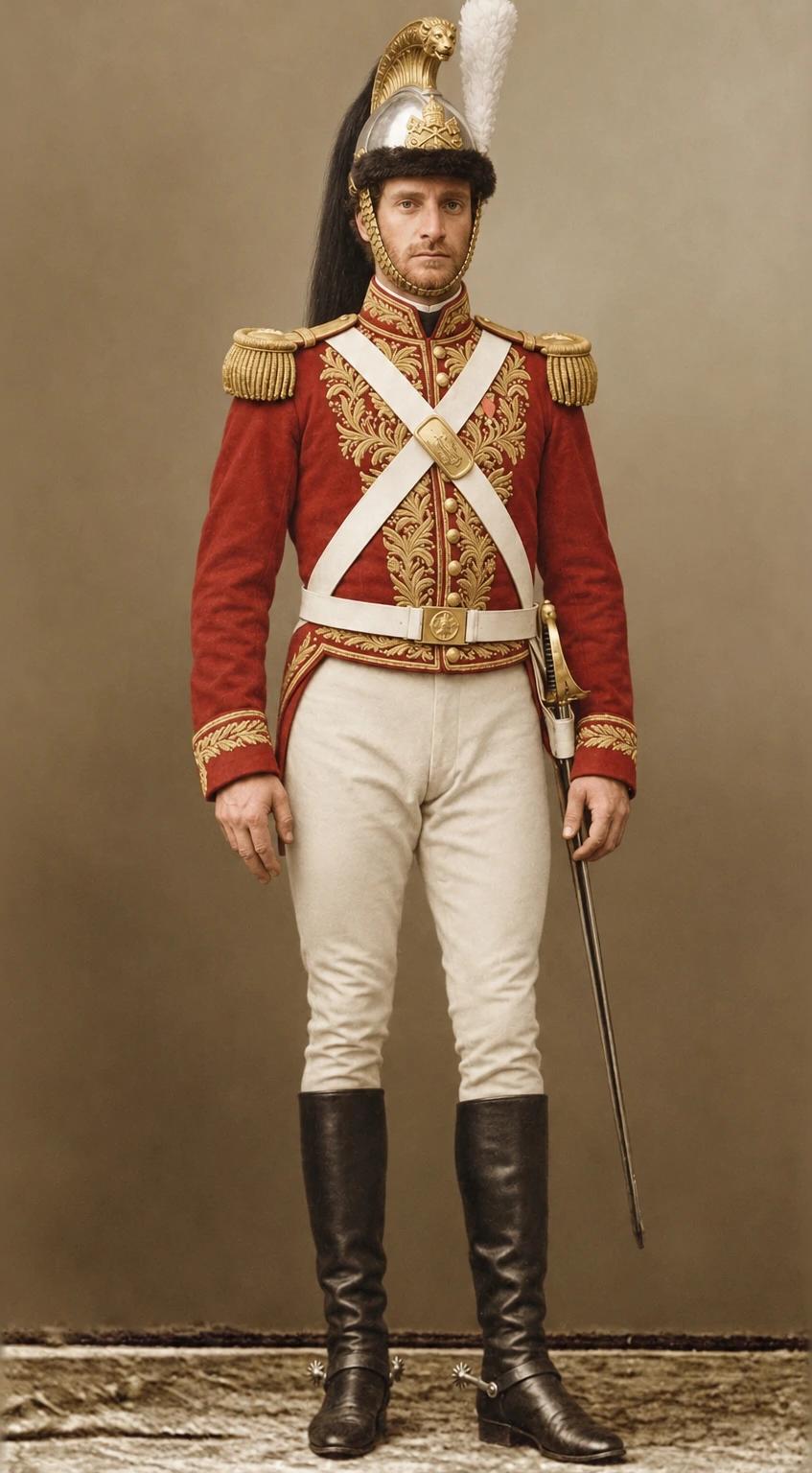
Uniform and equipment
| Uniform | Dark blue tailcoat with red cuffs, breeches, riding boots |
|---|---|
| Dress uniform | Red and blue with gold lace, white gloves, sashes |
| Headgear | Silver cuirassier-style helmet with gilt comb and black horsehair tail |
| Equipment | Sword, sometimes carbine for field service |
| Insignia and standard | Gold Papal Cross on helmet/epaulettes |
Service record
| First appeared | 1801 |
|---|---|
| Peak strength | ~100 men |
| Recruited from | Roman Aristocracy |
| Primary tactic | Personal Bodyguard |
| Signature engagement | Protection of Pope Pius VII |
| Motto or battle cry | Fidelitas et Virtus (Fidelity and Virtue) |
| Obsolescence | Reforms of Paul VI (1970) |
Timeline
- 1801: Formation. Pope Pius VII establishes the Guardia Nobile by merging the Cavalleggeri and the Lance Spezzate into a premier aristocratic bodyguard.
- 1809: Dissolution by France. Following the Napoleonic occupation of Rome, the unit is forcibly disbanded, and its members are stripped of their arms.
- 1816: Reconstitution. With the defeat of Napoleon and the return of the Pope, the Guard is reformed with renewed fervor and stricter entry requirements.
- 1870: Loss of Temporal Power. The capture of Rome by Italian forces ends the Guard's role as a field military unit; they become a palace guard for the Vatican.
- 1970: Abolition. Pope Paul VI disbands the Noble Guard as part of church modernizations, ending nearly two centuries of service.
Battles
Siege of the Quirinal
When Napoleonic forces stormed the Quirinal Palace, the Noble Guard stood their ground in the antechambers. Though disarmed by overwhelming French numbers, their refusal to abandon Pius VII marked a moral victory, cementing their reputation for absolute fidelity.
Flight to Gaeta
Amidst the chaos of the Roman Republic revolution, the Guard successfully orchestrated the covert extraction of Pope Pius IX. Disguised and moving through hostile territory, they delivered the Pontiff safely to the fortress of Gaeta, preserving the Papacy in exile.
Fall of Rome
As Italian troops breached Porta Pia, the Noble Guard manned the Vatican's defenses. Pope Pius IX ordered a cease-fire to prevent bloodshed, but the Guard remained at attention, swords drawn, transitioning from a field army to the 'Prisoners of the Vatican' alongside their Pope.
Commanders
Prince Paluzzo Altieri
The first Commandant of the Guard, Altieri was a scion of Roman nobility who set the standard for the unit's unwavering loyalty. He organized the initial corps from the dissolved Cavalleggeri, instilling a code of honor that prioritized the Pontiff's safety above aristocratic privilege.
Prince Camillo Rospigliosi
Serving during the tumultuous mid-19th century, Rospigliosi commanded the Guard during the rise of Italian nationalism. He maintained the unit's discipline and readiness as the temporal power of the Church crumbled, ensuring the Guard remained a formidable symbolic shield.
Tactics
The Inner Cordon
A defensive formation where Guardsmen physically shielded the Pope's body with their own, swords drawn, serving as the last line of defense against assassination.
Mounted Escort
Flanking maneuvers used during Papal processions to prevent the crowd from approaching the carriage, using the size of their horses to intimidate and push back mobs.
Static Intimidation
The use of rigid, motionless posture and resplendent uniform to project authority and deter aggression without engaging in active combat.