
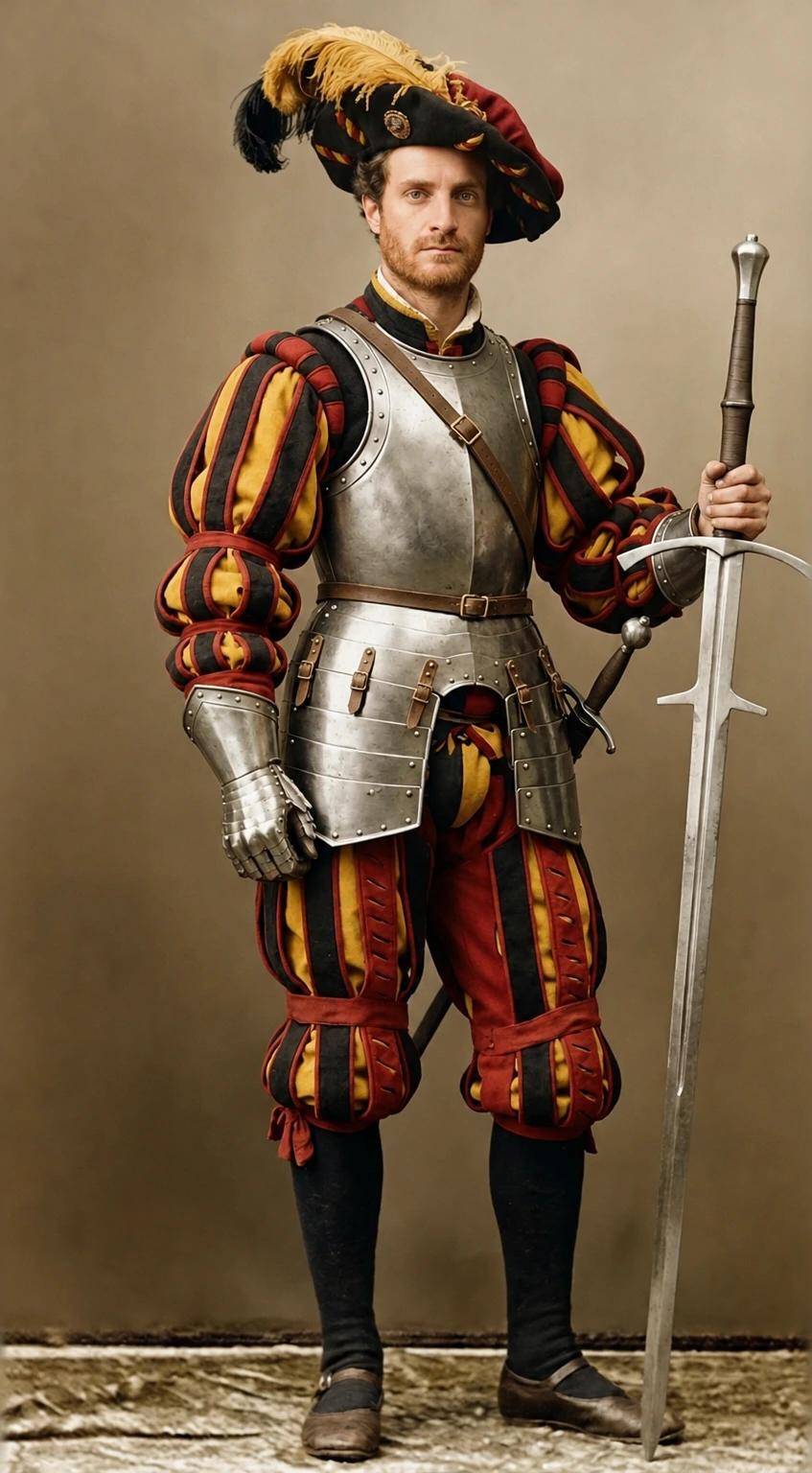
Uniform and equipment
| Uniform | Even more elaborate than regular Landsknechts, huge ribbons |
|---|---|
| Dress uniform | Silk and velvet, gold chains |
| Headgear | Elaborate plumed beret or bare head |
| Equipment | Zweihänder (two-handed sword), full armor |
| Insignia and standard | None (shared Landsknecht insignia) |
Service record
| First appeared | 1500s |
|---|---|
| Peak strength | 5,000 men |
| Recruited from | Veteran Mercenaries |
| Primary tactic | Breaking Pike Formations |
| Signature engagement | Battle of Pavia (1525) |
| Motto or battle cry | Gelt! Gelt! (Money! Money!) |
| Obsolescence | Dominance of Muskets |
Timeline
- 1486: Formation. Maximilian I establishes the first Landsknecht regiments, modeling them after the Swiss Reisläufer but adding German tactical innovations.
- 1499: Swabian War. Early engagements prove the worth of the Landsknechts, though they struggle against the Swiss masters of the pike.
- 1519: Imperial Election. Landsknecht units, paid by the Fugger bankers, secure the election of Charles V as Holy Roman Emperor.
- 1525: Triumph at Pavia. The unit achieves legendary status by defeating the French Gendarmes and Swiss pikemen, proving the efficacy of the combined arms approach.
- 1570: Tactical Obsolescence. As firearms improve, the utility of the great sword declines. Doppelsöldner transition to guarding colors or serving as elite halberdiers.
Battles
Battle of Marignano
A brutal 'Battle of Giants' against their arch-rivals, the Swiss Mercenaries. Though defeated by the arrival of Venetian allies, the Landsknecht Doppelsöldner fought with suicidal bravery, holding the line against overwhelming odds in a carnage of pike and sword.
Battle of Pavia
The zenith of Landsknecht power. In the misty dawn, Doppelsöldner units helped shatter the French heavy cavalry and Swiss pikemen. Their ferocity led to the capture of King Francis I, cementing the dominance of the Holy Roman Empire in Italy.
Sack of Rome
Starving and unpaid, the Landsknechts defied orders and stormed the Eternal City. The Doppelsöldner led the assault on the walls. While a military success, the ensuing looting and destruction left a dark stain on their historical legacy.
Commanders
Pier Gerlofs Donia
The 'Cross of the Dutchman,' Grutte Pier was a Frisian rebel and pirate of legendary stature. While not a traditional Landsknecht officer, he embodies the raw power of the Zweihänder-wielding giant, famously beheading multiple foes in a single swing with his 7-foot sword.
Georg von Frundsberg
Known as the 'Father of the Landsknechts,' Frundsberg was a tactical genius who instilled the fierce esprit de corps in the German mercenary regiments. A imposing figure who led from the front, he commanded the loyalty of the Doppelsöldner through shared hardship and spectacular victories.
Tactics
Gasse Schlagen
Translating to 'Beating the Lane,' Doppelsöldner swung great swords in wide arcs to chop the heads off enemy pikes, creating gaps for comrades to exploit.
Verlorene Haufen
The 'Forlorn Hope.' Doppelsöldner volunteered to stand in the front rank of the pike square, accepting near-certain death for glory and double wages.
Standard Guard
Veterans formed a defensive ring around the regiment's Fähnrich (ensign), swearing to die before letting the colors fall.