
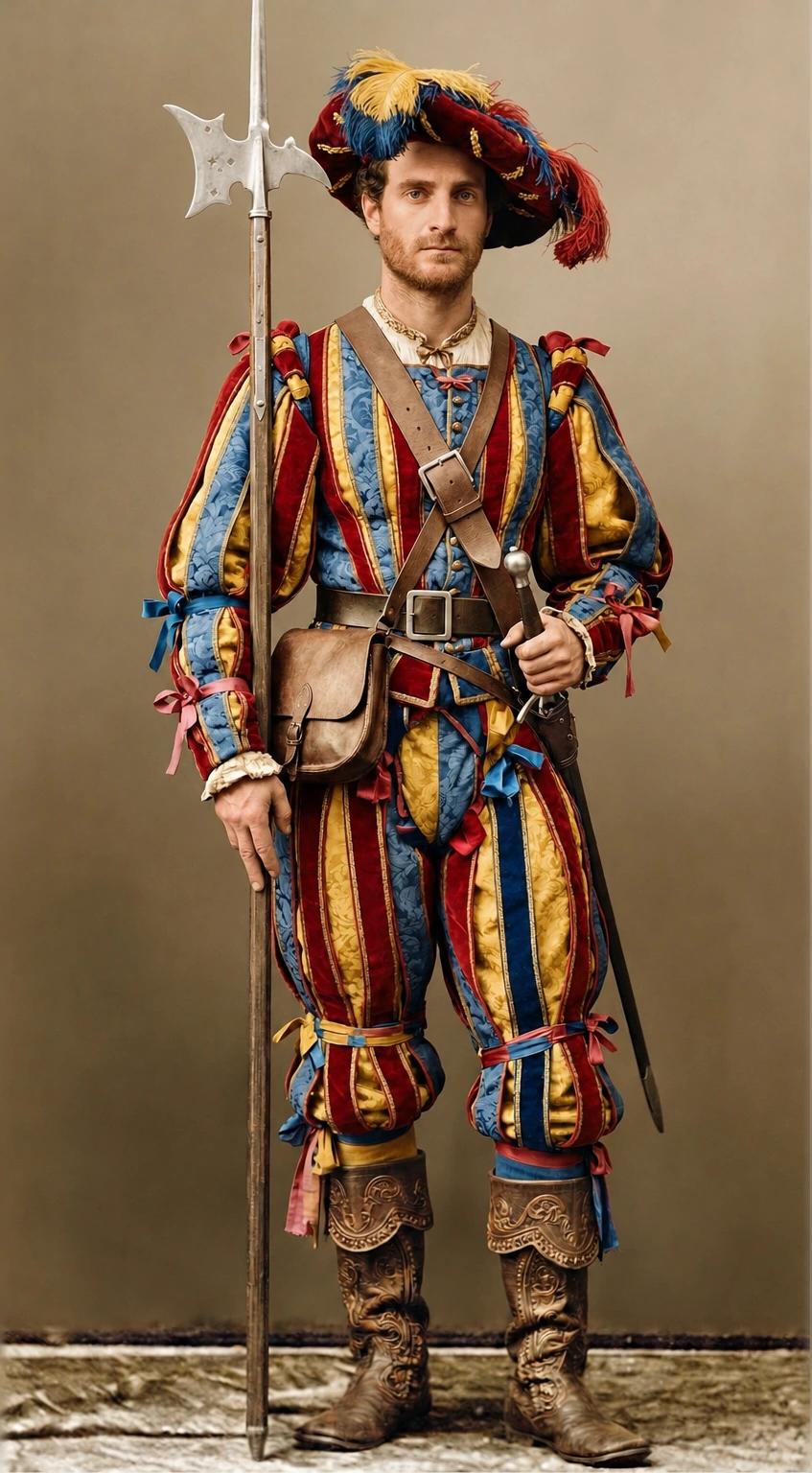
Uniform and equipment
| Uniform | Slashed doublets, striped multicolored hose, codpieces |
|---|---|
| Dress uniform | Even more elaborate slashing, silk and velvet |
| Headgear | Massive plumed berets, various angles |
| Equipment | Pike, zweihänder (some), katzbalger sword |
| Insignia and standard | Burgundian Cross (red ragged saltire) |
Service record
| First appeared | 1480s |
|---|---|
| Peak strength | 30,000 men |
| Recruited from | Mercenary Volunteers |
| Primary tactic | Pike Square (Gevierthaufen) |
| Signature engagement | Battle of Pavia (1525) |
| Motto or battle cry | Gelt, Gelt! (Money, Money!) |
| Obsolescence | Professional Standing Armies |
Timeline
- 1487: Formation. Maximilian I establishes the first Landsknecht regiments, modeled after the Swiss mercenaries but loyal to the House of Habsburg.
- 1519: Imperial Election. Landsknecht armies secure the election of Charles V as Holy Roman Emperor, cementing their political importance.
- 1525: Peak Dominance. Following the victory at Pavia, the Landsknechts are recognized as the dominant infantry force in Europe.
- 1527: The Sack of Rome. The mutiny and sack mark the height of their power but also the beginning of the end for the uncontrolled mercenary system.
- 1570: Standardization. As national armies begin to professionalize and firearms improve, the unique culture and tactical dominance of the Landsknechts fade into history.
Battles
Battle of Marignano
The 'Battle of Giants'. The Landsknechts fought ferociously but were ultimately bested by the French artillery and Venetian cavalry. It was a bloody lesson that spurred tactical reforms.
Battle of Bicocca
A tactical masterpiece where Landsknecht arquebusiers and pikes decimated the charging Swiss Reisläufer. This battle marked the decline of the Swiss pike square and the ascendancy of German combined arms.
Battle of Pavia
The Landsknechts' magnum opus. Frundsberg's men crushed the French Gendarmes and captured King Francis I. Their discipline in the face of heavy cavalry cemented their reputation as the premier infantry of Europe.
Sack of Rome
Starving and unpaid, the Landsknechts mutinied and stormed the Eternal City. While a military success, the ensuing brutal pillage highlighted the dangerous volatility of the mercenary system.
Commanders
Götz von Berlichingen
The 'Iron Hand'. A quintessential mercenary knight who fought alongside and led Landsknecht bands. Famous for his prosthetic iron hand and his memoir, he embodied the rough, independent spirit of the German mercenary class.
Georg von Frundsberg
Known as the 'Father of the Landsknechts', Frundsberg was a titan of loyalty and tactical innovation. He served the Habsburgs faithfully, molding the Landsknechts into a disciplined force capable of breaking the Swiss monopoly on pike warfare.
Sebastian Schertlin von Burtenbach
A brilliant tactician and Protestant leader who rose from common ranks to command vast armies. He famously led the Landsknechts during the Sack of Rome, demonstrating the terrifying effectiveness of these troops when unleashed.
Tactics
Gevierthaufen (Square)
A massive, deep square formation of pikemen, sometimes numbering 4,000 men. It was a moving fortress, bristling with pikes to repel cavalry and crush infantry.
Verlorene Haufen (Forlorn Hope)
A suicide squad of Doppelsöldner wielding two-handed swords and arquebuses, deployed in front of the main square to disrupt enemy lines before the main impact.
Bad War
When fighting their rivals, the Swiss Reisläufer, no quarter was given or taken. Prisoners were routinely executed, making these engagements exceptionally bloody.