
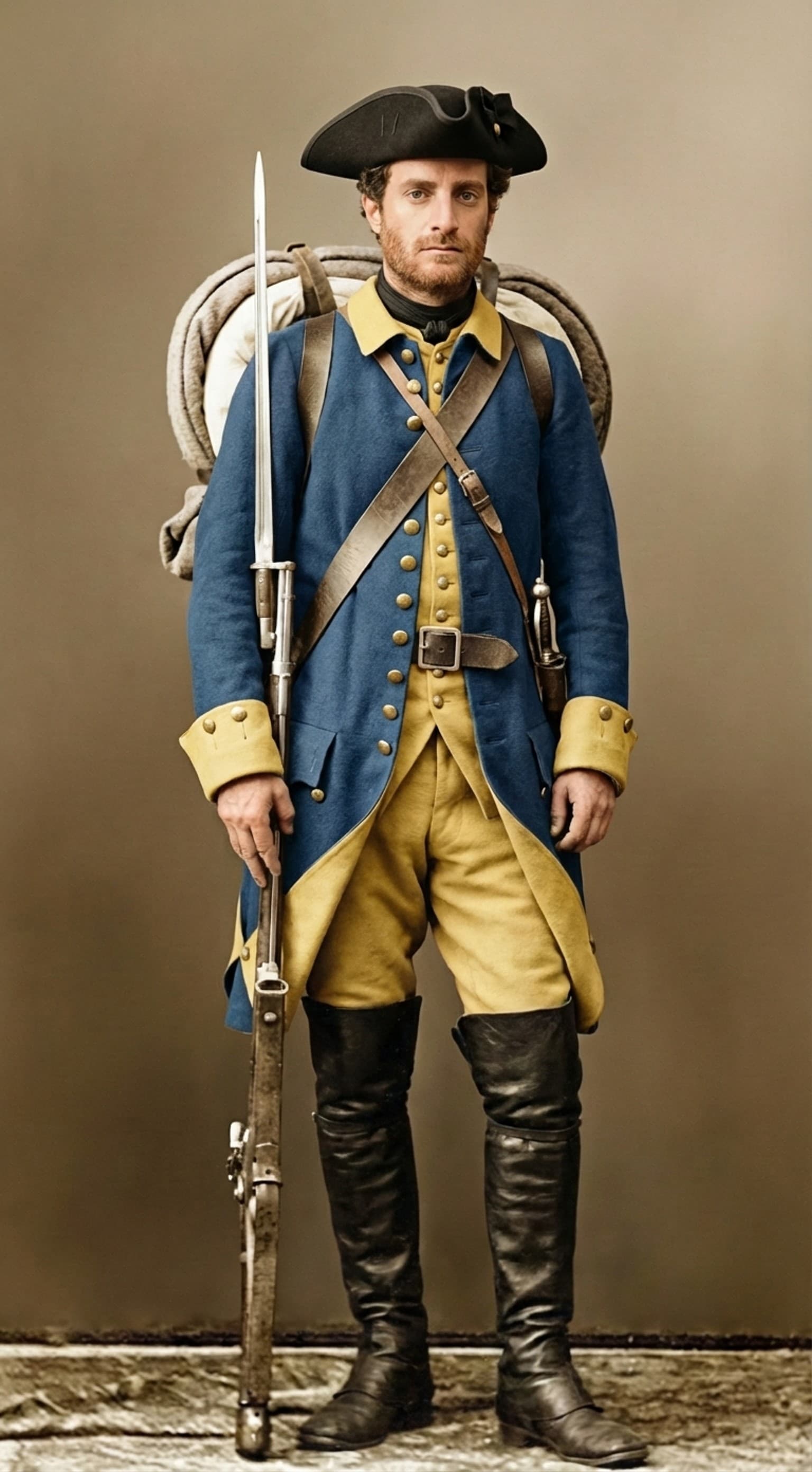
Uniform and equipment
| Uniform | Dark blue coats with yellow facings, knee-breeches |
|---|---|
| Dress uniform | Finely tailored blue coats with rich yellow cuffs and lapels |
| Headgear | Tricorn hats with cockade; officers with plumes and metal gorgets |
| Equipment | Flintlock musket and bayonet, sword; cavalry with sabres and pistols |
| Insignia and standard | Royal cypher 'CC' crowned on flags/uniform |
Service record
| First appeared | 1690s |
|---|---|
| Peak strength | 60,000 men |
| Recruited from | Allotment System (Indelta) |
| Primary tactic | Gå På (Aggressive Offensive) |
| Signature engagement | Battle of Narva (1700) |
| Motto or battle cry | Gud med oss (God with us) |
| Obsolescence | Battle of Poltava / Loss of Empire |
Timeline
- 1680: Establishment of the Allotment System. Charles XI reforms the military, creating a standing army of professional soldiers supported by local farms, the foundation of the Carolean force.
- 1700: Outbreak of the Great Northern War. Denmark, Poland-Lithuania, and Russia attack Sweden. The Caroleans mobilize and win the stunning Battle of Narva.
- 1706: Treaty of Altranstädt. Following the victory at Fraustadt, Charles XII forces Augustus II to renounce the Polish throne, marking the zenith of Swedish power.
- 1708: Invasion of Russia. The Grand Army marches east toward Moscow, facing scorched earth tactics and the coldest winter in memory.
- 1709: Surrender at Perevolochna. Days after the disaster at Poltava, the remnants of the army surrender, sending thousands of Caroleans into Siberian captivity.
- 1718: Death of Charles XII. The King is shot during the siege of Fredriksten in Norway. The offensive spirit dies with him.
- 1719: The Carolean Death March. General Armfeldt's army retreats from Norway over the mountains during a blizzard; 3,000 soldiers freeze to death.
- 1721: Treaty of Nystad. The war officially ends. Sweden loses its Baltic territories, marking the end of the Carolean era and Sweden as a Great Power.
Battles
Battle of Narva
Outnumbered four to one, the Caroleans attacked under the cover of a blinding blizzard. They breached the Russian entrenchments with terrifying speed, capturing the entire enemy artillery train and forcing a surrender in one of history's greatest upsets.
Battle of Fraustadt
Rehnskiöld's masterpiece. Facing a superior Saxon-Russian force, the Swedish cavalry executed a pincer movement while the infantry feigned weakness, collapsing the enemy flanks in a textbook double envelopment that annihilated the opposing army.
Battle of Poltava
The death knell of the Swedish Empire. Starved, outnumbered, and with the King wounded, the Caroleans launched a desperate assault against Peter the Great's fortified lines. The ensuing massacre broke the backbone of the Swedish army.
Battle of Helsingborg
A critical defensive battle where Stenbock's raw recruits, fighting on home soil, utilized the aggressive 'Gå På' tactics to drive the Danish invasion force back into the sea, proving the enduring efficacy of the Carolean doctrine.
Commanders
Charles XII
Known as the 'Lion of the North,' he was the warrior-king who personified the Carolean spirit. Ascending the throne at 15, he led his men from the front lines, eschewing luxury for the hardships of the field. His refusal to compromise defined the era.
Magnus Stenbock
A charismatic leader and defender of the homeland. While the King campaigned in Russia, Stenbock raised a ragtag army of peasants and remnants to crush the Danish invasion at Helsingborg, saving Sweden from total partition.
Carl Gustaf Rehnskiöld
Charles XII's most trusted field marshal and a tactical genius. He orchestrated the crushing victory at Fraustadt using a double envelopment maneuver. A master of logistics and cavalry warfare, he served as the pragmatic anchor to the King's aggressive ambition.
Tactics
Gå På ('Go On')
An hyper-aggressive doctrine requiring infantry to march silently into enemy fire without halting, firing a salvo only at point-blank range (10-20 meters) before charging with bayonets and swords.
The Cavalry Wedge
Cavalry formed tight, knee-to-knee wedge formations. Unlike other European cavalry that used pistol caracoles, Caroleans were forbidden to fire, relying entirely on the shock of the sword charge at full gallop.
Combined Arms Shock
Artillery, infantry, and cavalry acted in unison to break the enemy center. The infantry shock created gaps that the cavalry immediately exploited with cold steel.