
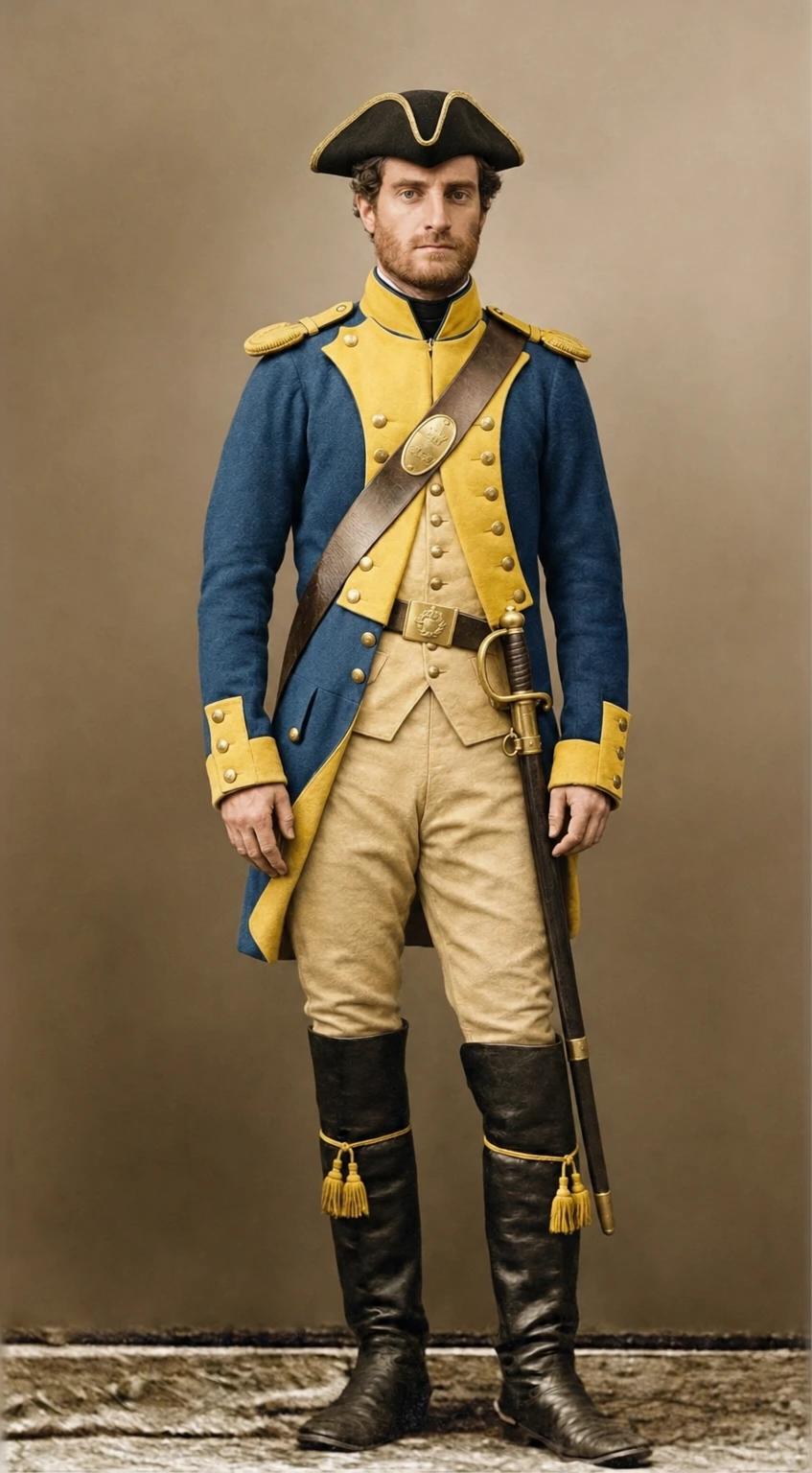
Uniform and equipment
| Uniform | Blue coat with yellow facings, gold lace |
|---|---|
| Dress uniform | Blue and yellow with extensive gold |
| Headgear | Black tricorne with gold lace |
| Equipment | Straight broadsword, pair of flintlock pistols, carbine |
| Insignia and standard | Royal monogram embroidered on chest |
Service record
| First appeared | 1521 |
|---|---|
| Peak strength | 150 men |
| Recruited from | Hand-picked Officers |
| Primary tactic | Close Protection / Shock |
| Signature engagement | Battle of Narva (1700) |
| Motto or battle cry | Gud med oss (God with us) |
| Obsolescence | Changes in Court Ceremony |
Timeline
- 1700: Reorganization. Charles XII reforms the Drabant Corps into an elite unit where every private holds the rank of an officer (Corporal or higher).
- 1700: Battle of Narva. The unit achieves legendary status by routing the Russian army in a blizzard.
- 1702: Polish Campaign. The Trabants serve as the vanguard in the invasion of Poland-Lithuania.
- 1708: Battle of Holowczyn. Charles XII's favorite victory; the Trabants display peak efficiency in difficult terrain.
- 1709: Disaster at Poltava. The corps is decimated covering the King's retreat; the majority are killed or captured.
- 1713: Skirmish at Bender. The 'Kalabalik at Bender'; a handful of surviving Trabants defend the King against Ottoman forces in a house siege.
- 1718: Death of the King. Charles XII is killed at Fredriksten; the Drabant Corps loses its primary purpose and status as a combat shock unit.
Battles
Battle of Narva
In a blinding snowstorm, the Trabants spearheaded the assault against a vastly superior Russian force. Acting as the tip of the Swedish spear, they shattered the Russian lines in close-quarters combat, securing a legendary victory against 4-to-1 odds.
Battle of Kliszów
The Trabants executed a decisive charge against the Saxon cavalry. Despite facing heavy fire, they closed the distance rapidly, breaking the enemy morale with cold steel and securing Charles XII's dominance in Poland.
Battle of Poltava
The graveyard of the Swedish Empire. With the King wounded and carried on a litter, the Trabants fought with desperate ferocity to protect him from capture, suffering catastrophic casualties as the army collapsed around them.
Commanders
Charles XII
The 'Carolus Rex' and Captain of the Drabant Corps. A warrior-king who eschewed courtly luxury for the mud of the camp. He led his Trabants personally into the thickest fire, demanding absolute fearlessness and aggressive shock tactics from his elite bodyguard.
Arvid Horn
A hardened tactician and Lieutenant-Captain of the Drabants. Horn was the steel spine of the unit during the early campaigns of the Great Northern War, famous for his disciplined leadership during the crossing of the Düna and the initial charges at Narva.
Tactics
Gå På (Go On)
An ultra-aggressive doctrine requiring the unit to close with the enemy as fast as possible, ignoring incoming fire to deliver a psychological and physical shock.
Cold Steel Charge
Unlike other cavalry that halted to fire carbines, Trabants charged at a full gallop with swords drawn, using pistols only at the moment of impact.
The King's Shield
In chaotic melees, the unit formed a tight, impenetrable perimeter around Charles XII, sacrificing themselves to intercept blows meant for the monarch.