
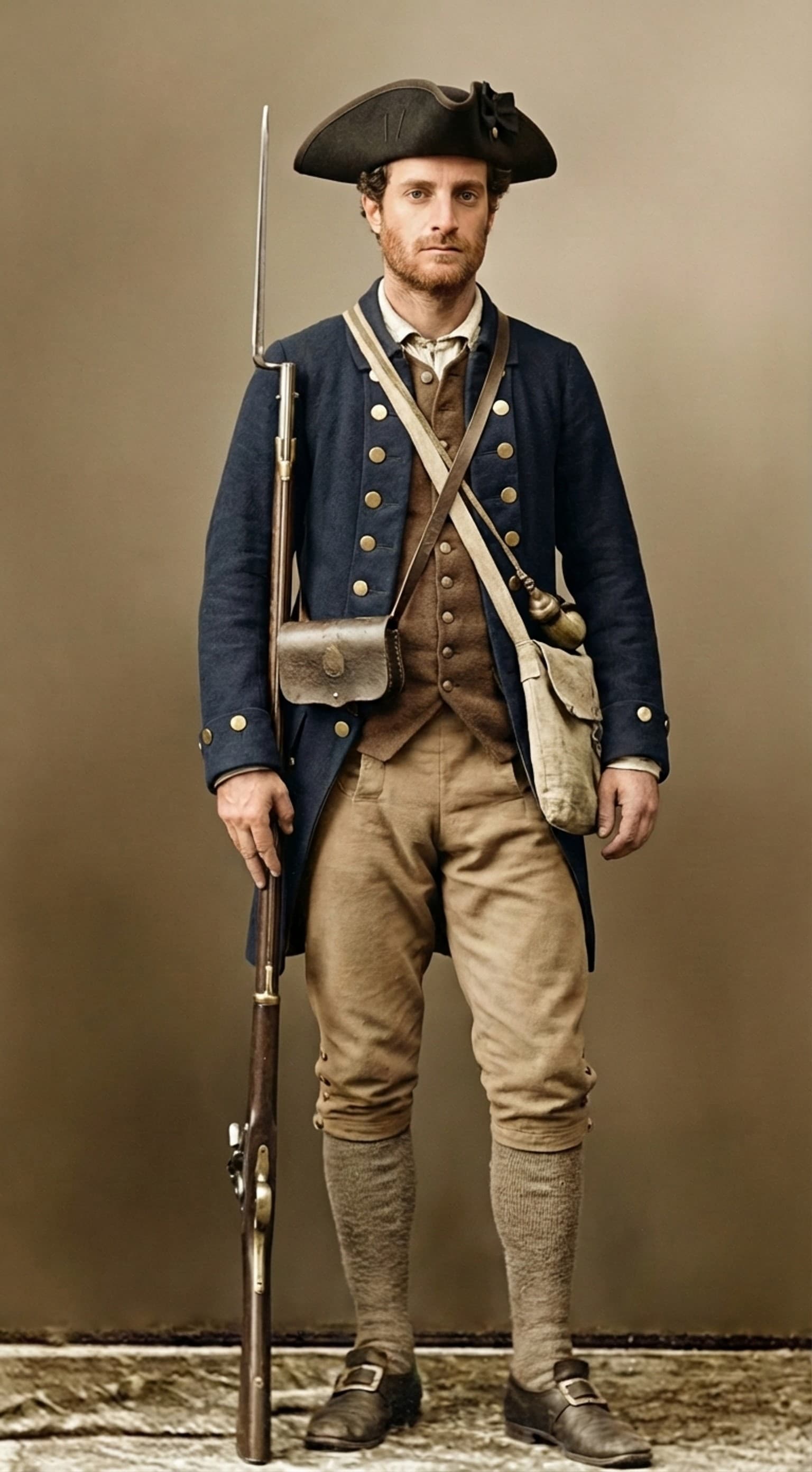
Uniform and equipment
| Uniform | Civilian clothes, hunting shirts |
|---|---|
| Dress uniform | N/A |
| Headgear | Tricorn hat |
| Equipment | Musket (fowling piece), powder horn |
| Insignia and standard | None (civilian militia) |
Service record
| First appeared | 1774 |
|---|---|
| Peak strength | Local companies |
| Recruited from | Civilian Farmers |
| Primary tactic | Skirmish / Ambush |
| Signature engagement | Battles of Lexington and Concord (1775) |
| Motto or battle cry | Liberty or Death! |
| Obsolescence | Continental Army formation |
Timeline
- 1645: Early Formation. Massachusetts Bay Colony establishes 'alarm companies' drawn from local militia to respond rapidly to attacks.
- 1774: Worcester Convention. Patriots urge the resignation of British-appointed officials and the reorganization of militia into specialized 'minute' companies.
- 1774: Provincial Congress Resolution. Massachusetts Provincial Congress officially recommends that 25% of the militia be ready to march at a minute's notice.
- 1775: The Powder Alarm. British seizure of gunpowder in Somerville triggers a massive, though bloodless, mobilization of thousands of Minutemen.
- 1775: Lexington and Concord. The unit type achieves legendary status by engaging British Regulars, initiating the American Revolutionary War.
- 1776: Integration and Disbandment. As the Continental Army professionalizes under Washington, the specific 'Minuteman' designation fades, with men joining the regular line or reverting to standard militia.
Battles
Battle of Lexington
The opening engagement of the war. Captain Parker's company stood in a symbolic show of force on the village green. Overwhelmed by British regulars, the militia suffered casualties and dispersed, marking the first bloodshed of the Revolution.
Battle of Concord
At the North Bridge, Minutemen and militia returned British fire for the first time under orders (
Battle of Menotomy
The bloodiest phase of the British retreat. Minutemen ambushed the column from houses and stone walls. It became a brutal, close-quarters fight involving bayonets and clubbed muskets, inflicting heavy losses on the exhausted British forces.
Commanders
John Parker
A veteran of the French and Indian War and a farmer by trade. Despite suffering from tuberculosis, he commanded the Lexington militia on April 19, 1775. He famously ordered his men to stand their ground but not to fire unless fired upon, sparking the revolution.
Isaac Davis
A gunsmith and Captain of the Acton Minutemen. Known for his meticulous attention to his men's equipment, he led the advance at the North Bridge in Concord. He was the first American officer killed in the war, shot through the heart while declaring, "I haven't a man that's afraid to go."
William Heath
A farmer and self-taught tactician who organized the Massachusetts militia. He directed the running battle during the British retreat from Concord, orchestrating the circle of fire that decimated the Regulars using loose skirmish tactics.
Tactics
Alarm Riders
A sophisticated network of riders, bells, and beacon fires designed to muster companies from surrounding towns within hours of a threat detection.
Skirmish Line
Fighting in loose, open order rather than rigid ranks, allowing individual marksmen to utilize terrain for cover and concealment.
Enfilade Ambush
Positioning behind stone walls and trees along a road to fire into the flanks of a marching column, creating a 'gauntlet of fire'.
Asymmetrical Harassment
Avoiding pitched battles in open fields against superior British firepower, preferring hit-and-run attacks to wear down the enemy mentally and physically.