
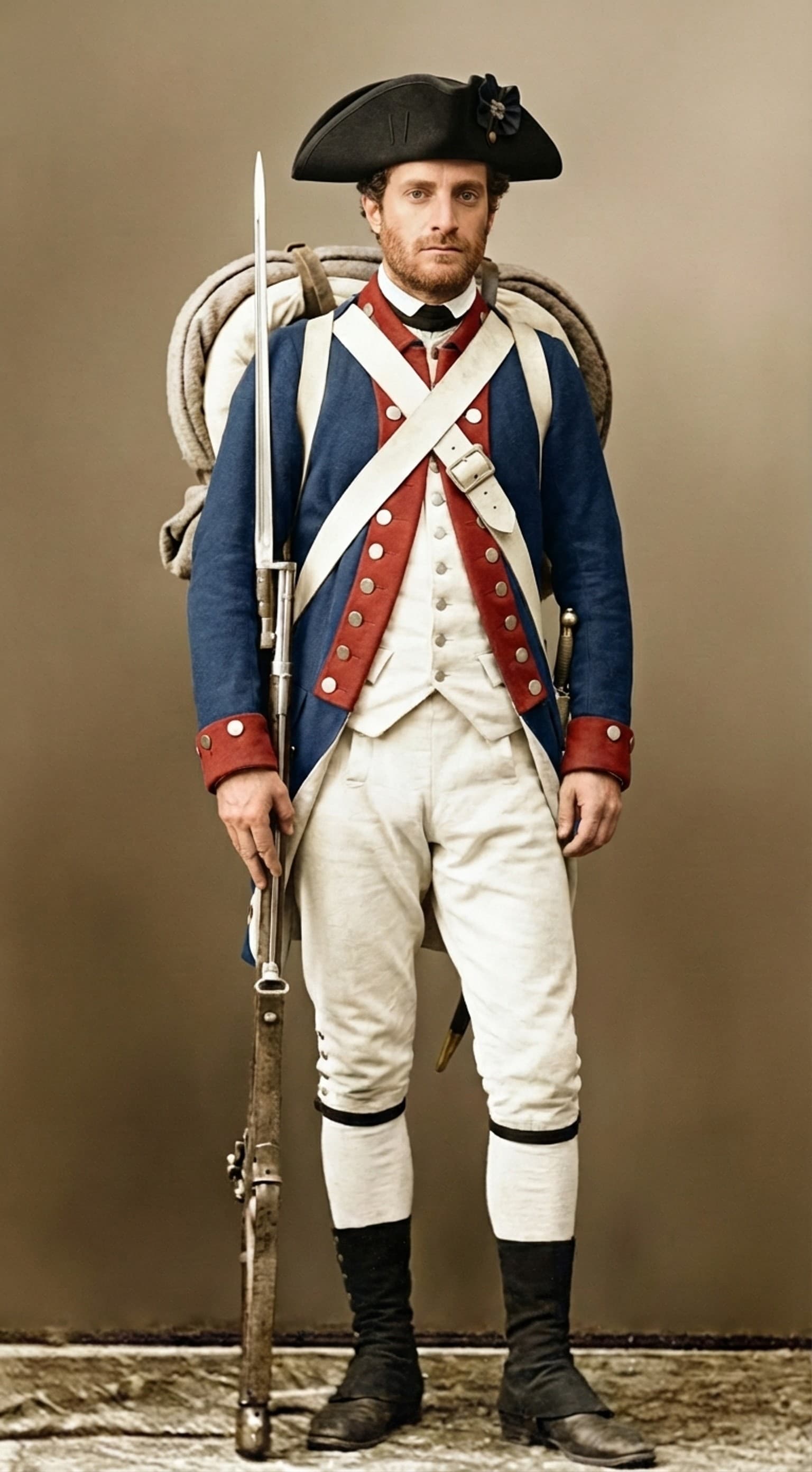
Uniform and equipment
| Uniform | Blue coat with red/white facings (variable) |
|---|---|
| Dress uniform | Blue coat, white waistcoat, breeches |
| Headgear | Tricorn or cocked hat |
| Equipment | Charleville musket, bayonet |
| Insignia and standard | Interlaced 'USA' pewter buttons |
Service record
| First appeared | 1775 |
|---|---|
| Peak strength | 35,000 men |
| Recruited from | Volunteers |
| Primary tactic | Linear Volley / Bayonet |
| Signature engagement | Battle of Yorktown (1781) |
| Motto or battle cry | Don't Tread on Me (Flag motto) |
| Obsolescence | Disbanded after War |
Timeline
- 1775: Formation of the Continental Army. The Second Continental Congress adopts the New England forces besieging Boston as the first Continental Army.
- 1776: The New York Campaign. A disastrous series of defeats forces the army to retreat across New Jersey, nearly ending the war.
- 1777: Winter at Valley Forge. The army endures starvation and disease but emerges transformed by Von Steuben's rigorous drilling.
- 1778: Battle of Monmouth. The newly professionalized army proves it can stand against the British in open field combat.
- 1781: Victory at Yorktown. Combined American and French forces trap Cornwallis, effectively ending major combat operations.
- 1783: Disbandment. Following the Treaty of Paris, the Continental Army is largely disbanded, leaving a small residue at West Point.
Battles
Battle of Trenton
A desperate winter gamble where Washington crossed the icy Delaware River to surprise Hessian mercenaries. This audacious strike saved the Revolution from collapse, proving the Continentals could fight and win against professional European soldiers.
Battle of Monmouth
The first test of Steuben's training. In sweltering heat, the Continentals stood firm in linear formation against British bayonets. While tactically a draw, it was a moral victory that proved the American line would no longer break under fire.
Siege of Yorktown
The decisive death blow to British rule. Continental Regulars, fighting alongside French allies, executed a textbook siege. Storming Redoubts #9 and #10 with unloaded muskets and fixed bayonets, they forced Cornwallis's surrender.
Commanders
George Washington
The indispensable man who forged an army from mud and desperation. His stoic leadership held the fraying Continental line together through the starving winters of Valley Forge and Morristown, transforming a rabble into a professional force capable of defeating the British Empire.
Friedrich Wilhelm von Steuben
A Prussian drillmaster who arrived at Valley Forge to find chaos and left behind a machine. He standardized drills, introduced the bayonet as a lethal weapon rather than a cooking skewer, and instilled the discipline required to stand toe-to-toe with British Regulars.
Nathanael Greene
The Fighting Quaker and Washington's most trusted strategist. He orchestrated the brilliant campaign in the South, exhausting British forces through a war of attrition. He never won a major battle, yet he never lost a campaign, bleeding the enemy dry until victory was inevitable.
Tactics
Linear Volley Fire
Soldiers formed in two or three ranks to deliver massed musket fire, maximizing the hit probability of inaccurate smoothbore weapons.
Bayonet Charge
A psychological and physical shock tactic used to break enemy lines or clear fortifications, emphasized heavily after 1778.
Fabian Strategy
A strategy of avoiding decisive battles against superior forces to wear down the enemy through attrition and skirmishes.