
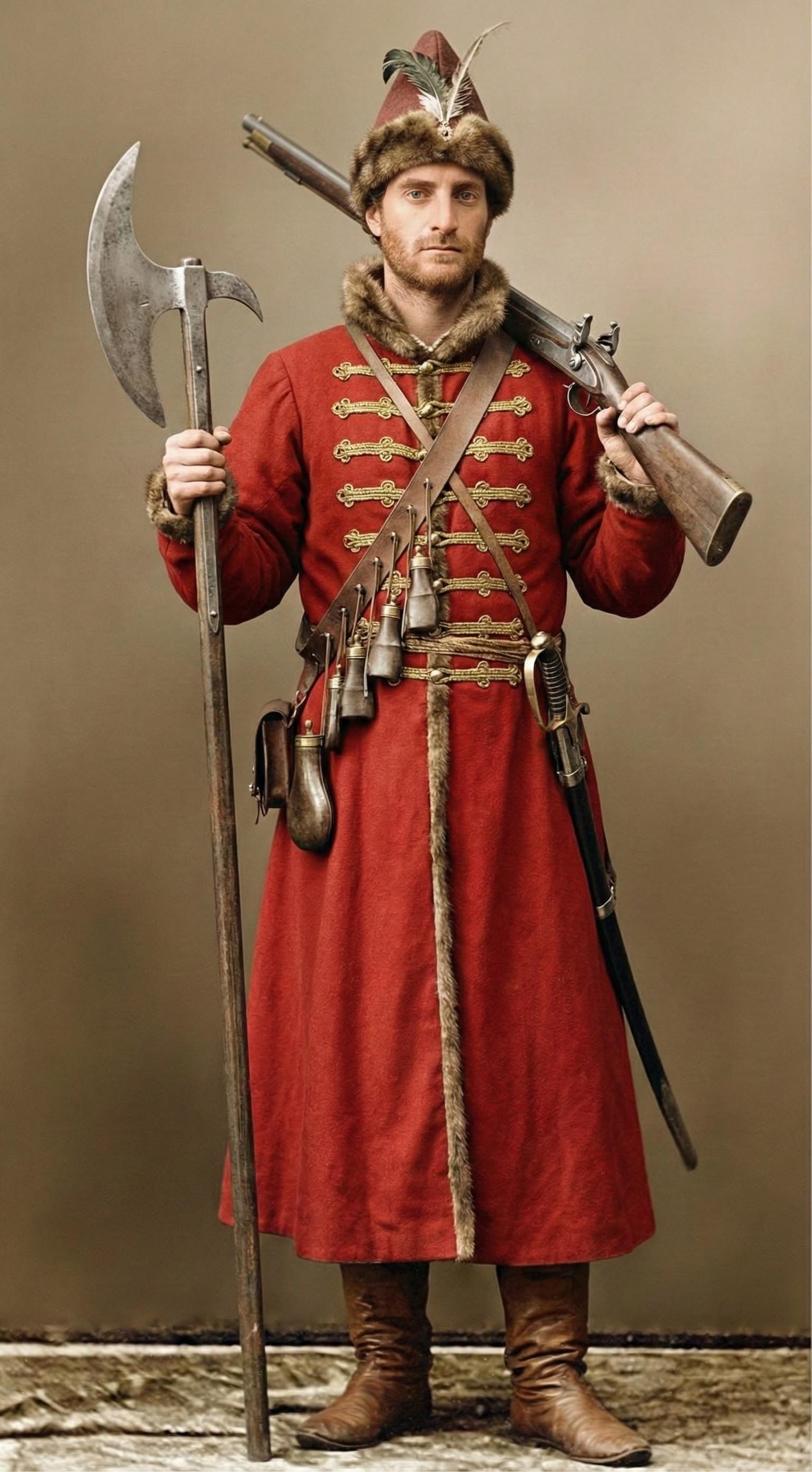
Uniform and equipment
| Uniform | Long red caftan, colored trim by regiment |
|---|---|
| Dress uniform | Red with gold braiding, fur trim |
| Headgear | Tall fur hat or steel helmet |
| Equipment | Bardiche axe, arquebus/musket, sabre |
| Insignia and standard | Orthodox saint/ Virgin Mary banners |
Service record
| First appeared | 1540s |
|---|---|
| Peak strength | 25,000 men |
| Recruited from | Hereditary Tradesmen-Soldiers |
| Primary tactic | Static Fire / Axe Defense |
| Signature engagement | Siege of Kazan (1552) |
| Motto or battle cry | God be with us! |
| Obsolescence | Peter the Great's Reforms (Execution) |
Timeline
- 1550: Formation. Ivan the Terrible establishes the first six regiments (prikazy) of Streltsy, totaling 3,000 men, as a permanent standing force.
- 1552: Conquest of Kazan. The unit proves its worth in the conquest of the Kazan Khanate, solidifying their role as the core of the Russian army.
- 1572: Defense of Molodi. Streltsy play a decisive role in defeating the Crimean Tatars, utilizing mobile fortifications.
- 1682: The Moscow Uprising. The 'Khovanshchina'. Streltsy revolt against the Naryshkin family, slaughtering boyars and installing Sophia Alekseyevna as regent.
- 1698: The Grand Execution. Following a failed rebellion, Peter the Great brutally suppresses the Streltsy, executing over 1,000 and disbanding the Moscow regiments.
- 1720: Final Dissolution. The last remnants of the municipal Streltsy are formally abolished or integrated into the regular army.
Battles
Siege of Kazan
The Streltsy's baptism of fire. Amidst sappers and artillery smoke, they stormed the breaches of the Tatar fortress. Their disciplined volley fire suppressed defenders while they hacked through barricades with bardiches, securing the Volga for Russia.
Siege of Narva
During the early Livonian War, Streltsy units spearheaded the assault on the Swedish/Livonian stronghold. Their ability to maintain sustained fire during the assault proved critical in breaking the morale of the garrison.
Battle of Molodi
Facing a massive Crimean Tatar horde, the Streltsy utilized the 'Gulay-Gorod' mobile fortress. From behind wooden walls, their relentless musket fire decimated the Tatar cavalry, saving Moscow from total annihilation in a pivotal defensive stand.
Commanders
Ivan IV (The Terrible)
The ruthless visionary who forged the Streltsy in 1550. Seeing the obsolescence of feudal levies, he created Russia's first standing army, granting them land and status in exchange for lifelong service and absolute loyalty to the Tsar.
Prince Ivan Khovansky
A charismatic voyevoda who became the de facto leader of the Streltsy during the chaotic 1682 uprising. Known as 'Tararui' (The Babbler), he championed the Streltsy's grievances against modernization until his execution by the regency.
Tactics
The Axe-Rest Volley
Streltsy planted their bardiches into the ground to serve as a monopod for their heavy muskets, allowing for greater accuracy and stability than handheld firing.
Gulay-Gorod Defense
Deployment of a 'Walking City'—mobile wooden walls mounted on sleds or wheels. Streltsy fired through gun ports, immune to enemy arrows and light cavalry charges.
Static Line Fire
Unlike later linear tactics, Streltsy often fought from static positions or behind cover, prioritizing volume of fire and defensive integrity over maneuverability.