
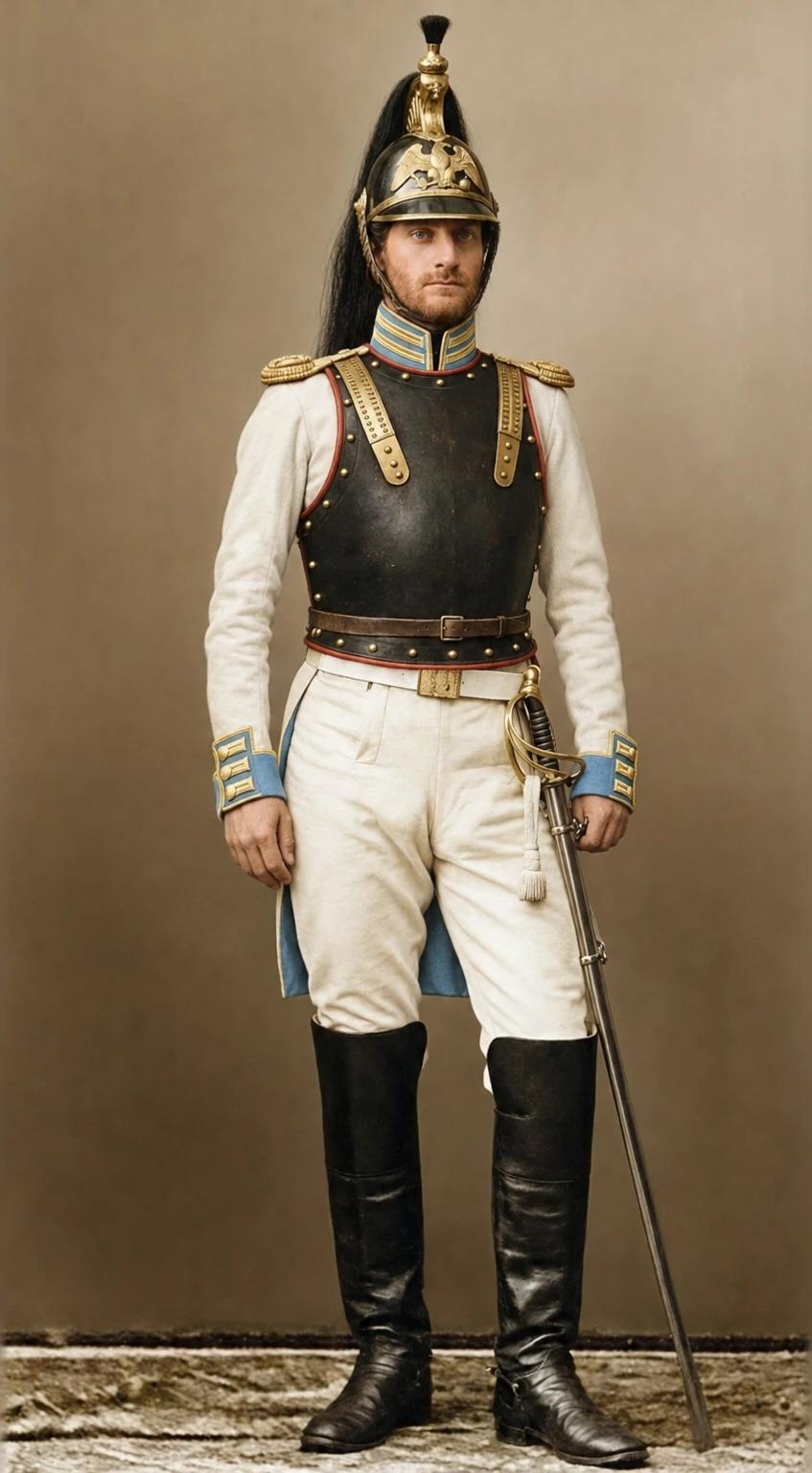
Uniform and equipment
| Uniform | White kolet with colored facings, black iron cuirass |
|---|---|
| Dress uniform | Highly polished cuirass, white gloves, sashes and medals |
| Headgear | Helmet with double-headed eagle plate and black plume |
| Equipment | Straight heavy sword, pistols, cuirass |
| Insignia and standard | Imperial double-headed eagle helmet plate |
Service record
| First appeared | 1812 |
|---|---|
| Peak strength | ~3,000 men |
| Recruited from | Tall Nobles / Wealthy |
| Primary tactic | Massed Heavy Charge |
| Signature engagement | Battle of Borodino (1812) |
| Motto or battle cry | For Faith, Tsar and Fatherland |
| Obsolescence | Russian Revolution (1917) |
Timeline
- 1800: Reorganization. Paul I reorganizes the Chevalier Guard Corps into a three-squadron combat regiment.
- 1805: The Bloody Baptism. Devastating losses at Austerlitz; the regiment gains legendary status for its self-sacrifice.
- 1812: Patriotic War. The Guards distinguish themselves at Borodino, halting the French advance on the Great Redoubt.
- 1813: Battle of Kulm. The unit plays a critical role in trapping Vandamme's corps in Bohemia.
- 1814: Entry into Paris. The Cuirassier Guards march triumphantly down the Champs-Élysées.
- 1917: Dissolution. Following the Russian Revolution, the Imperial Guard regiments are disbanded.
Battles
Battle of Austerlitz
The unit's baptism of fire. The Chevalier Guards charged the French Guard Cavalry in a muddy vineyard. Though they suffered horrific casualties and lost their standards, their sacrifice allowed the shattered Russian center to retreat, preventing total encirclement.
Battle of Borodino
Defending the Raevsky Redoubt, the Cuirassiers engaged in a brutal melee with Saxon heavy cavalry. Amidst choking smoke and carnage, they held the line against repeated onslaughts, turning the Russian center into an impregnable wall of steel and horseflesh.
Battle of Fère-Champenoise
A decisive cavalry action where the Russian Cuirassier Guards broke French infantry squares. Utilizing a sudden storm to mask their approach, they decimated the enemy formations, capturing thousands and opening the road to Paris.
Commanders
Nikolay Ivanovich Depreradovich
A titan of the heavy cavalry, Depreradovich commanded the Chevalier Guard Regiment with iron discipline. At Austerlitz, he led the desperate counter-charge against the French Imperial Guard, sacrificing his squadron to save the Russian infantry from total annihilation.
Baron Alexander Budberg
A quintessential aristocratic warrior, Budberg served in the Life-Guard Horse Regiment. Known for his personal bravery during the 1812 campaign, he embodied the stoic resilience of the Russian officer corps, leading men into the teeth of French artillery fire without flinching.
Tactics
The Shock Charge
Riding knee-to-knee at a trot, accelerating to a gallop only at the final moment to deliver a massive kinetic impact.
Counter-Shock
A reactive maneuver used to intercept enemy heavy cavalry, relying on the weight of the horses and the length of the pallasch.
Square Breaking
Psychological and physical assault on infantry squares, often coordinated with horse artillery to create gaps for the swordsmen.