
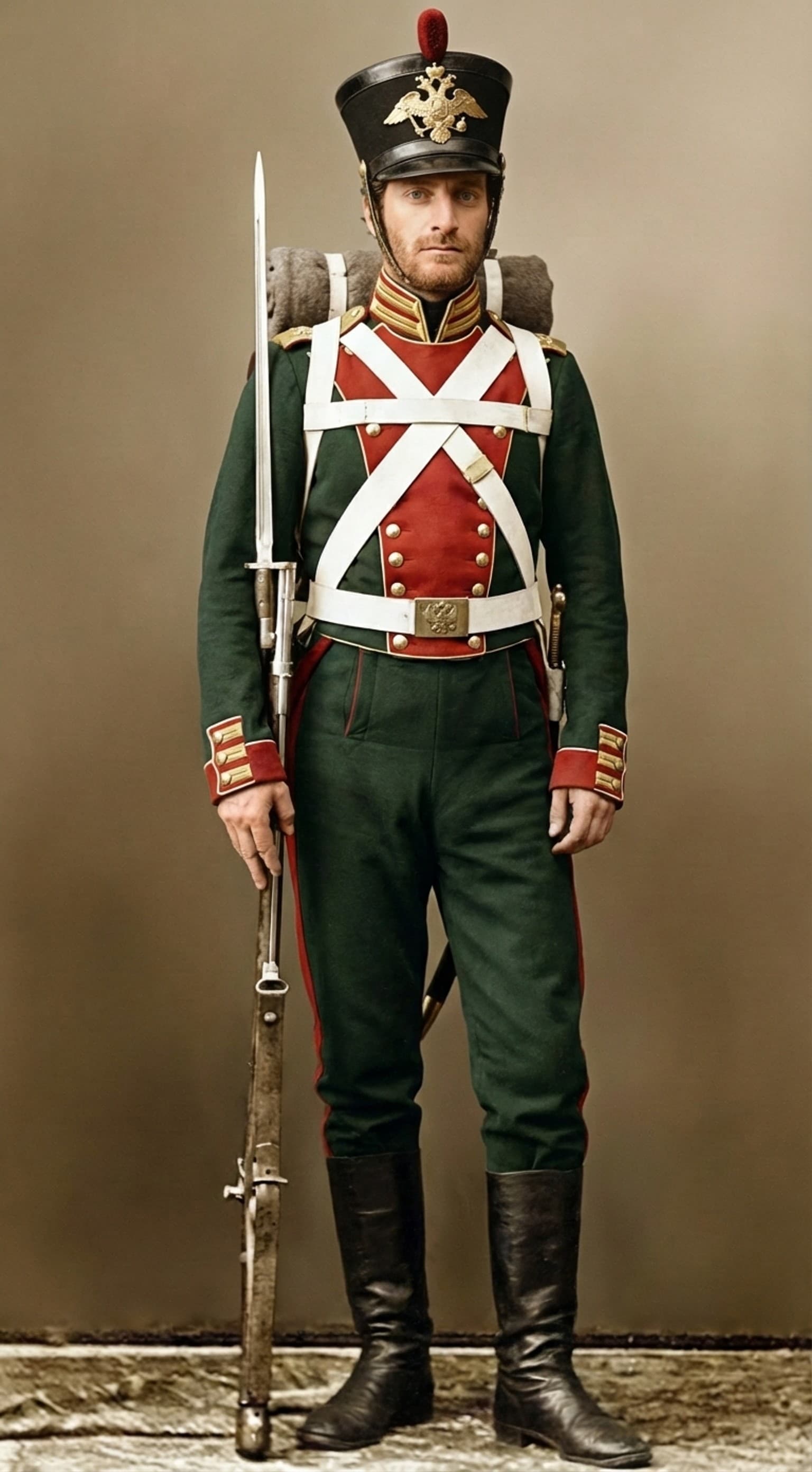
Uniform and equipment
| Uniform | Dark green coat with red facings, white breeches |
|---|---|
| Dress uniform | Bright green with extensive gold braid, sash in guard colors |
| Headgear | Early tricorn, later tall shako; officers with taller plumes |
| Equipment | Musket, bayonet, officer swords and canes |
| Insignia and standard | St. Andrew's Cross gorget |
Service record
| First appeared | 1690s |
|---|---|
| Peak strength | 4,000–5,000 men |
| Recruited from | Nobility / Toy Soldiers of Peter |
| Primary tactic | Steadfast Line Defense |
| Signature engagement | Battle of Poltava (1709) |
| Motto or battle cry | Za Veru, Tsarya i Otechestvo (For Faith, Tsar and Fatherland) |
| Obsolescence | Russian Revolution (1917) |
Timeline
- 1683: Formation of the Toy Army. Peter I establishes the unit as a 'Poteshnye' (toy) regiment in the village of Preobrazhenskoye to learn the art of war.
- 1700: Baptism of Fire at Narva. The regiment earns its elite status and Life Guard designation by preventing the total annihilation of the Russian army.
- 1722: Table of Ranks Reform. Preobrazhensky officers are granted a two-grade seniority advantage over regular army officers, cementing their prestige.
- 1762: Palace Coup. The regiment plays a decisive role in deposing Peter III and installing Catherine the Great to the throne.
- 1812: Defense of the Motherland. The regiment serves as the strategic reserve at Borodino, standing under withering cannon fire to hold the center.
- 1917: Dissolution. Following the February Revolution and internal mutiny, the oldest regiment of the Imperial Guard is disbanded.
Battles
Battle of Narva
While the raw Russian army routed in a blizzard, the Preobrazhensky stood firm against the Swedish onslaught. They suffered massive casualties but surrendered with honors, earning the right to wear red stockings—symbolizing the blood they stood knee-deep in.
Battle of Poltava
The regiment anchored the Russian center, absorbing the shock of the desperate Swedish charge. Their disciplined volley fire shattered the invincible reputation of Charles XII's Caroleans, marking Russia's ascent as a European superpower.
Battle of Kulm
Outnumbered three-to-one, the Guards held the 'Priest's Valley' against Vandamme's French corps. They acted as a human wall to save the Coalition army, suffering horrific losses but capturing the French commander and earning the Banner of St. George.
Commanders
Peter the Great
The Tsar-Carpenter who forged the regiment from his childhood 'toy army.' Serving not as a distant monarch but rising through the ranks from drummer to colonel, he instilled a culture of meritocracy and ruthless discipline that modernized the Russian military soul.
Alexander Menshikov
Rising from selling pies on the streets to becoming a Prince of the Empire, Menshikov was Peter's right hand. A cavalry commander of reckless bravery and questionable ethics, he frequently led the Preobrazhensky troops into the thickest fighting of the Great Northern War.
Count Ostermann-Tolstoy
A stoic commander during the Napoleonic Wars who famously lost his arm at Kulm. When asked what to do as his lines were decimated by French artillery, he simply replied, 'Stand and die,' embodying the regiment's grim determination.
Tactics
The Iron Wall
A defensive doctrine emphasizing immovable linear formations that absorbed enemy charges through sheer physical endurance and discipline rather than tactical maneuvering.
Suvorov's Push
Aggressive bayonet assaults launched immediately after a close-range volley, relying on shock and morale to break the enemy line.
Square Formation
A hollow defensive square used to repel cavalry; at Borodino, they maintained this formation for hours under artillery fire without breaking.