
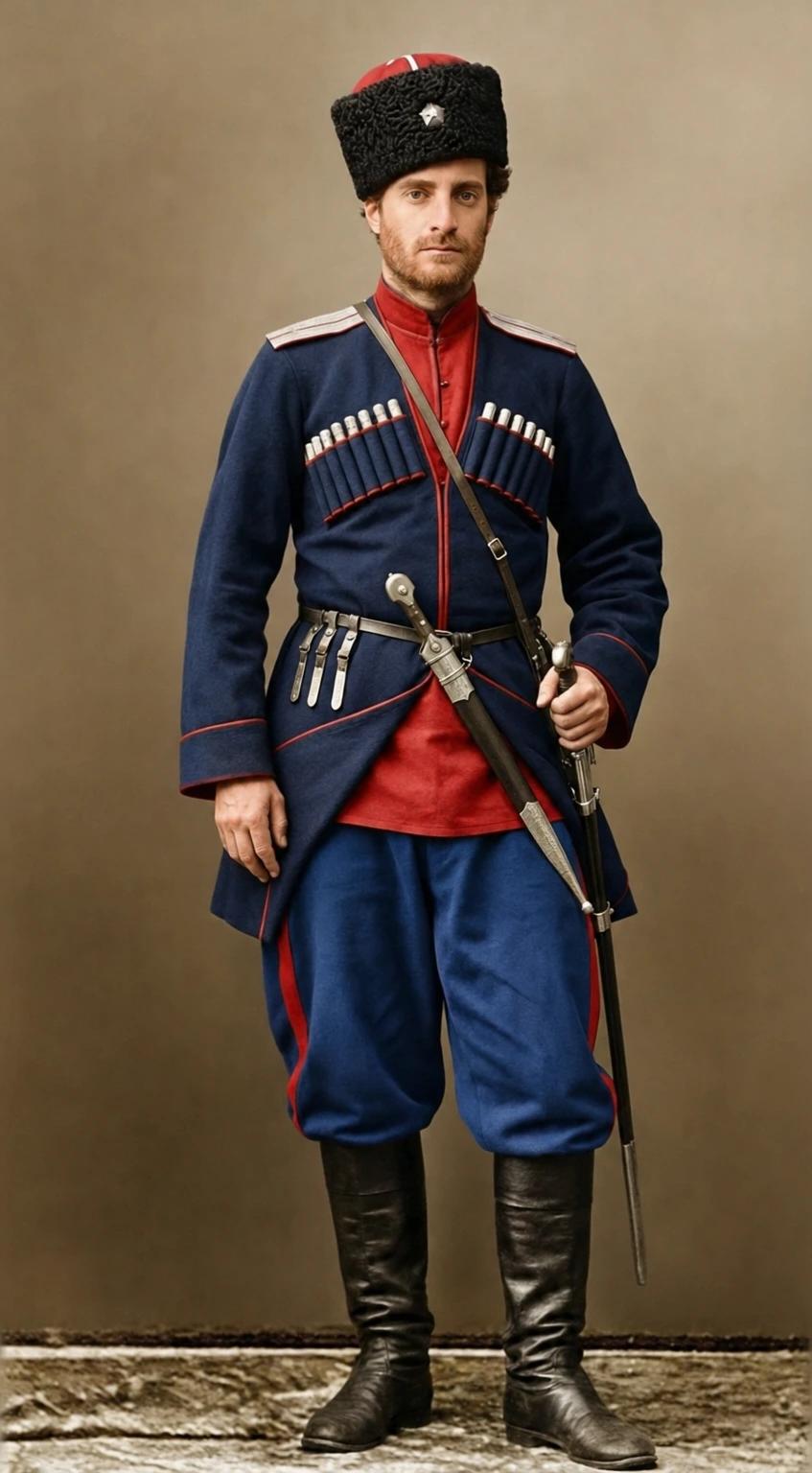
Uniform and equipment
| Uniform | Scarlet caftan (circassian coat) with silver gasari |
|---|---|
| Dress uniform | Red caftan, blue trousers, extensive silver braid |
| Headgear | Fur papakha with colored top |
| Equipment | Kindjal dagger, shashka, carbine |
| Insignia and standard | Imperial cypher on shoulder boards/sabretache |
Service record
| First appeared | 1811 |
|---|---|
| Peak strength | ~500 men |
| Recruited from | Terek and Kuban Nobility |
| Primary tactic | Close Escort / Charge |
| Signature engagement | Russo-Turkish War (1877) |
| Motto or battle cry | Vernost', Chest', Dolg (Fidelity, Honour, Duty) |
| Obsolescence | Russian Revolution (1917) |
Timeline
- 1811: Formation of the Black Sea Hundred. The genesis of the unit, formed from elite Black Sea Cossacks to serve as the Emperor's personal guard.
- 1828: Integration of the Mountain Tribes. Circassian and other Caucasian nobles are added to the escort, blending exotic warrior cultures into the Imperial Guard.
- 1877: The Balkan Campaign. The Konvoi deploys to the front lines of the Russo-Turkish War, earning battle honors under the direct gaze of the Tsar.
- 1881: Reorganization. Following the assassination of Alexander II, the unit is restructured with a heavier focus on counter-intelligence and close protection.
- 1917: Disbandment. Following the February Revolution and the Tsar's abdication, the unit is dissolved, its members scattering into the chaos of the Civil War.
Battles
Skirmish at Lovcha
A sharp, violent engagement where the Konvoi demonstrated the lethality of Caucasian warfare. Acting as a rapid reaction force, they cut down Ottoman irregulars, securing the flank for the main Russian advance.
Battle of Gorni Dubnik
The Konvoi's defining hour. Amidst a bloody assault on Turkish redoubts, the Tsar's personal escort charged through withering fire to protect the Imperial headquarters and support the Guard Infantry, proving they were warriors first and courtiers second.
Commanders
Tsar Nicholas II
The last Colonel-in-Chief of the Konvoi. Though a tragic monarch, he wore the Kuban Cherkeska with pride. His bond with his 'own' Cossacks was personal and profound, viewing them as the loyal archetype of Old Russia until the empire's bitter end.
Tsar Alexander II
The 'Tsar-Liberator' who rode with the Konvoi into the fires of the Russo-Turkish War. He transformed the unit from a ceremonial guard into a battle-hardened force, personally witnessing their valor in the Bulgarian mountains.
General Pyotr Cherevin
A steely commander of the Escort who maintained iron discipline. He served as the Tsar's shadow, ensuring the safety of the autocrat through an era of rising anarchism and assassination attempts, embodying the Konvoi's protective ethos.
Tactics
The Lava
A loose, fluid formation attack where Cossacks spread out to envelop the enemy, maximizing the psychological impact of their charge and minimizing target density for enemy gunners.
The Living Wall
A close-protection protocol where the escort formed an impenetrable, moving perimeter around the Tsar, ready to intercept bullets or assassins with their own bodies.
Dzhigitovka
Combat acrobatics on horseback—hanging from the saddle to dodge fire or shooting from under the horse's neck—used to confuse and terrify opponents.