
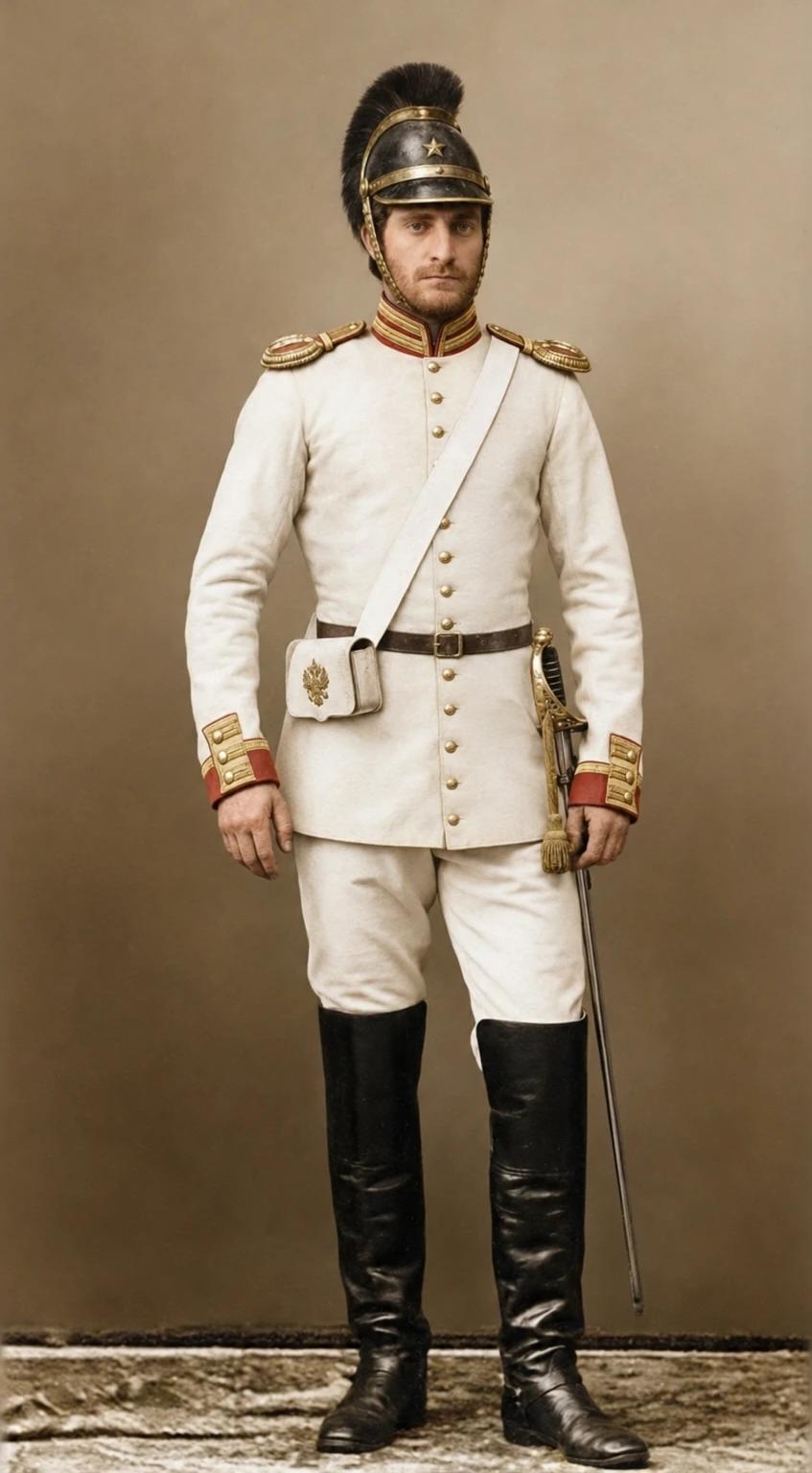
Uniform and equipment
| Uniform | White kolet with red collar and cuffs |
|---|---|
| Dress uniform | White with gold, ceremonial cuirass |
| Headgear | Black leather helmet with brass star and black hair crest |
| Equipment | Pallasch, pistols |
| Insignia and standard | Star of St. Andrew eight-pointed |
Service record
| First appeared | 1724 |
|---|---|
| Peak strength | 1,200 men |
| Recruited from | Highest Russian Nobility |
| Primary tactic | Heavy Cavalry Charge |
| Signature engagement | Battle of Austerlitz (1805) |
| Motto or battle cry | For Faith and Fidelity |
| Obsolescence | Russian Revolution (1917) |
Timeline
- 1800: Reformation. Tsar Paul I reforms the Chevalier Guard Corps into a three-squadron heavy cavalry combat regiment.
- 1805: The Sacrifice at Austerlitz. The regiment suffers catastrophic losses charging the French Imperial Guard cavalry.
- 1812: Patriotic War. The unit distinguishes itself at Borodino and Krasnoi during the repulsion of Napoleon's invasion.
- 1814: Entry into Paris. The Chevalier Guards march triumphantly into the French capital, restoring their honor.
- 1917: Dissolution. Following the Russian Revolution, the Imperial Guard is disbanded, and its officers are executed or exiled.
Battles
Battle of Austerlitz
The regiment's baptism of fire. Ordered to halt the French breakthrough, they launched a desperate counter-charge against the French Imperial Guard. Though destroyed as a fighting force, their sacrifice bought time for the Russian infantry to escape total annihilation.
Battle of Borodino
Stationed behind the Raevsky Redoubt, the Guards endured hours of artillery fire before engaging Saxon heavy cavalry. In the swirling dust and smoke, they held the line, proving their mettle in the defense of the Motherland.
Battle of Fère-Champenoise
A decisive cavalry action where the Chevalier Guards, operating with other Allied cavalry, broke French infantry squares and captured vast amounts of artillery, paving the way to Paris.
Commanders
Grand Duke Constantine Pavlovich
The mercurial brother of Tsar Alexander I, Constantine commanded the Imperial Guard with a mixture of erratic fury and genuine courage. At Austerlitz, he threw the Chevalier Guards into the furnace of battle to save the crumbling Russian center.
Prince Nikolai Repnin-Volkonsky
A paragon of aristocratic valor, Repnin led the Chevalier Guards' suicidal charge at Austerlitz. Wounded and surrounded by French Mamelukes, he fought until collapsing, earning Napoleon's personal respect for his regiment's sacrifice.
Tactics
Shock Charge
A knee-to-knee gallop designed to deliver maximum kinetic energy, using the weight of the heavy horses and armored riders to smash enemy lines.
Counter-Shock
A reactive tactic used at Austerlitz; rapidly deploying from reserve to collide head-on with enemy cavalry that has already broken through the first line.