
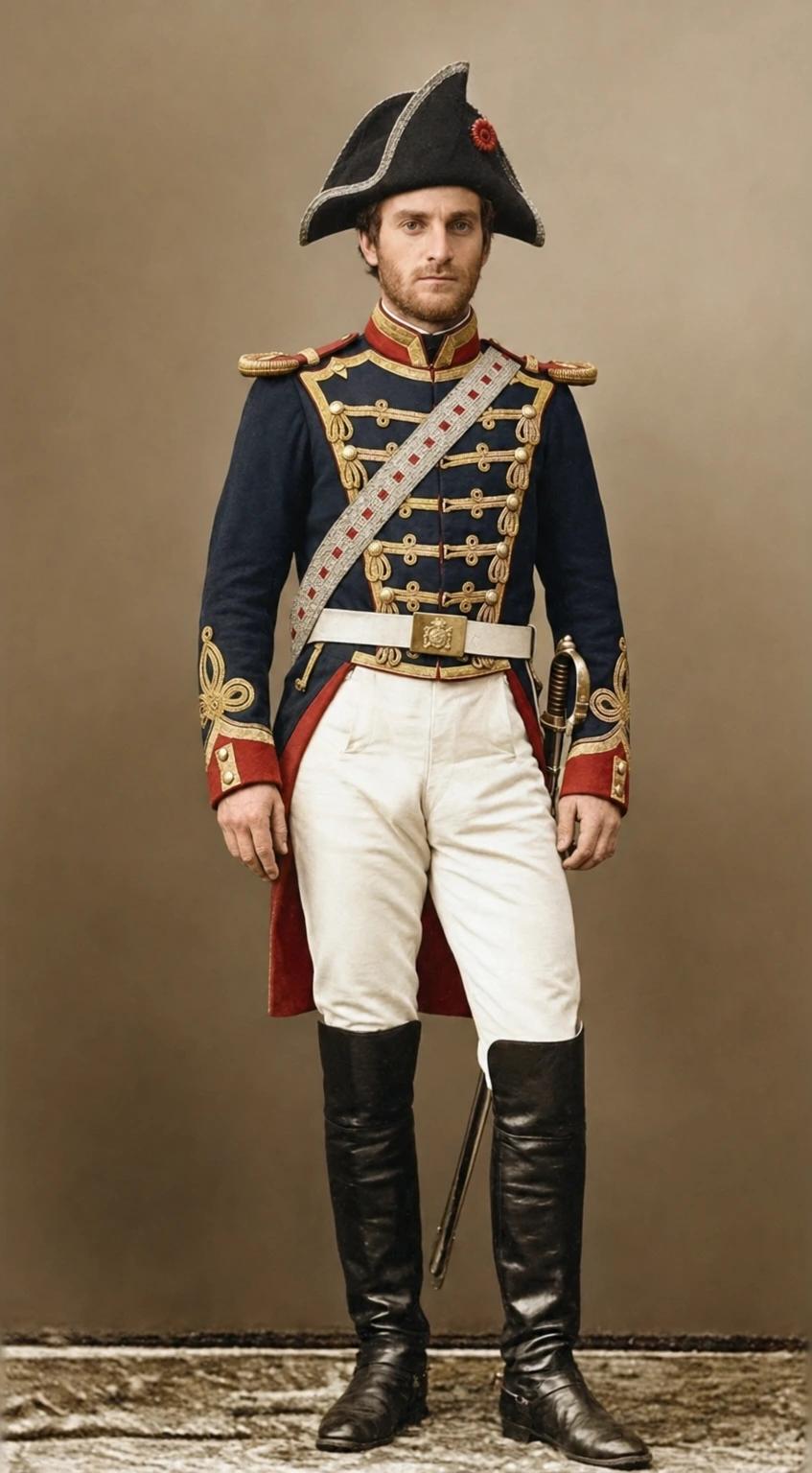
Uniform and equipment
| Uniform | Dark blue coat with red facings, silver lace |
|---|---|
| Dress uniform | White dress coat with gold or silver lace, sash |
| Headgear | Black bicorne with silver lace and red cockade |
| Equipment | Straight sword, pistols |
| Insignia and standard | Royal cypher of Spanish monarch, crowned |
Service record
| First appeared | 1704 |
|---|---|
| Peak strength | ~1,000 troopers |
| Recruited from | Aristocracy |
| Primary tactic | Palace Defense |
| Signature engagement | Dos de Mayo Uprising |
| Motto or battle cry | Custodiae Pacis (Custodians of Peace) |
| Obsolescence | Republicanism |
Timeline
- 1704: Formation. King Philip V establishes the Reales Guardias de Corps, modeled directly on the French Gardes du Corps to replace the Habsburg guards.
- 1793: War of the Pyrenees. The Corps deploys to the French border, engaging in sharp cavalry actions against Revolutionary forces.
- 1808: Mutiny of Aranjuez. In a twist of loyalty, the Guards turn on their former commander Godoy, storming his palace and forcing King Charles IV's abdication.
- 1841: Dissolution. Regent Baldomero Espartero disbands the unit, replacing the aristocratic bodyguard with a more modern, constitutional military structure.
Battles
Battle of Almansa
The baptism of fire for the newly formed Bourbon guards. They delivered a crushing heavy cavalry charge against the Allied lines, securing Philip V's throne and cementing their reputation as the iron fist of the new dynasty.
War of the Oranges
A brief campaign commanded by Godoy himself. The Guards led the ceremonial yet intimidating advance into Portugal, capturing Olivenza in a display of martial pageantry that masked the rotting foundations of the Spanish state.
Dos de Mayo Uprising
In the chaotic streets of Madrid, elements of the Royal Household fought a desperate, unauthorized defense against Murat's French Mamelukes and Cuirassiers. It was a bloody, confused skirmish that sparked the Peninsular War.
Commanders
Manuel Godoy
The 'Prince of the Peace' who rose from a mere cadet in the Guards to the de facto ruler of Spain. A controversial figure whose rapid ascent through the ranks epitomized the political power wielded by the Corps, ultimately leading to the Mutiny of Aranjuez.
Pedro Téllez-Girón, 9th Duke of Osuna
A quintessential aristocrat and commander who embodied the noble lineage required for the Corps. He maintained the unit's opulent standards and discipline during the twilight of the Enlightenment, balancing courtly duties with military readiness.
Tactics
The Royal Screen
A defensive formation where troopers formed a living, mobile wall around the monarch's carriage, ready to intercept assassins or projectiles with their own bodies.
Shock Charge
A disciplined heavy cavalry assault using straight swords and the sheer weight of horses to shatter enemy infantry squares or ride down opposing cavalry.
Urban Pacification
Deployment in pairs or small squads within Madrid to enforce curfews and suppress riots, using the flat of the blade or pistol butts.