
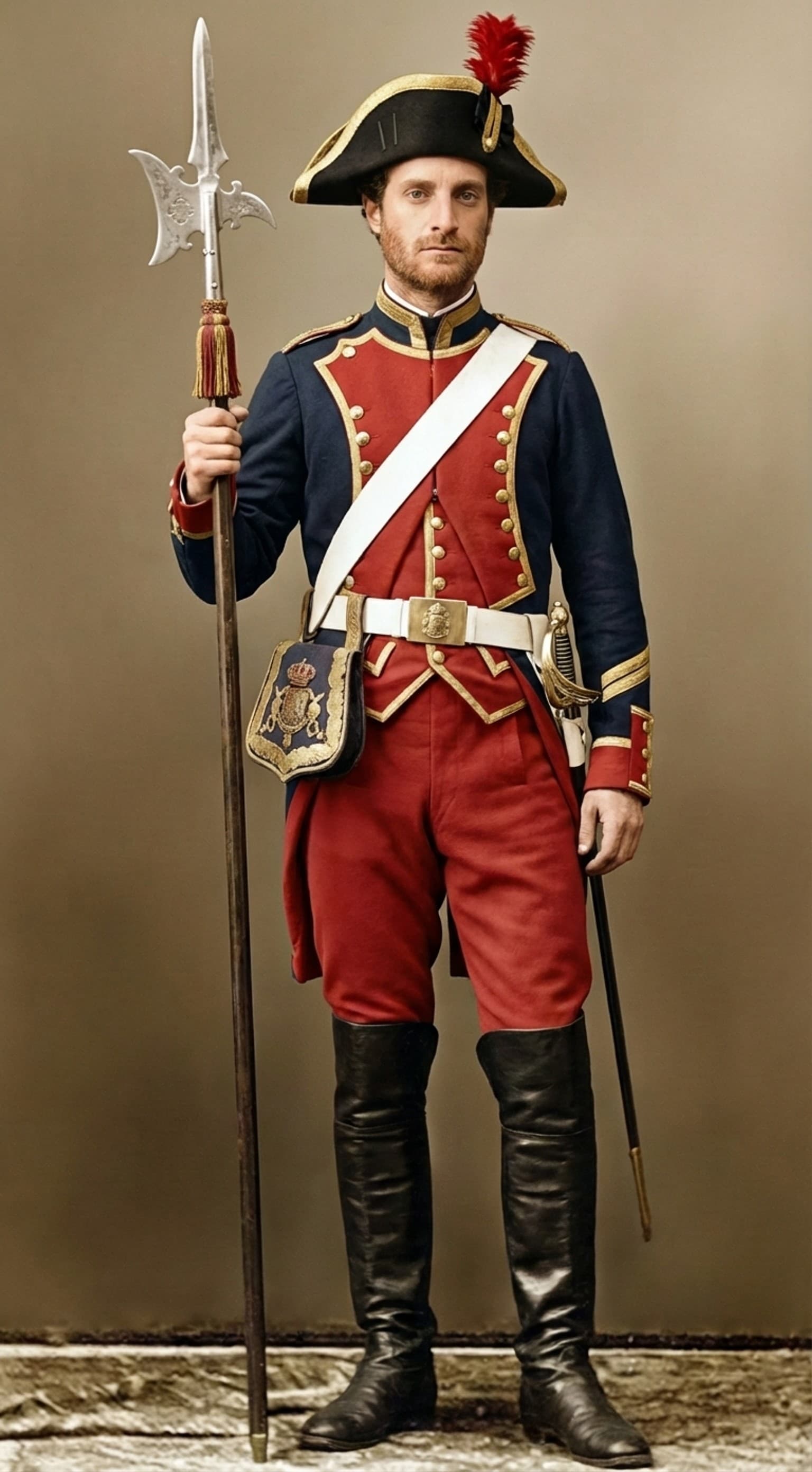
Uniform and equipment
| Uniform | Red and blue 17th-century style doublets, white hose |
|---|---|
| Dress uniform | Heavily braided coats, sashes in national colors, lace ruffs |
| Headgear | Morion-style helmets with red plumes |
| Equipment | Decorated halberd, sword |
| Insignia and standard | Royal Arms of Spain on chest and banners |
Service record
| First appeared | 1504 |
|---|---|
| Peak strength | ~200 men |
| Recruited from | Selected Veterans (NCOs) |
| Primary tactic | Palace Defense / Halberd |
| Signature engagement | Defense of Royal Palace (1841) |
| Motto or battle cry | Tutus in te (Safe in thee) |
| Obsolescence | N/A (Still Active) |
Timeline
- 1504: Foundation. King Ferdinand the Catholic establishes the 'Guardia de Alabarderos' to protect the royal person, distinct from the regular army.
- 1704: Bourbon Reorganization. Philip V reorganizes the Royal Household troops, solidifying the Halberdiers' status as the elite inner-circle guard.
- 1841: The Night of the Halberdiers. A small detachment successfully defends Queen Isabella II from a coup attempt at the Royal Palace in Madrid.
- 1931: Disbandment. Following the proclamation of the Second Spanish Republic and the exile of Alfonso XIII, the Royal Guard is dissolved.
- 1975: Restoration. With the restoration of the monarchy under Juan Carlos I, the Halberdiers are reinstated as part of the modern Guardia Real.
Battles
Defense of the Royal Palace
The unit's defining hour. 18 Halberdiers led by Dulce held the main staircase of the Palacio de Oriente against a full battalion of rebel soldiers. Fighting in close quarters, they prevented the abduction of Queen Isabella II until loyalist reinforcements arrived, cementing their legend.
Commanders
Ferdinand II of Aragon
The Catholic Monarch who founded the 'Guardia de Alabarderos' in 1504. Seeking a personal guard loyal only to the crown rather than feudal lords, he established the unit's ethos of unwavering fidelity, modeling them after the Swiss mercenaries but composed of elite Spanish veterans.
Domingo Dulce y Garay
A paragon of loyalty, Dulce commanded the Halberdiers during the 1841 assault on the Royal Palace. While rebel generals sought to kidnap the young Queen Isabella II, Dulce rallied his men on the grand staircase, repelling repeated waves of veteran infantry with cold steel and iron discipline.
Tactics
Staircase Denial
Utilizing the reach of the halberd to hold narrow architectural choke points (staircases, doorways) against superior numbers, forcing enemies into a fatal funnel.
The Royal Shield
A static defensive formation where guards form a physical wall around the VIP, using their bodies and polearms to intercept projectiles or assailants.
Mixed Arms Skirmish
In the 19th century, the unit integrated musketry volleys with cold steel charges, firing from cover before engaging with swords and halberds in the corridors.