
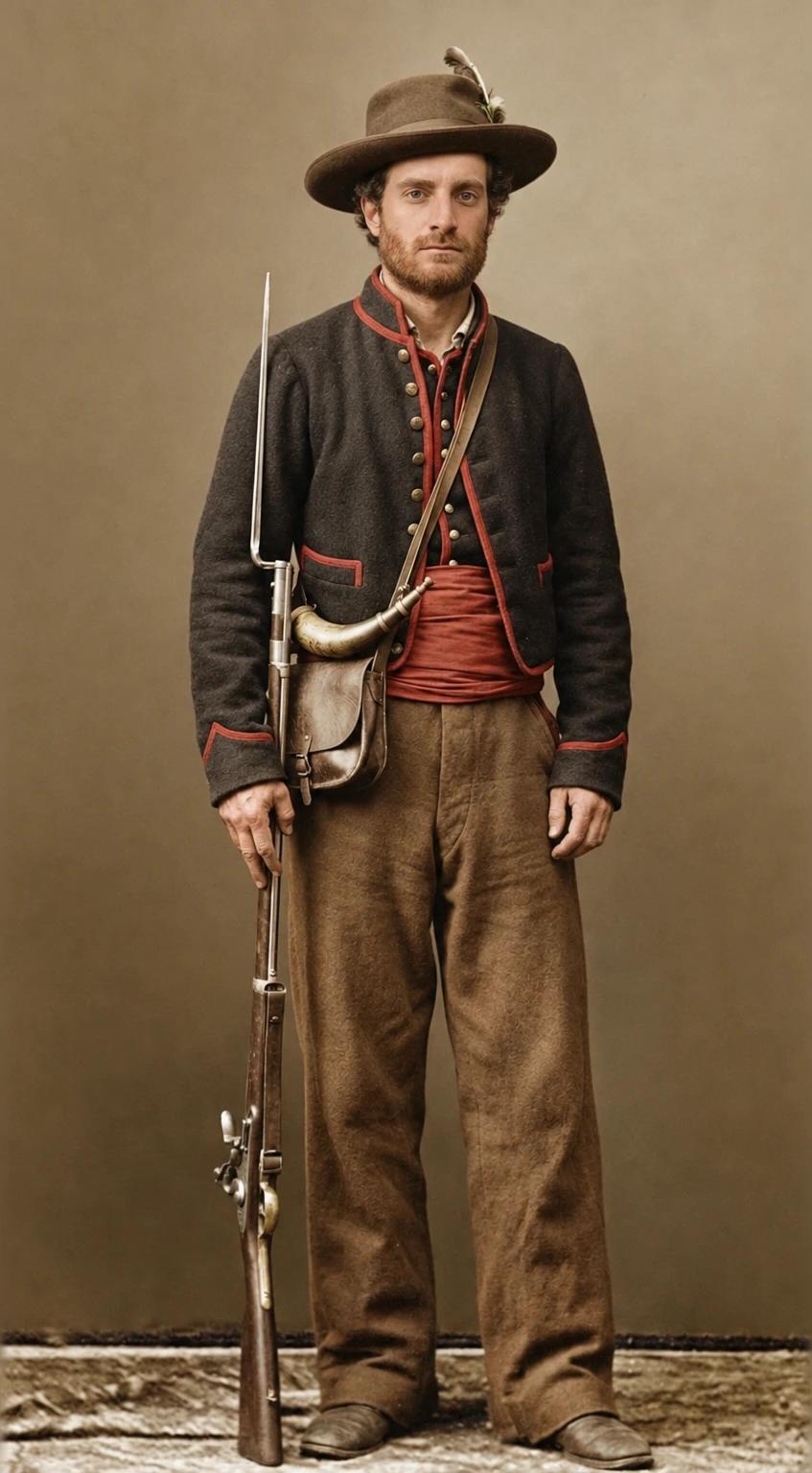
Uniform and equipment
| Uniform | Civilian clothes, sash, blanket |
|---|---|
| Dress uniform | N/A |
| Headgear | Hat or scarf |
| Equipment | Musket, blunderbuss, navaja (large knife) |
| Insignia and standard | Red cockade on hat |
Service record
| First appeared | 1808 |
|---|---|
| Peak strength | Unknown (Widespread) |
| Recruited from | Civilians |
| Primary tactic | Ambush / Assassination |
| Signature engagement | Peninsular War Ambushes |
| Motto or battle cry | Muerte al Francés! (Death to the Frenchman!) |
| Obsolescence | End of War |
Timeline
- 1808: Dos de Mayo Uprising. The people of Madrid rise against French occupation; the insurrection spreads nationwide.
- 1808: Formation of the Juntas. Local provincial governments form to organize resistance, officially sanctioning irregular warfare.
- 1809: Decree of the Corso Terrestre. The Supreme Central Junta issues the 'Regulations for the Land Corsairs', legalizing guerrilla bands and granting them military rank.
- 1810: French Control Limits. French control is reduced to major cities and immediate supply lines; the countryside belongs to the guerrillas.
- 1812: Wellington's Offensive. Guerrilla leaders coordinate major diversionary attacks to support the Anglo-Portuguese advance on Salamanca.
- 1814: Demobilization. With the French expelled, many guerrilla units are disbanded or integrated into the regular Spanish army, though some turn to banditry.
Battles
Dos de Mayo Uprising
The spontaneous popular insurrection against Murat's troops. While crushed brutally by the Mamelukes and Imperial Guard, the blood spilled here ignited the powder keg of the Spanish resistance.
Battle of Puente Sanpayo
A ragtag force of regulars and armed peasants held the bridge against Marshal Ney's VI Corps. The victory forced the French to evacuate Galicia, proving irregulars could hold ground in favorable terrain.
Ambush at Arlabán
Espoz y Mina ambushed a massive French convoy escorted by 1,600 troops. The guerrillas liberated over 1,000 Spanish prisoners and seized massive quantities of loot, crippling French logistics in the north.
Capture of the Vitoria Convoy
Following the main battle, Longa's guerrillas harassed the retreating French columns, turning a retreat into a rout and capturing Joseph Bonaparte's baggage train.
Commanders
Francisco Espoz y Mina
A farmer from Navarre who rose to command the Division of Navarre. Renowned for his strict discipline and strategic acumen, he effectively governed a state-within-a-state, funding his operations through customs levied on the French border.
Jerónimo Merino (The Curate)
A parish priest who traded the Bible for the sword. Motivated by fierce traditionalism and hatred of French secularism, he led a highly effective band in Castile, coordinating closely with Wellington's Anglo-Portuguese army.
Juan Martín Díez (El Empecinado)
A peasant farmer turned legendary partisan. Known for his stubbornness and brutality against the invader, he organized the Partida de El Empecinado, terrorizing French supply lines in the Duero valley and eventually commanding regular divisions.
Tactics
Interdiction of Couriers
Systematic hunting of French dispatch riders. This isolated French commanders, forcing them to send battalion-sized escorts for single letters.
Hit-and-Run (La Guerrilla)
Attacking the enemy's flanks or rear in difficult terrain, then dispersing immediately into the landscape before a counter-attack could form.
Scorched Earth
Denying the enemy local resources by hiding food, poisoning wells, or destroying bridges, exacerbating the French army's logistical nightmare.
Psychological Terror
The brutal execution of stragglers and sentries to lower French morale and induce a constant state of paranoia among the occupiers.