
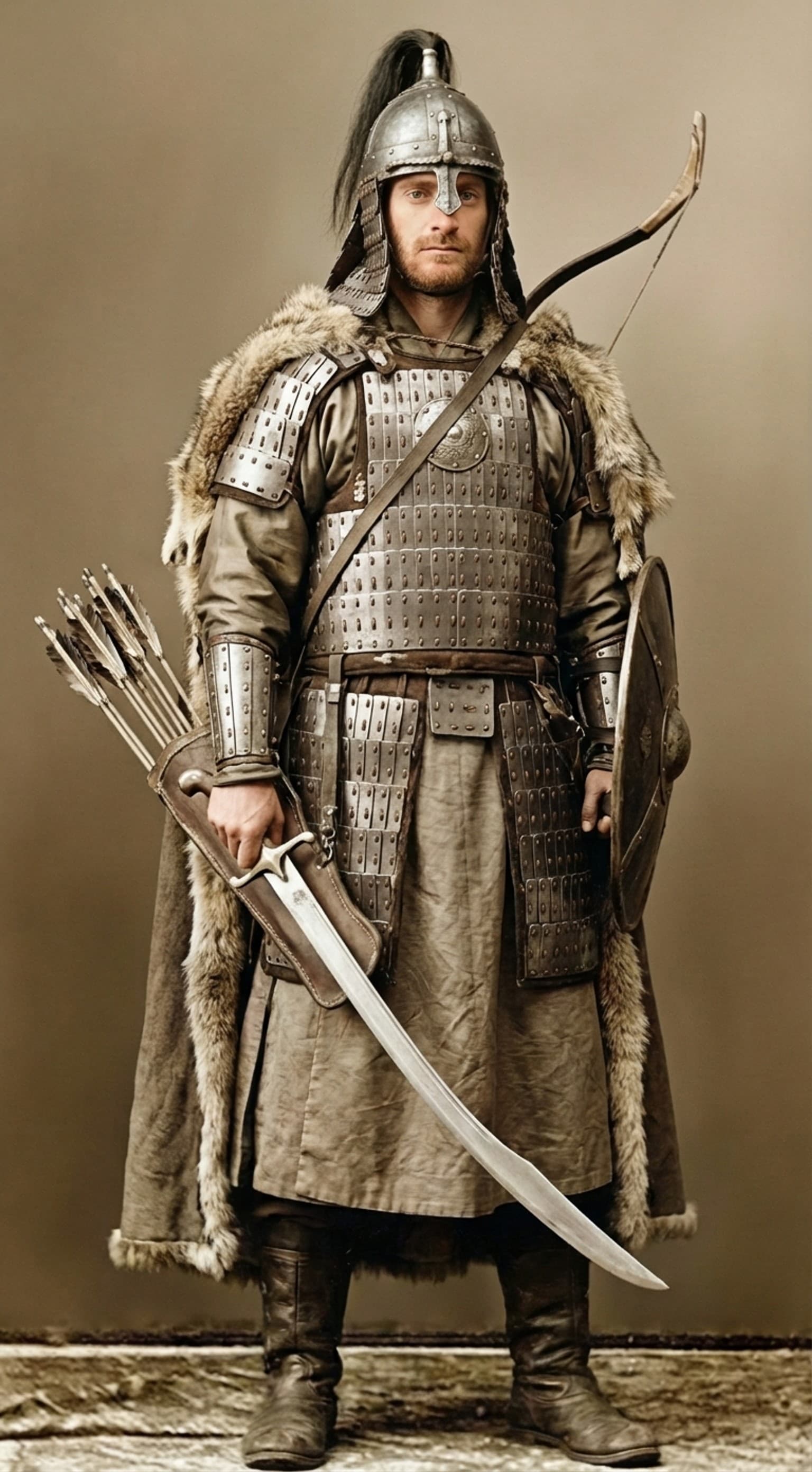
Uniform and equipment
| Uniform | Lamellar armor over caftan, fur-trimmed boots |
|---|---|
| Dress uniform | Silk caftans in imperial colors, gilded lamellar plates, elaborate quivers |
| Headgear | Pointed helmets or fur caps with plume |
| Equipment | Composite bow, sabre, lance, lasso |
| Insignia and standard | Nine White Banners (horse-tail standards) |
Service record
| First appeared | 13th century |
|---|---|
| Peak strength | 10,000–12,000 men |
| Recruited from | Sons of Commanders / Meritocracy |
| Primary tactic | Feigned Retreat / Horse Archery |
| Signature engagement | Battle of Mohi (1241) |
| Motto or battle cry | Hurrah! (Traditional cry) |
| Obsolescence | Fragmentation of Empire |
Timeline
- 1203: Formation of the Kheshig. Temujin (Genghis Khan) establishes a personal guard of 80 night guards and 70 day guards following the defeat of the Keraits.
- 1206: Expansion at the Kurultai. Upon being proclaimed Genghis Khan, the Kheshig is expanded to 10,000 men, split into the Torguud (day), Khevtuul (night), and Khorchin (archers).
- 1211: Invasion of Jin China. The Kheshig serves as the elite shock troops in the first major campaign against a sedentary empire, proving their worth against fortified positions.
- 1227: Succession to Ogedei. Following Genghis's death, the Kheshig transitions to serve Ogedei Khan, maintaining their status as the administrative and military core of the empire.
- 1260: Fragmentation. With the civil war between Kublai and Ariq Böke, the unified Imperial Kheshig fractures, evolving into distinct royal guards for the Yuan Dynasty and Ilkhanate.
Battles
Battle of Yehuling
The destruction of the Jin Dynasty's field army. Outnumbered significantly, the Kheshig spearheaded a charge through the mountainous terrain, shattering the Jin center. This victory signaled the end of Jurchen dominance and the rise of the Mongol hegemony.
Battle of the Kalka River
A reconnaissance force including Kheshig elements feigned retreat for nine days, exhausting the Rus' coalition. Turning suddenly, they crushed the disorganized pursuers. The captured princes were suffocated under wooden boards while the Mongols feasted atop them.
Battle of Mohi
Subutai's masterpiece. The Mongols outmaneuvered the Hungarian army at the bridge over the Sajó. Using stone-hurling catapults to clear the far bank, the Kheshig led a pincer movement that annihilated the European knights, opening the gates to Vienna.
Commanders
Subutai
Rising from a blacksmith's son to the Kheshig, Subutai became the Empire's primary strategist. A master of psychological warfare and deep operations, he conquered 32 nations and won 65 pitched battles, directing armies across thousands of miles with terrifying precision.
Borokhula
One of Genghis Khan's 'Four Steeds', Borokhula was a fierce commander of the Kheshig. Known for his unyielding loyalty, he once sucked clotted blood from the Khan's neck wound to save his life. He died fighting the Tumed, embodying the sacrificial ethos of the Guard.
Tactics
The Feigned Retreat
The unit simulates panic and rout, drawing the enemy out of formation. Once the enemy is strung out and exhausted, the Mongols wheel around and shower them with arrows.
The Caracole
Mounted archers ride in a rotating circle in front of the enemy line, firing a continuous barrage of arrows while remaining a moving, difficult target.
Nerge (The Great Hunt)
A vast encirclement tactic derived from hunting. The army forms a massive ring miles wide, slowly contracting to trap the enemy army in a killing zone with no escape.