
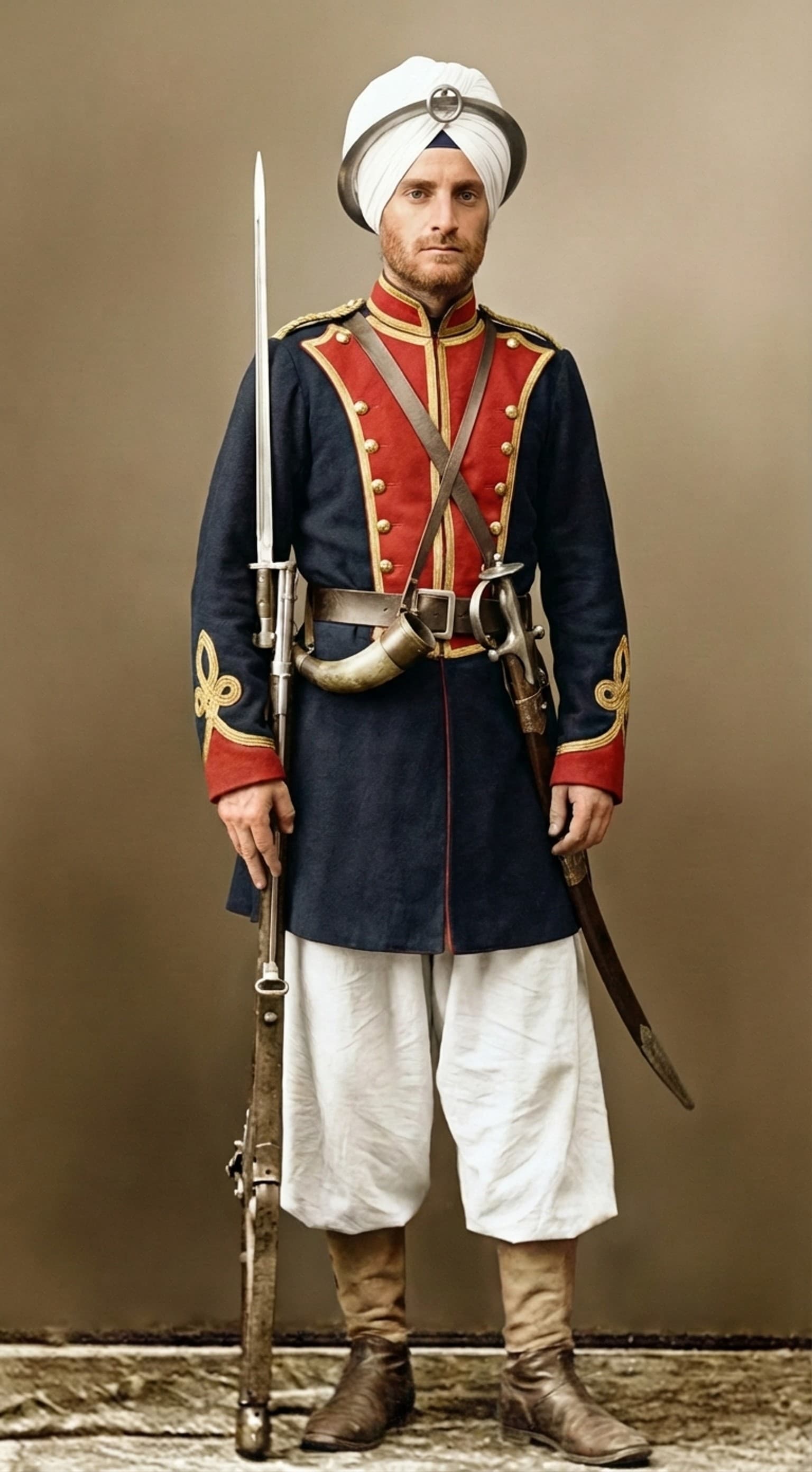
Uniform and equipment
| Uniform | Indigo or dark blue kurta, pajama trousers, cummerbund |
|---|---|
| Dress uniform | Bright blue or saffron garments, multiple steel bangles (kara) |
| Headgear | Tall domed turban sometimes with steel quoits (chakrams) |
| Equipment | Musket, tulwar sword, shield, occasional spear |
| Insignia and standard | Khanda with chakram and paired kirpans on banners |
Service record
| First appeared | early 19th century |
|---|---|
| Peak strength | ~50,000 infantry |
| Recruited from | Sikh Peasantry / Religious Orders |
| Primary tactic | European Drill / Volley Fire |
| Signature engagement | Battle of Ferozeshah (1845) |
| Motto or battle cry | Bole So Nihal, Sat Sri Akal! (Whoever proclaims shall be fulfilled; Eternal is the Great Truth) |
| Obsolescence | Annexation by British Raj |
Timeline
- 1799: Capture of Lahore. Ranjit Singh captures Lahore, laying the foundation for a unified Sikh Empire and the need for a standing army.
- 1822: Arrival of French Officers. Ventura and Allard arrive in Lahore, beginning the modernization of the infantry into the 'Fauj-i-Khas'.
- 1823: Battle of Nowshera. Early display of the modernized infantry's effectiveness against Afghan tribal forces.
- 1839: Death of Ranjit Singh. The 'Lion of Punjab' dies, leading to political instability that eventually undermines the army's command structure.
- 1845: First Anglo-Sikh War. The Khalsa Army crosses the Sutlej, initiating a bloody conflict with the British East India Company.
- 1849: Battle of Gujrat. The final defeat of the Sikh Army, leading to the annexation of the Punjab and the disbandment of the Khalsa regiments.
Battles
Battle of Jamrud
A brutal defensive action at the mouth of the Khyber Pass. While the Sikhs lost their legendary commander Hari Singh Nalwa, the infantry's stubborn resistance halted the Afghan invasion, permanently securing the frontier for the Empire.
Battle of Ferozeshah
Known as the 'Night of Terrors.' The Khalsa infantry stood toe-to-toe with the British, inflicting horrific casualties. The British army was brought to the brink of surrender, saved only by treason within the Sikh high command and the exhaustion of Sikh munitions.
Battle of Chillianwala
One of the bloodiest checks on British power in India. The Sikh infantry, utilizing dense scrub for cover, shattered British cavalry charges and decimated infantry lines with disciplined musketry, proving they were the equal of their colonial adversaries.
Commanders
General Jean-Baptiste Ventura
A veteran of Napoleon's Grande Armée who traveled to Lahore to serve Ranjit Singh. He was the architect of the 'Fauj-i-Khas' (Special Brigade), transforming the Sikh infantry into a disciplined machine capable of matching European standards in drill and maneuver.
Hari Singh Nalwa
The Commander-in-Chief of the Sikh Khalsa Army and a figure of legendary prowess. Known for his aggressive expansionism, he tamed the turbulent North-West Frontier and struck terror into the hearts of Afghan tribesmen. A master of logistics and fortification.
Sham Singh Attariwala
The embodiment of Sikh martial honor. At the Battle of Sobraon, refusing to retreat, he dressed in white ceremonial robes and led a suicidal charge against the British lines, rallying his breaking battalions until he fell under a hail of bullets.
Tactics
Disciplined Volley Fire
Under French tutelage, the infantry mastered the art of firing in rhythmic ranks, creating a wall of lead to break enemy charges.
Square Formation
A defensive maneuver used to repel cavalry; soldiers formed a hollow square with bayonets fixed outward.
The Tulwar Charge
A unique hybrid tactic where, after a volley, troops would discard muskets for swords and shields to engage in shock combat.