
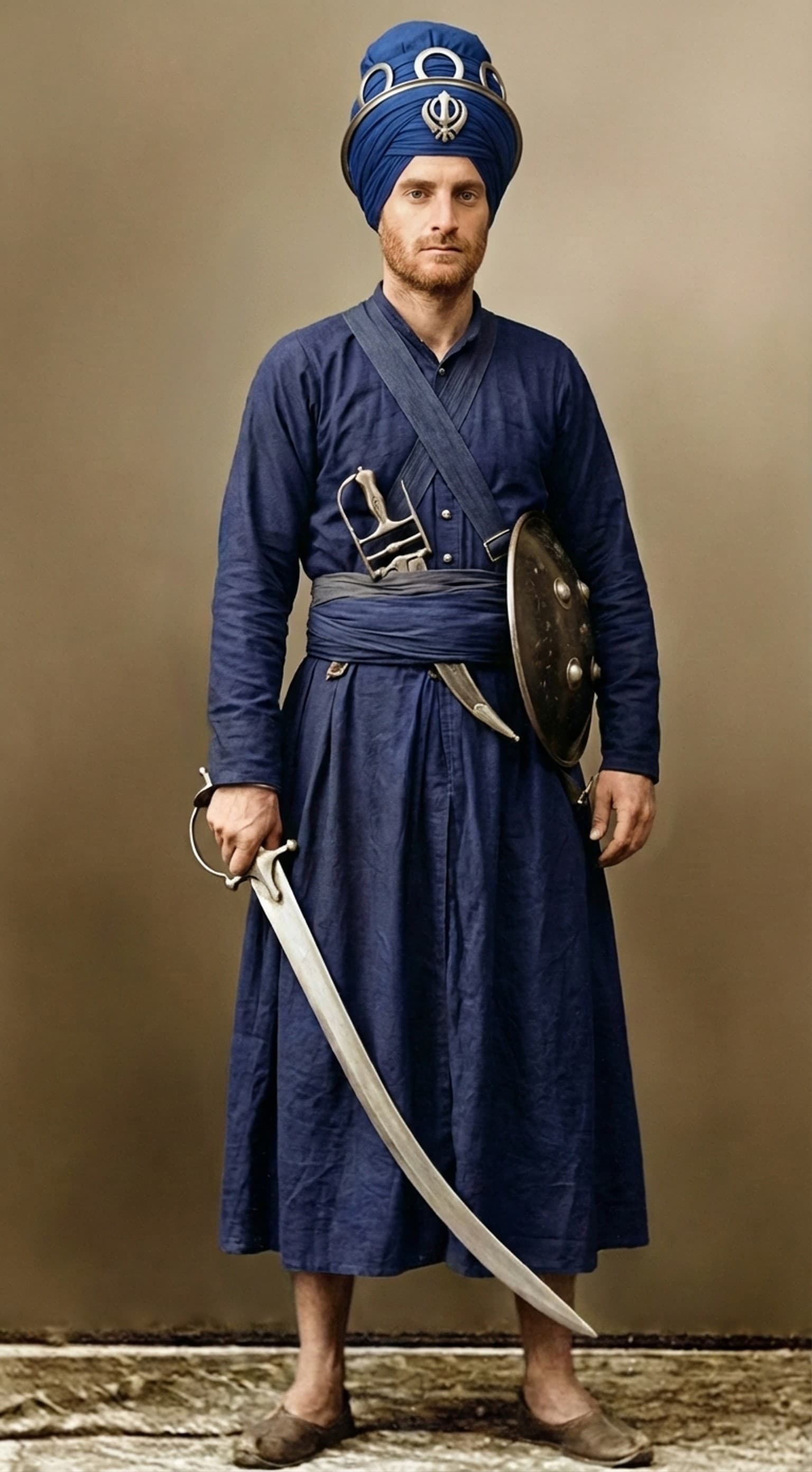
Uniform and equipment
| Uniform | Deep blue robes, multiple steel quoits on high turban |
|---|---|
| Dress uniform | Layered blue garments, bright sashes, chains of steel weapons |
| Headgear | High conical turban wrapped with steel quoits and spikes |
| Equipment | Talwar sword, spear, chakram throwing rings, buckler |
| Insignia and standard | Aad Chand steel crescent with khanda on turban |
Service record
| First appeared | 1700s |
|---|---|
| Peak strength | ~5,000 warriors |
| Recruited from | Religious Devotees |
| Primary tactic | Fanatical Charge |
| Signature engagement | Battle of Sobraon (1846) |
| Motto or battle cry | Sat Sri Akal! (God is Truth) |
| Obsolescence | British Raj Disarmament |
Timeline
- 1699: Formation of the Khalsa. Guru Gobind Singh establishes the Khalsa Panth; the precursors to the Nihangs emerge as the 'Akali' (Immortals) suicide squads.
- 1762: Vadda Ghalughara. The Great Holocaust. Nihangs play a crucial role in protecting the Sikh community from Afghan genocide, surviving through guerrilla warfare.
- 1801: Rise of Ranjit Singh. The Akalis integrate into the Sikh Empire's army as irregular shock troops, often acting independently of the state's regular command.
- 1818: Capture of Multan. Nihang shock tactics prove decisive in breaching the fortress walls, validating their role in siege warfare.
- 1823: Death of Phula Singh. The legendary commander falls at Nowshera; the order retains its prestige but loses its most unifying political figure.
- 1849: Annexation of Punjab. Following the Second Anglo-Sikh War, the British disband the Sikh army and actively persecute the Nihangs, forcing them into hiding.
Battles
Battle of Multan
When the siege stalled, Akali Phula Singh led a storming party of Nihangs. Chanting war cries and ignoring withering fire, they scaled the breaches and engaged in brutal hand-to-hand combat, breaking the Afghan defense and securing the citadel for the Sikh Empire.
Battle of Nowshera
Facing overwhelming Afghan numbers, the Sikh army wavered. The Akalis, refusing to retreat, launched a fanatical frontal charge. Though Phula Singh was killed, their ferocity shattered the Afghan morale, securing Sikh dominance over the Peshawar Valley.
Battle of Sobraon
The tragic last stand of the First Anglo-Sikh War. Betrayed by their generals and with bridges destroyed behind them, the Nihangs fought the British with sword and shield against cannon fire, dying almost to a man in the bloody waters of the Sutlej river.
Commanders
Akali Hanuman Singh
Successor to Phula Singh, he became the Jathedar of the Budha Dal. A fierce opponent of British expansionism, he led the Nihangs during the chaotic post-Ranjit Singh era. He was martyred fighting British forces, refusing to surrender even as the Sikh Empire crumbled around him.
Akali Phula Singh
The archetypal Nihang commander who answered only to the Timeless One. Notorious for censuring Maharaja Ranjit Singh for moral lapses, he led the Akalis in suicidal charges that turned the tide of impossible battles. He fell leading a desperate assault against Afghan artillery at Nowshera.
Tactics
The Akali Charge
A psychologically devastating frontal assault. Nihangs would abandon cover, chanting 'Sat Sri Akal', and sprint directly into enemy fire to engage in melee, often unnerving disciplined lines.
Chakram Barrage
Prior to contact, the front ranks would spin and launch a volley of steel chakrams, creating a 'wall of steel' to disrupt enemy formations and inflict gruesome casualties.
Mounted Skirmishing
Expert horsemanship allowed them to fire muskets from the saddle at full gallop, harass flanks, and retreat before the enemy could counter-attack.