
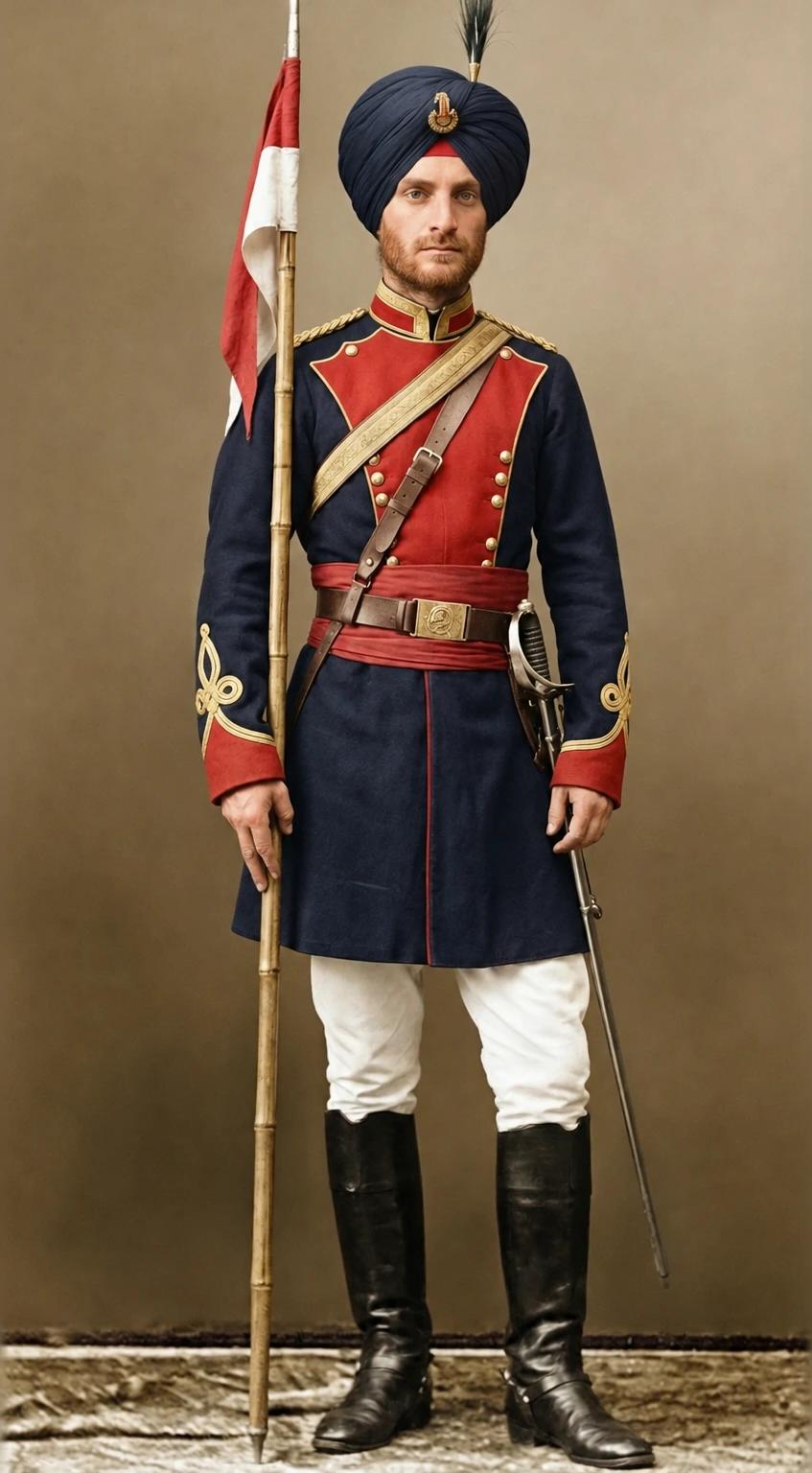
Uniform and equipment
| Uniform | Khaki tunic, breeches, brown boots, regimental-colored cummerbund |
|---|---|
| Dress uniform | Khaki or colored tunic with elaborate lace, bright blue or scarlet turbans |
| Headgear | Tall Sikh turban with steel quoits and badge, often with fan-shaped plume |
| Equipment | Lance with pennon, sabre, carbine |
| Insignia and standard | Chakram with crossed lances |
Service record
| First appeared | 1890s |
|---|---|
| Peak strength | ~4,000 lancers |
| Recruited from | Martial Race (Sikh Jats) |
| Primary tactic | Lance Charge / Pursuit |
| Signature engagement | Sinai and Palestine Campaign (WWI) |
| Motto or battle cry | Jo Bole So Nihal, Sat Sri Akal! (Whoever proclaims shall be fulfilled; Eternal is the Great Truth) |
| Obsolescence | Partition of India (1947) |
Timeline
- 1889: Formation of Imperial Service Troops. The Princely States of India, including Patiala, organize elite units to serve alongside the British Army.
- 1914: Mobilization for Great War. Upon the outbreak of WWI, the Sikh Lancers are mobilized and shipped to the Middle Eastern theatre.
- 1918: The Great Pursuit. Following the Battle of Megiddo, the unit participates in the rapid advance to Damascus, capturing thousands of prisoners.
- 1922: Reorganization. Post-war reforms see the Imperial Service Troops restructured into the Indian State Forces (ISF).
- 1947: Integration. With Indian Independence, the princely units are absorbed into the regular Indian Army, ending their separate royal status.
Battles
Defense of the Suez Canal
Deployed to the scorching sands of Egypt, the Lancers patrolled the vital canal zone. Amidst blinding dust storms and sniper fire, they repelled Ottoman raids, proving that the turbaned horsemen of the Punjab were masters of desert warfare.
Third Battle of Gaza
Part of the Imperial Service Cavalry Brigade, the Sikhs exploited the breach in the Turkish lines. They rode hard into the vacuum left by the retreating enemy, turning a tactical withdrawal into a disorganized rout through relentless pursuit.
Jordan Valley Operations
Enduring heat, malaria, and flies in a valley described as 'hell on earth,' the Lancers maintained a tenuous line against determined Ottoman counter-attacks, conducting aggressive patrols that kept the enemy off-balance until the final offensive.
Commanders
Major General Sir Harry Davis Watson
A British officer who commanded the Imperial Service Cavalry Brigade. He recognized the martial ferocity of the Sikh lancers, utilizing their horsemanship to devastating effect in the arid wastes of the Sinai and the rocky hills of Palestine against the Ottoman Turks.
Maharaja Bhupinder Singh
The ruling Maharaja of Patiala and a titan of the Princely States. He mobilized the Patiala Rajindra Lancers for the Great War, serving on the General Staff in France and Palestine. A figure of immense charisma, he ensured his Sikh troops were equipped and motivated to fight for the Empire.
Tactics
The Lance Charge
A shock tactic where troopers formed a line and galloped at full speed, utilizing the momentum of horse and rider to drive the lance point through enemy infantry or cavalry.
Relentless Pursuit
Once an enemy line broke, the Lancers were unleashed to harry the retreating columns, cutting down stragglers and preventing the enemy from regrouping.
Mounted Screening
Operating ahead of the main force to locate the enemy while masking the movements of their own infantry and artillery.