
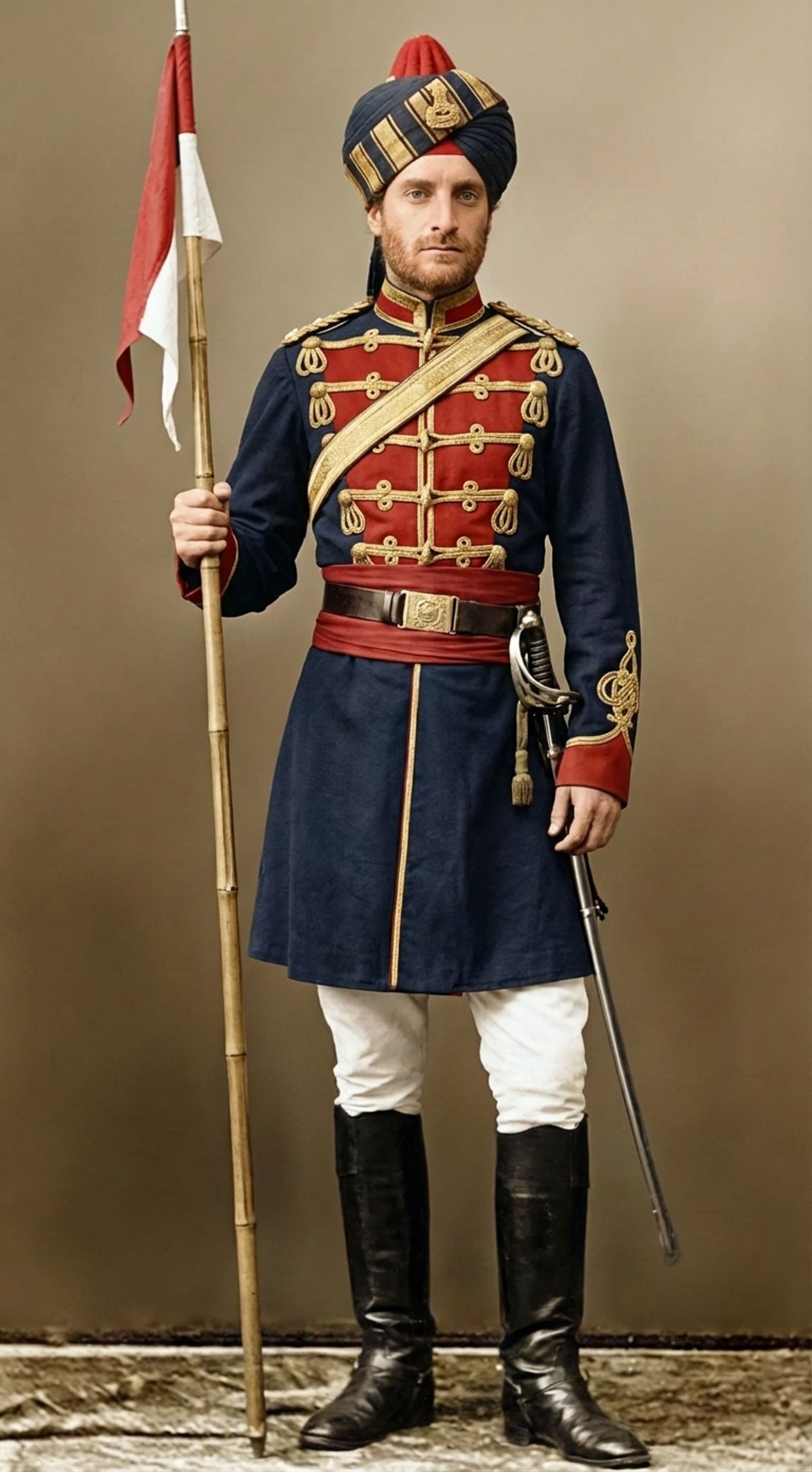
Uniform and equipment
| Uniform | Khaki or blue kurtas with colored facings |
|---|---|
| Dress uniform | Brightly colored full-dress kurtas, gold braid |
| Headgear | Tall pugree-wrapped turban with pennon colors |
| Equipment | Lance, sabre, carbine |
| Insignia and standard | Crossed bamboo lances with pennons badge |
Service record
| First appeared | 1803 |
|---|---|
| Peak strength | ~8,000 lancers |
| Recruited from | Martial Races |
| Primary tactic | Lance Charge |
| Signature engagement | Second Afghan War |
| Motto or battle cry | Himmat-i-Mardan, Madad-i-Khuda (The bravery of man is by the help of God) |
| Obsolescence | Tanks |
Timeline
- 1803: Formation of Skinner's Horse. James Skinner raises the first irregular cavalry regiment, setting the template for the Bengal Lancers.
- 1857: The Indian Mutiny. While much of the Bengal Army mutinies, key irregular cavalry units remain loyal, later forming the backbone of the new post-Mutiny army.
- 1878: Second Afghan War. The Lancers prove their worth in the rugged terrain of Afghanistan, mastering the art of mountain reconnaissance.
- 1903: Kitchener Reforms. Lord Kitchener reorganizes the Indian Army, renumbering regiments and standardizing the 'Bengal Lancer' designation.
- 1914: Deployment to the Western Front. Bengal Lancers are shipped to France, facing the shock of trench warfare and heavy artillery.
- 1922: Great Amalgamation. Post-WWI reductions see many famous regiments merged (e.g., 1st and 3rd amalgamate to form Skinner's Horse).
- 1947: Partition of India. The regiments are split between the new armies of India and Pakistan, ending the British colonial era.
Battles
Battle of Kandahar
In the dusty heat of the Second Afghan War, the Bengal Lancers executed a devastating pursuit of Ayub Khan's broken army. Their relentless harrying of the retreating Afghans turned a tactical defeat into a rout, securing General Roberts' fame and the frontier.
Relief of Peking
During the Boxer Rebellion, the 1st Bengal Lancers were among the first to breach the city walls. Fighting through narrow streets ill-suited for horses, they utilized their lances and carbines to break the siege of the International Legations, displaying immense discipline.
Battle of Cambrai
A tragic testament to courage. The Bengal Lancers attempted a classic cavalry breakthrough against German machine guns and wire. While the charge failed to break the line, the sight of lancers riding into the teeth of modern industrial warfare became a gritty legend of the Western Front.
Commanders
General Sir Dighton Probyn
A fearless commander of the 11th Bengal Lancers (Probyn's Horse). He earned the Victoria Cross during the Indian Mutiny for a series of gallant charges against overwhelming odds. His leadership cemented the reputation of the Bengal Cavalry as an elite shock force.
Colonel James 'Sikandar' Skinner
The son of a Scotsman and a Rajput princess, Skinner founded the legendary 'Yellow Boys' (1st Bengal Lancers). Denied a commission in the regular army due to his mixed race, he forged the premier irregular cavalry force of the Raj, famous for their yellow kurtas and fierce loyalty.
Tactics
Shock Action
The primary tactic: a coordinated gallop culminating in a lance charge to break enemy infantry formations or scatter light cavalry.
Tent Pegging
Originally a training drill to practice lifting tent pegs with a lance at full gallop to collapse enemy tents during dawn raids.
Dismounted Action
Unlike European heavy cavalry, Bengal Lancers were trained to fight effectively on foot with carbines when terrain prevented riding.