
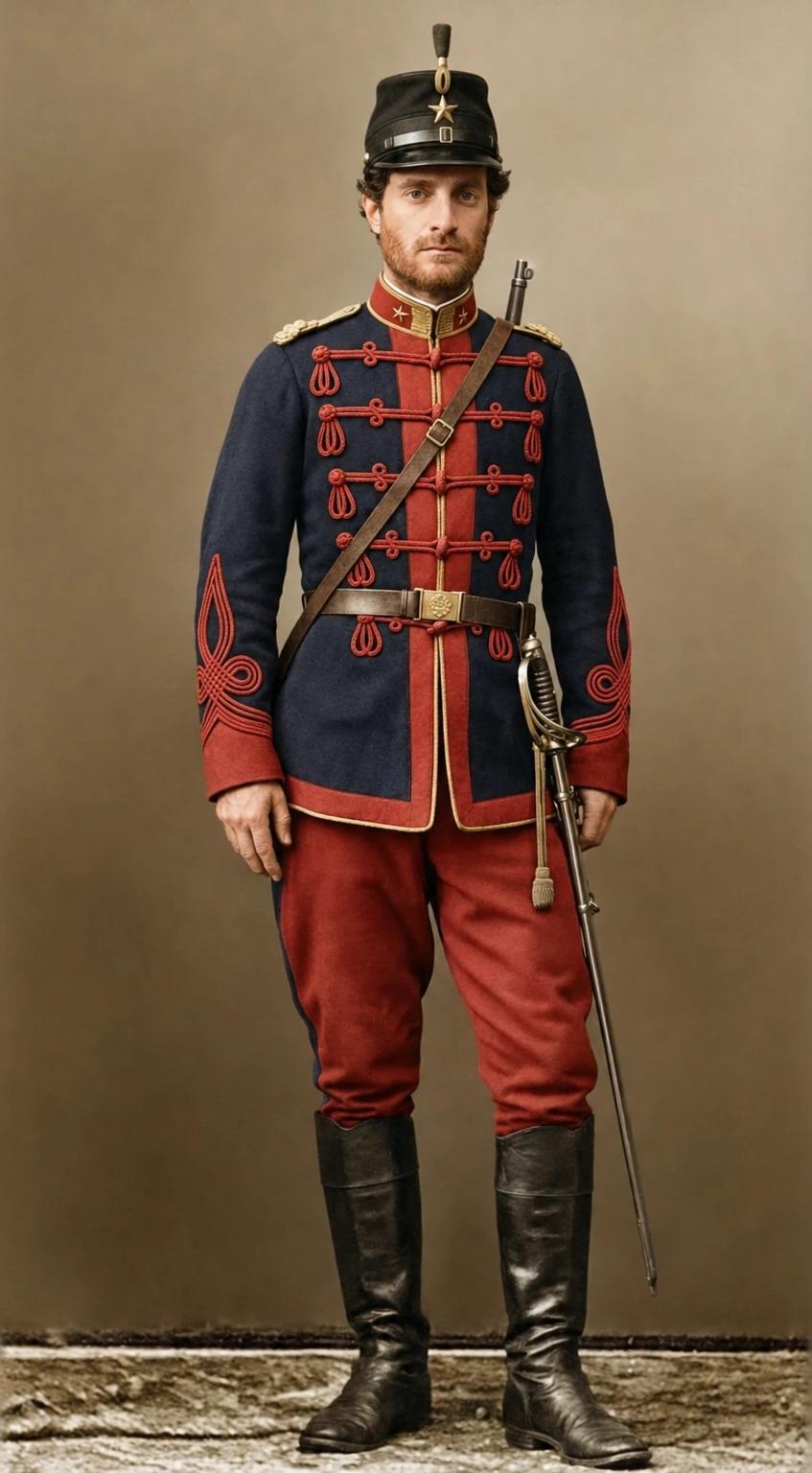
Uniform and equipment
| Uniform | Dark blue tunic with red collars and cuffs, breeches with stripes |
|---|---|
| Dress uniform | Full-dress tunic with sash, sometimes cuirass for ceremony, white gloves |
| Headgear | Dark blue kepi with red band and brass star |
| Equipment | Saber, carbine, pistols |
| Insignia and standard | 16-petal gold Chrysanthemum on helmet |
Service record
| First appeared | 1871 |
|---|---|
| Peak strength | ~1,200 men |
| Recruited from | Samurai Families / Conscripts |
| Primary tactic | Cavalry Reconnaissance |
| Signature engagement | Russo-Japanese War (1904) |
| Motto or battle cry | Tenno Heika Banzai (Long live the Emperor) |
| Obsolescence | WWII Surrender |
Timeline
- 1871: Formation. The Imperial Guard is established to directly protect the Emperor Meiji, incorporating elite samurai lineage.
- 1894: First Sino-Japanese War. The unit sees its first major overseas deployment, proving the efficacy of modernized Japanese cavalry.
- 1904: Russo-Japanese War. The unit's golden age; they engage globally renowned Russian Cossacks in Manchuria and prove their equal.
- 1930: Mechanization Transition. As warfare evolves, the Guard Cavalry begins the slow transition from horses to armored cars and tanks.
- 1945: Disbandment. Following the surrender of Japan, the Imperial Guard is dissolved and reorganized, ending the lineage of the horse cavalry.
Battles
Battle of Shaho
In a grueling engagement defined by freezing mud and artillery barrages, the Guard Cavalry executed vital screening maneuvers, protecting the Japanese flanks from Russian encirclement while suffering heavy casualties in close-quarters skirmishes.
Battle of Mukden
The largest land battle prior to WWI. The Guard Cavalry pushed deep into the snowy plains, harassing Russian supply lines and screening Nogi's massive flanking movement that ultimately broke the Russian army's resolve.
Commanders
Prince Kan'in Kotohito
A scion of the Imperial House who traded palace silks for a cavalry tunic. During the Russo-Japanese War, he commanded with aristocratic fervor, leading the Guard Cavalry through the freezing plains of Manchuria to challenge the supremacy of the legendary Cossacks.
Akiyama Yoshifuru
Known as the father of the Japanese Cavalry. Though often commanding mixed brigades, his modernization doctrines forged the Imperial Guard Cavalry into a force capable of utilizing both the saber charge and dismounted carbine fire effectively.
Tactics
Reconnaissance in Force
Aggressive probing of enemy lines to determine strength and disposition, often provoking skirmishes to draw fire.
Dismounted Action
Unlike traditional heavy cavalry, the Guard was trained to dismount and fight as light infantry when facing entrenched machine guns.
Screening Flanks
Using mobility to create a defensive curtain around the main infantry force, preventing enemy surprise attacks.