
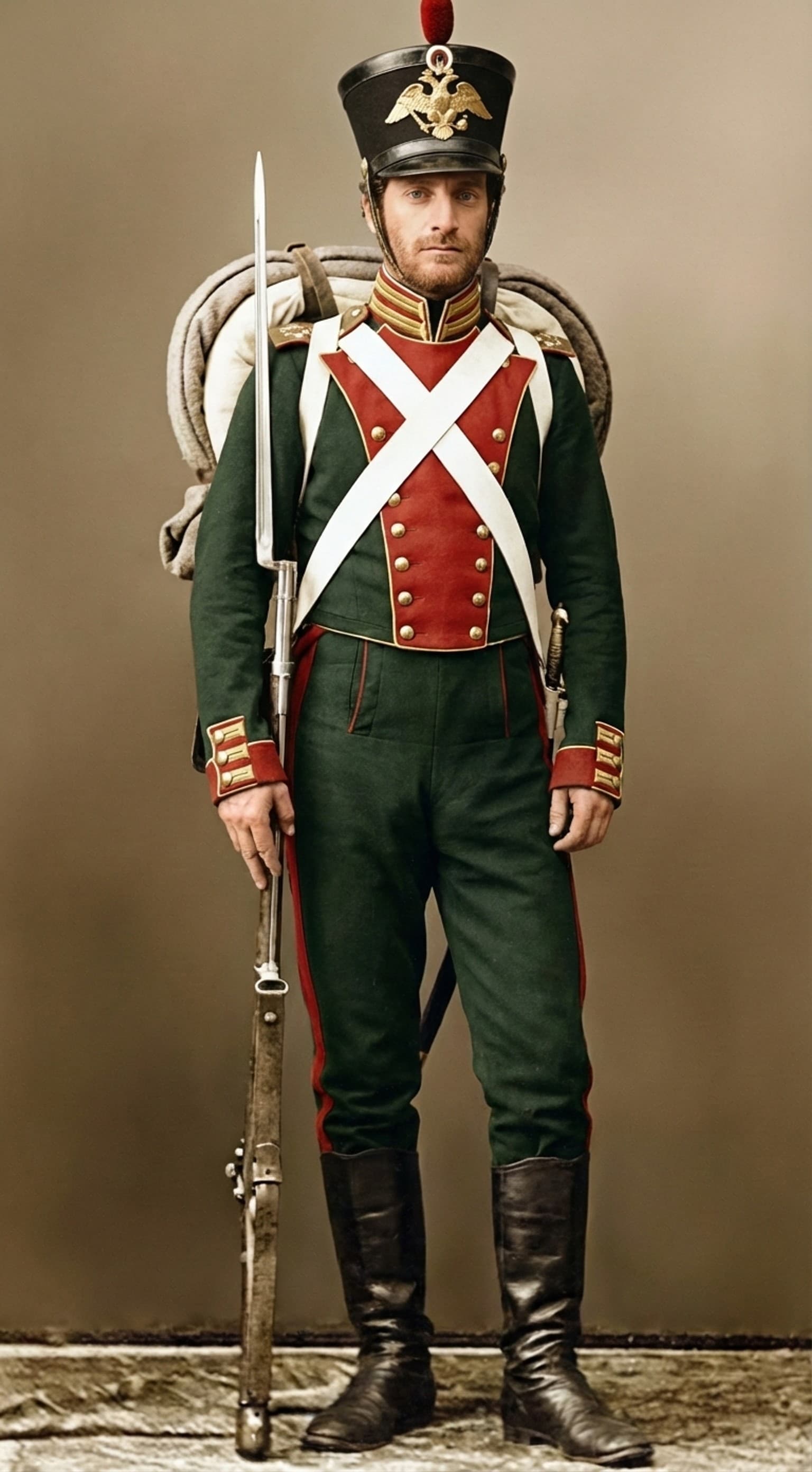
Uniform and equipment
| Uniform | Dark green coats with blue facings, white breeches |
|---|---|
| Dress uniform | Green with blue facings, extensive gold braiding and sashes |
| Headgear | Tricorn then shako with colored pompom; officer shakos with taller plumes |
| Equipment | Musket, bayonet, officer swords |
| Insignia and standard | Tsar's cypher on epaulettes |
Service record
| First appeared | 1690s |
|---|---|
| Peak strength | 4,000 men |
| Recruited from | Nobility / Peter's Play Regiments |
| Primary tactic | Guard Reserve |
| Signature engagement | Battle of Borodino (1812) |
| Motto or battle cry | Za Veru, Tsarya i Otechestvo (For Faith, Tsar and Fatherland) |
| Obsolescence | Russian Revolution (1917) |
Timeline
- 1683: Formation. Established by Peter the Great in the village of Semyonovskoye as a 'Toy Army' unit for his war games.
- 1700: Baptism of Fire. The regiment earns its elite reputation at Narva, holding the line while the rest of the army collapses.
- 1805: Austerlitz Campaign. The regiment suffers heavy casualties trying to stem the French tide but retires in good order.
- 1812: Patriotic War. Participates in the defense of Russia, distinguishing itself at Borodino by withstanding massive artillery bombardment.
- 1820: Semyonovsky Mutiny. Soldiers protest brutal treatment by Colonel Schwartz. The regiment is disbanded and reformed, sending shockwaves through the Tsar's court.
- 1917: Dissolution. Following the Russian Revolution, the Imperial Guard is dissolved, ending over two centuries of service.
Battles
Battle of Narva
Amidst a catastrophic Russian rout, the Semyonovsky and Preobrazhensky regiments stood firm. They repelled repeated Swedish assaults, reportedly standing knee-deep in blood, earning the right to wear red stockings as a mark of their gritty heroism.
Battle of Borodino
Stationed in reserve, the regiment was moved to the center to plug the line under a hurricane of French artillery. For hours, they stood in square formation, absorbing canister fire without firing a shot back, holding the ground with stoic sacrifice.
Battle of Kulm
The Russian Guards, outnumbered, held the valley against Vandamme's corps. The Semyonovsky regiment fought fiercely in the mountains, preventing the French from crushing the Coalition's rear, securing a vital strategic triumph.
Commanders
Alexander Suvorov
The undefeated Generalissimo who began his career as a private in the Semyonovsky ranks. Known for his iron discipline and the maxim 'Train hard, fight easy,' he embodied the regiment's spirit of offensive aggression and unyielding endurance.
Peter the Great
The Tsar-Reformer who founded the regiment from his childhood 'Toy Army.' He served as its honorary Colonel, forging a modern fighting force from the ground up to challenge European powers and end Russia's isolation.
Tactics
Suvorovian Bayonet Charge
Aggressive linear advance followed by a shock charge. 'The bullet is a fool, the bayonet is a sheepdog.'
The Iron Square
A defensive formation used at Borodino to repel cavalry. The unit stands shoulder-to-shoulder, bayonets outward, immobile under fire.
Strategic Reserve
As elite Guards, they were often held back to deliver the knockout blow or to save the army from total collapse in critical moments.