
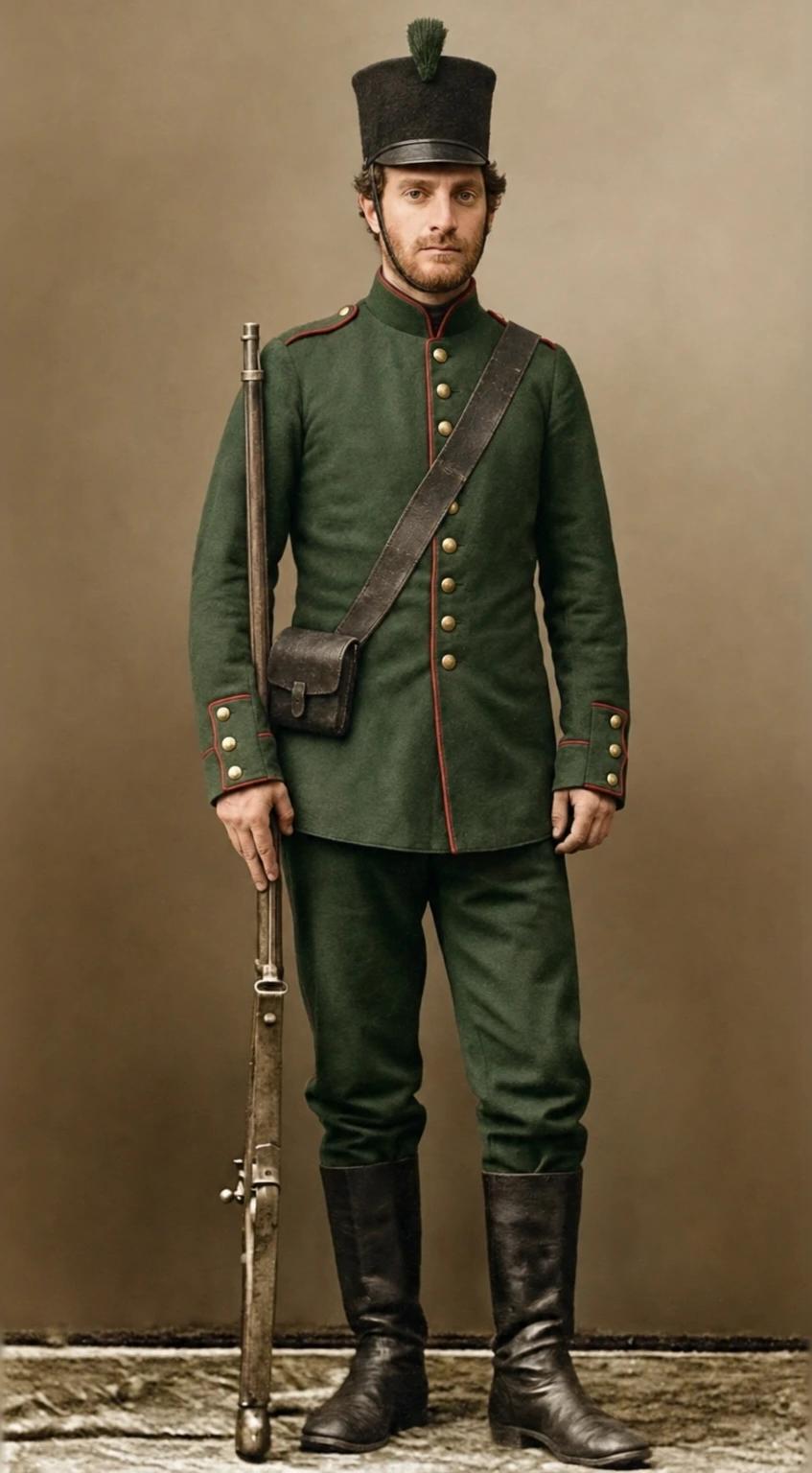
Uniform and equipment
| Uniform | Dark green coat, black facings, gray trousers |
|---|---|
| Dress uniform | Green with black velvet collar |
| Headgear | Black shako with green plume |
| Equipment | Rifle, sword-bayonet, powder horn |
| Insignia and standard | Black/white cockade on shako |
Service record
| First appeared | 1787 |
|---|---|
| Peak strength | ~5,000 men |
| Recruited from | Selected Marksmen |
| Primary tactic | Precision Skirmishing |
| Signature engagement | Battle of Jena-Auerstedt (1806) |
| Motto or battle cry | Gott mit uns (God is with us) |
| Obsolescence | Integration into Line Infantry |
Timeline
- 1787: Formation of Schützen Platoons. Ten riflemen are selected from each company of line infantry to act as designated sharpshooters.
- 1806: The Catastrophe of Jena. The destruction of the old Prussian army highlights the desperate need for flexible light infantry.
- 1808: The Great Reform. Under Scharnhorst and Gneisenau, the Schützen are reorganized into independent battalions with specialized training.
- 1813: Wars of Liberation. The reformed Schützen deploy en masse against Napoleon, utilizing new 'swarm' tactics.
- 1815: Triumph at Waterloo. Schützen units play a decisive role in the final defeat of the French Empire.
Battles
Battle of Jena-Auerstedt
A catastrophic failure where rigid Prussian lines were dismantled by French Tirailleurs. The Schützen fought bravely in the chaos, but their defeat became the catalyst for the sweeping reforms that would later modernize the Prussian army.
Battle of Leipzig
The 'Battle of Nations.' Reorganized Schützen battalions spearheaded the assault on Napoleon's forces, utilizing cover in the villages to pick off officers and artillery crews, proving the lethality of the new Prussian skirmishing doctrine.
Battle of Waterloo
At Plancenoit, Prussian Schützen engaged in vicious house-to-house fighting against the Imperial Guard. Their discipline and marksmanship in the smoking ruins were pivotal in collapsing the French right flank.
Commanders
August Neidhardt von Gneisenau
A visionary reformer who forged steel from the ashes of 1806. While best known as Blücher's Chief of Staff, his early defense of Kolberg and advocacy for light infantry tactics revolutionized the Prussian Schützen, turning them into an elite, independent fighting force.
Ludwig Yorck von Wartenburg
The father of Prussian light infantry. A stern, pragmatic commander who drilled the Schützen and Jägers in the art of open-order combat. He transformed them from mere line-support into autonomous hunters capable of shattering French columns with precision fire.
Tactics
Plänkeln (Skirmishing)
Deploying in a loose, irregular chain ahead of the main line to harass the enemy, screen movements, and silence officers.
Rotte Formation
Fighting in pairs (Rotten). One man fires while the other loads and observes, ensuring a constant threat and mutual protection.
Terrain Exploitation
Unlike line infantry, Schützen were trained to utilize trees, ditches, and ruins for cover, firing from kneeling or prone positions.