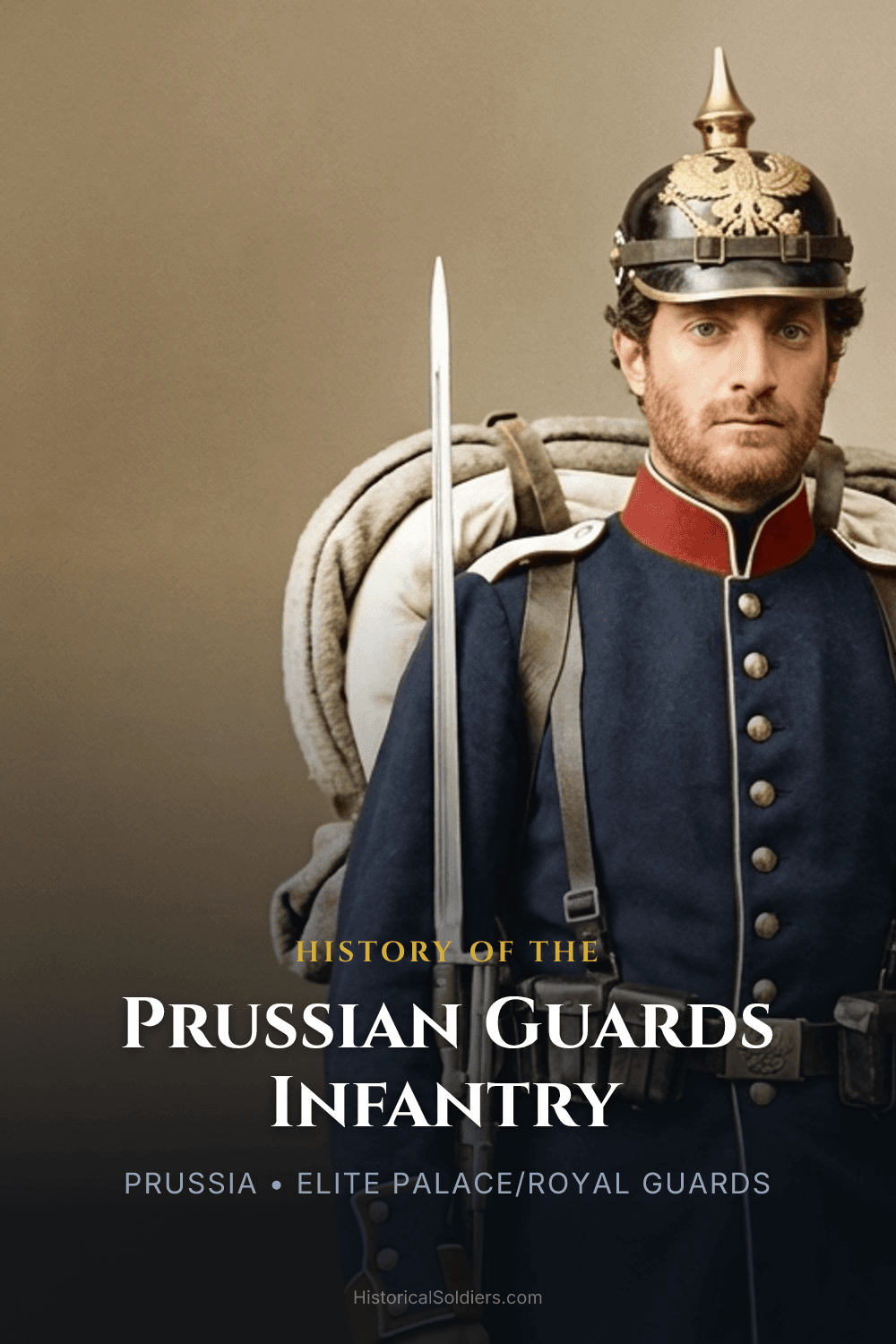
The Iron Heart of Prussia: The Evolution and Glory of the Guards Infantry
In the pantheon of military history, few formations command the same mixture of awe, fear, and aesthetic recognition as the Prussian Guards Infantry. To the uninitiated, they are the soldiers of the Pickelhaube—the spiked helmet that became the shorthand symbol for German militarism. To the historian, they represent a timeline of martial evolution that stretches from the baroque courts of the late 17th century to the muddy trenches of the 20th. However, it is in the crucible of the 19th-century Wars of Unification where the Guard truly cemented its legend.
They were the "First of the First," the monarch’s personal shield and the ultimate hammer of the Prussian General Staff. While their origins lie in the pomp of the 1690s, their defining moments were forged in the fire of the industrial age, wielding the revolutionary Dreyse Needle Gun and marching under the banner of the Iron Cross. This article explores the anatomy of this elite corps, tracing their journey from palace ornaments to the shock troops who forged an empire.
Origins & Formation: From Giants to Grenadiers
The genesis of the Prussian Guards Infantry is rooted in the ambitious consolidation of the Hohenzollern lands in the late 17th century. While the "Era: 1690s" marks the embryonic stage of this development under Elector Frederick III (later King Frederick I), the spiritual birth of the Guard is inextricably linked to his successor, Frederick William I, the "Soldier King."
In the early 1700s, the concept of a "Guard" was often more theatrical than tactical. Frederick William I, however, possessed an obsession with tall soldiers. He formed the "Grand Grenadiers of Potsdam," colloquially known as the Potsdam Giants (Lange Kerls). These men were recruited—or kidnapped—from all over Europe based solely on their height. While they were drilled with a precision that bordered on the mechanical, they were largely a royal hobby, a collection of living toy soldiers kept safe from the rigors of actual war.
It was Frederick the Great who, upon ascending the throne in 1740, disbanded the expensive giant regiment and reorganized the best men into the First Battalion of the Guard (No. 15). He transformed them from a sideshow into a combat-ready elite. By the time of the Seven Years' War, the Prussian Guard had become the standard-bearer for linear warfare, executing complex maneuvers under fire with a coolness that unnerved their Austrian and French counterparts. This tradition of absolute discipline became the bedrock upon which the 19th-century Guard was built. By the 1860s, the Guard Corps had expanded significantly, yet it retained the exclusive prestige of its origins: every officer was a nobleman, and every soldier was hand-picked for physique and loyalty.
Uniform & Equipment: The Anatomy of a Prussian Guardsman
To understand the Prussian Guardsman of the mid-to-late 19th century, one must look closely at the equipment that defined his silhouette. By the time of the Franco-Prussian War (1870–1871), the Guard was a synthesis of tradition and industrial innovation. The visual impact of a Guard regiment on parade was designed to project invincibility, but their kit was designed for the grim reality of modern slaughter.
The Pickelhaube (Model 1867)
The most iconic element of the uniform was undoubtedly the Pickelhaube. By 1867, the design had been refined from earlier, taller models. Constructed of boiled leather reinforced with brass trim, it offered protection against saber cuts from cavalry—a threat that was still very real. For the Guards, the helmet plate featured the spread eagle of Prussia, often with a silver star of the Order of the Black Eagle overlaid, distinguishing them from the line infantry. The spike itself, while decorative, served as a ventilation port. In the field, this shining beacon was often covered with a cloth cover (Überzug) to reduce visibility, a nod to the changing nature of warfare.
The Dreyse Needle Gun
If the helmet was the symbol, the Dreyse Needle Gun (Zündnadelgewehr) was the tool of their trade. Adopted in 1841 but proving its worth in the 1860s, this was the world's first practical bolt-action military rifle. Unlike the muzzle-loaders used by the Austrian Imperial Army, the Dreyse allowed the Prussian Guardsman to reload while lying prone. This was a tactical revolution. A Guardsman could fire five rounds a minute from a concealed position, decimating standing formations of enemies before they could close the distance. It was a weapon that rewarded the cool, rhythmic drill the Guard was famous for.
Field Gear and Accoutrements
The Guardsman carried his life on his back. The Tornister (knapsack) was a boxy, cowhide-covered frame containing spare clothes, rations, and personal effects. Strapped to it was the Feldflasche (canteen), essential for long marches, and the rolled greatcoat. On his belt hung the heavy Cartridge Pouch, holding the paper cartridges for the Dreyse, and the Infanterie-Säbel. This short sword, often referred to as a briquet, was largely ceremonial by the 1870s, used more for cutting wood than fencing, yet it remained a symbol of the infantryman's status.
Finally, for those who distinguished themselves in the crucible of battle, there was the Iron Cross 2nd Class. Revived by King Wilhelm I in 1870, this decoration was worn on a ribbon through the buttonhole of the tunic. For the Guard, earning this cross was the ultimate validation of their motto: Suum Cuique ("To Each His Own").
Tactics & Doctrine: The School of Moltke
The Prussian Guards Infantry did not fight like the armies of Napoleon. By the mid-19th century, they were the instrument of Helmuth von Moltke the Elder’s General Staff. The doctrine had shifted from rigid linear formations to a more flexible approach, though the "shock column" remained a favored tactic for the final blow.
The Guard was trained in Auftragstaktik (mission-type tactics). Unlike the Russian Imperial Guard or other contemporaries who waited for rigid orders, Prussian junior officers and NCOs were expected to understand the commander's intent and act on their own initiative. If a gap opened in the enemy line, a Guard company commander would exploit it without waiting for a courier.
However, the transition to modern firepower was bloody. The Guard still prided itself on the aggressive offensive. They were trained to close with the enemy rapidly, utilizing the "fire and movement" capability of the Dreyse rifle. The standard tactic involved a skirmish line to suppress the enemy with rapid fire, followed by the main body advancing in company columns to shatter the opponent's will. While effective against the Austrians, this doctrine proved costly against the superior Chassepot rifles of the French Army in 1870, forcing the Guard to adapt to using terrain and open order formations more heavily.
Combat History: A Trail of Blood and Iron
The combat record of the Prussian Guards Infantry reads like a history of the rise of the German Empire. From the snowy fields of Silesia to the rolling hills of France, they were always present where the fighting was thickest.
Battle of Leuthen (1757)
To understand the soul of the Guard, one must look back to Leuthen. Here, under Frederick the Great, the Prussian infantry executed an oblique order of battle that crushed a vastly superior Austrian force. The Guard battalions displayed a discipline that allowed them to maneuver across the battlefield as if on a parade ground, cementing their reputation as the finest infantry in Europe.
Battle of Königgrätz (1866)
Over a century later, during the Austro-Prussian War, the Guard proved that their reputation was not merely historical. At Königgrätz, the decisive battle of the war, the Prussian Guard Corps arrived late to the field, striking the Austrian right flank at the critical moment. Fighting through the Swiepwald forest and storming the heights of Chlum, they shattered the Austrian center. It was here that the Dreyse Needle Gun proved its devastating superiority, mowing down the brave but obsolete bayonet charges of the Austrians.
Battle of Gravelotte-St. Privat (1870)
The Franco-Prussian War brought the Guard their greatest glory and their greatest tragedy. At St. Privat, the Guard Corps, commanded by Prince August of Württemberg, was ordered to assault the French positions across open ground. The French, armed with the superior Chassepot rifle, unleashed a hail of lead.
The Guards advanced with suicidal bravery. Within minutes, thousands of Prussia's finest soldiers were cut down. It was a massacre that shook the Prussian leadership, yet the Guard did not break. They continued to advance, eventually taking the village with the support of Saxon flanking maneuvers. Among the young officers who survived the "Guard's Grave" at St. Privat was a Lieutenant named Paul von Hindenburg. He would carry the lessons of that bloody day—the cost of frontal assaults against modern firepower—into the next century.
Battle of Sedan (1870)
The culmination of the Guard's 19th-century history occurred at Sedan. Having learned from the bloodletting at St. Privat, the Guard played a key role in the encirclement of the French Army of Châlons. They held the northern sector of the siege ring, preventing the escape of Emperor Napoleon III. The discipline of the Guard ensured the trap remained shut, leading to the capitulation of the French army and the subsequent proclamation of the German Empire.
Legacy: The Archetype of Militarism
The legacy of the Prussian Guards Infantry extends far beyond the battlefields of the 19th century. They became the cultural archetype of the professional soldier. Their drill, their uniforms, and their ethos were copied by nations ranging from Chile to Japan. The Imperial Japanese Army, in particular, modeled its officer corps and structure heavily on the Prussian Guard after 1870.
Culturally, the image of the tall Guardsman in a Pickelhaube became a double-edged sword. To the German people, they were the guardians of unity and tradition, the men who had forged the Reich. To the rest of Europe, they became the symbol of a terrifying, mechanical efficiency that threatened the balance of power.
The Guard Corps would march to war one last time in 1914, trading their colorful tunics for field grey and their Pickelhaubes for steel helmets. Yet, the spirit of the unit remained rooted in the traditions established by Frederick William I and honed by Moltke. They were, until the very end, the Iron Heart of Prussia—a testament to the power of discipline, technology, and the terrible cost of glory.