
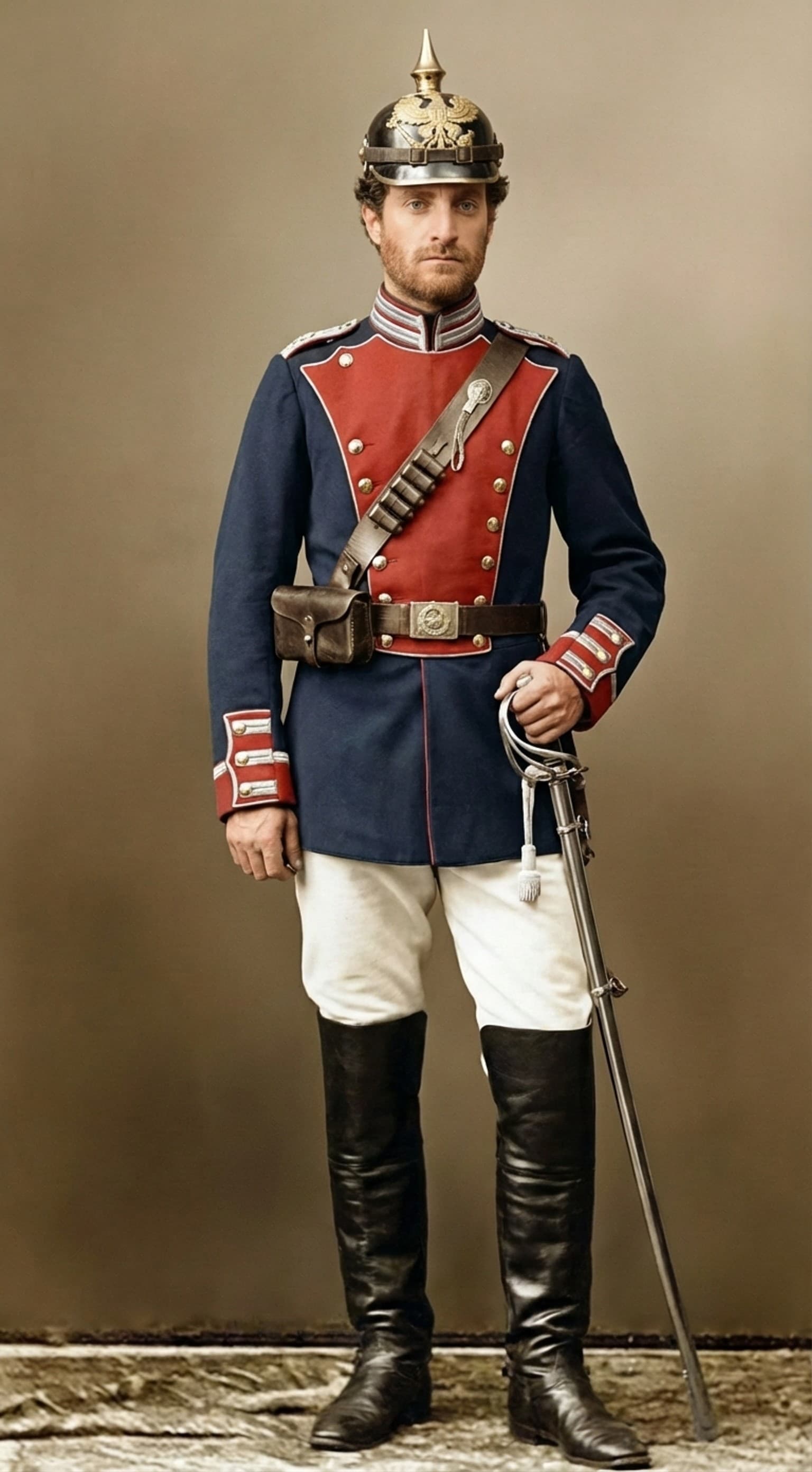
Uniform and equipment
| Uniform | White (Garde du Corps) or blue with extensive gold |
|---|---|
| Dress uniform | Elaborate with gold/silver, ceremonial appointments |
| Headgear | Eagle-crested helmet or bearskin |
| Equipment | Pallasch, ceremonial weapons |
| Insignia and standard | Star of the Black Eagle on helmet/cuirass |
Service record
| First appeared | 1740 |
|---|---|
| Peak strength | ~2,000 men |
| Recruited from | High Aristocracy |
| Primary tactic | Ceremonial Escort / Shock |
| Signature engagement | Battle of Gravelotte (1870) |
| Motto or battle cry | Gott mit uns (God is with us) |
| Obsolescence | End of Monarchy (1918) |
Timeline
- 1740: Formation of the Gardes du Corps. Frederick the Great establishes the unit as his personal bodyguard, setting the standard for discipline and drill.
- 1806: Disaster at Jena-Auerstedt. The old Prussian cavalry is humiliated by Napoleon, prompting a painful but necessary period of modernization and reform.
- 1813: Wars of Liberation. The reformed Guard Cavalry plays a pivotal role in driving Napoleon out of Germany, restoring Prussian honor.
- 1870: Franco-Prussian War. The zenith of the unit's history; they execute the last great cavalry charges of the 19th century at Gravelotte and Mars-la-Tour.
- 1914: World War I Mobilization. The Guard deploys to the Western Front, but machine guns and trenches quickly force them to dismount and fight as infantry.
- 1919: Dissolution. Following the fall of the German Empire and the Treaty of Versailles, the Imperial Guard units are disbanded.
Battles
Battle of Königgrätz
The decisive clash against Austria. The Guard Cavalry was held in reserve until the critical moment, unleashed to pursue the shattering Austrian formations. Their discipline turned a retreat into a rout, cementing Prussian dominance in Germany with cold steel and thunderous pursuit.
Battle of Gravelotte-St. Privat
In a display of suicidal bravery, the Guard Cavalry charged French positions to relieve pressure on the infantry. They rode directly into a storm of Chassepot rifle fire. Though the charge was decimated, halting the French advance, it marked the twilight of heavy cavalry charges in modern warfare.
Battle of Mars-la-Tour
While famous for Bredow's Death Ride, the Guard Dragoons also saw fierce action. In the heat and dust, Prussian horsemen slammed into French lines, trading heavy casualties for time. It was a gritty, chaotic melee that proved the Prussian cavalry's willingness to sacrifice all for the strategic initiative.
Commanders
Prince Friedrich Karl of Prussia
Known as the 'Red Prince' for his distinctive hussar uniform, he was a fierce disciplinarian who forged the Prussian cavalry into a weapon of terror. He commanded the Second Army with an iron fist, believing that the cavalry's role was to break the enemy's will through sheer, thundering aggression.
Wilhelm I, German Emperor
As King and later Emperor, he was the ultimate symbol of the Prussian military aristocracy. Often seen in the uniform of the Regiment of the Gardes du Corps, he embodied the stoic, unwavering tradition of the Guard, leading his nation through the unification wars with regal determination.
Tactics
Shock Charge
A tight, knee-to-knee formation accelerating from a trot to a gallop, designed to deliver a kinetic hammer-blow to break enemy infantry squares.
Kleinkrieg (Little War)
Screening and reconnaissance operations where small detachments harassed enemy supply lines and gathered intelligence ahead of the main army.
Ceremonial Escort
Rigid, highly choreographed formations used to protect the monarch during state functions, emphasizing absolute immobility and precision.